Salmos 124
The Orthodox Jewish Bible · Toque num versículo para ver as referências cruzadas.
Our Help Is in the Name of the LORD
1(Shir HaMa'alot [Song of Ascents], of Dovid)
1 If it had not been Hashem Who was lanu (for us, on our side),
now may Yisroel say;
2If it had not been Hashem Who was lanu,
when adam (man) rose up against us;
3Then they had swallowed us up chayyim (alive);
when their wrath was kindled against us;
4Then the mayim would have overwhelmed us,
the torrent would have swept over nafsheinu (our nefesh);
5Then the mayim hazedonim (treacherous waters)
would have swept over nafsheinu (our nefesh).
6Baruch Hashem,
Who hath not given us up
as a prey to their shinayim (teeth).
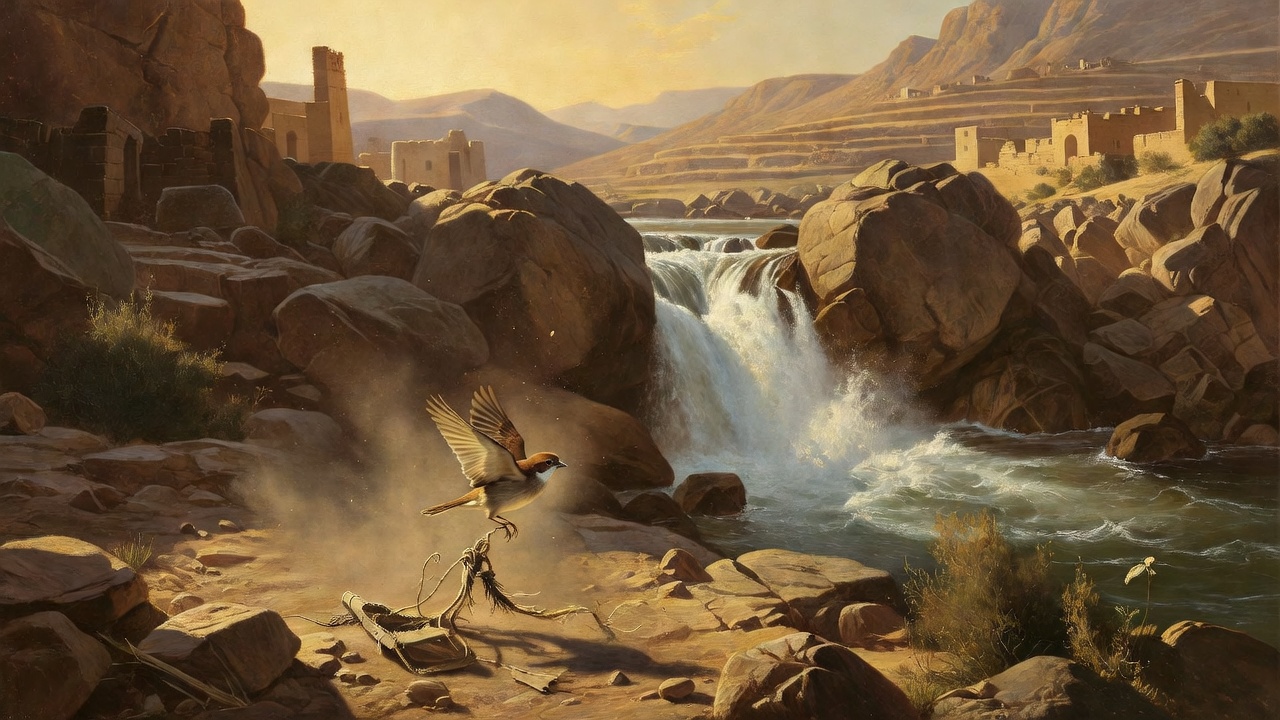
7Nafsheinu (our nefesh) is escaped as a tzippor (bird)
out of the pach (snare of the fowlers);
the pach is broken,
and we are escaped.
8Ezreinu (our help) B'Shem Hashem
Oseh Shomayim vaAretz.
Você sabia?
Cântico de Livramento de Israel
- O título do Salmo 124 o identifica como um cântico de romagem atribuído a Davi. A composição funciona como um hino comunitário de gratidão, convocando Israel a proclamar em conjunto que só sobreviveu ao ataque de seus adversários porque o Senhor esteve ao seu lado.Fontes: o próprio texto bíblico
- O poema retrata o perigo enfrentado pela comunidade por meio de vívidas metáforas da natureza, comparando os inimigos a feras prontas para devorá-los com seus dentes e a torrentes e águas impetuosas que ameaçavam arrastá-los.Fontes: o próprio texto bíblico
- O salmo encerra a reflexão sobre o livramento com a imagem de um pássaro que escapa do laço quebrado de um passarinheiro, fundamentando a confiança da comunidade no nome do Senhor, o Criador dos céus e da terra.Fontes: o próprio texto bíblico
Notas escritas com auxílio de IA a partir de fontes abertas (Theographic Bible Metadata, CC BY-SA 4.0; Easton’s Bible Dictionary, domínio público) e revisadas antes de publicar.
Lugares deste capítulo
- Jerusalem · 31.777, 35.234 · versículo 1
Só aparecem lugares com identificação de alta confiança (90% ou mais segundo as fontes acadêmicas reunidas pelo OpenBible). Mapa da época: DARE (Digital Atlas of the Roman Empire), CC BY 4.0; mapa atual: © colaboradores do OpenStreetMap; lugares: OpenBible.info (CC BY 4.0).
Créditos e licença desta tradução
The Orthodox Jewish Bible
The Orthodox Jewish Bible - Tanakh and Orthodox Jewish Brit Chadasha - The Holy Bible
copyright © 2002-2011, 2021, 2024 Artists for Israel International
Language: English
Contributor: Artists for Israel International
THE ORTHODOX JEWISH TANAKH
Artists For Israel Intl Inc.
This version also appears with the Orthodox Yiddish Triglot which presents the Hebrew Yiddish script in Latin script and an English word for word translation, available at afii.org/Torah
To donate PayPal.Me
This translation is made available to you under the terms of the
Creative Commons Attribution license 4.0.
You may share and redistribute this Bible translation or extracts from it in any format, provided that:
You include the above copyright and source information.
If you make any changes to the text, you must indicate that you did so in a way that makes it clear that the original licensor is not necessarily endorsing your changes.
Pictures included with Scriptures and other documents on this site are licensed just for use with those Scriptures and documents.
For other uses, please contact the respective copyright owners.
Note that in addition to the rules above, revising and adapting God's Word involves a great responsibility to be true to God's Word. See Revelation 22:18-19.
2026-01-06
Títulos de seção adaptados da Berean Standard Bible (domínio público); não fazem parte do texto bíblico desta tradução.
Fonte: http://ebible.org/engojb/ · eBible.org