Salmos 106
The Orthodox Jewish Bible · Toque num versículo para ver as referências cruzadas.
Give Thanks to the LORD, for He Is Good
1Praise Hashem!
O give thanks unto Hashem; for He is tov;
for His chesed endureth l'olam.
2Who can speak of the gevurot (mighty acts) of Hashem?
Who can show forth all His tehillah (praise)?
3Ashrei (happy, blessed) are they who are shomrei mishpat,
and he that doeth tzedakah at all times.
4Remember me, Hashem, with the favor that Thou bearest unto Thy people;
O visit me with Thy Yeshu'ah (salvation);
5That I may see the good of Bechireicha (Thy chosen ones),
that I may rejoice in the simchah of Thy nation,
that I may glory with Thine nachalah (the people of Thy inheritance).
6We have sinned with Avoteinu,
we have committed iniquity, we have done wickedly.
7Avoteinu had no seichal concerning Thy nifla'ot (wonders) in Mitzrayim;
they remembered not the multitude of Thy mercies
but provoked Him at the yam, even at the Yam Suf.
8Nevertheless He saved them for the sake of Shmo,
that He might make His gevu'rot (mighty power) to be known.
9He rebuked the Yam Suf also, and it dried up;
so He led them through the tehomot, as through the midbar.
10And He saved them from the yad of him that hated them,
and He acted to make the go'el redemption from the yad of the oyev (enemy).
11And the mayim covered their enemies;
there was not echad (one) of them left surviving.
12Then believed they in His Devarim;
they sang His tehillah.
13Then they hurried, they forgot His ma'asim;
they waited not for His etzah (counsel, advice, wisdom);
14But lusted exceedingly in the midbar,
and tempted G-d in the desert.
15And He gave them their she'elah (request);
but sent leanness into their nefesh.
16They envied Moshe also in the machaneh,
and Aharon the kadosh Hashem (Aharon the holy one of Hashem ).
17Eretz opened and swallowed up Datan
and covered over the Adat Aviram (the company of Aviram).
18And an eish was kindled in their edah (assembly);
the flame burned up the resha'im.
19They made an egel (a calf) in Chorev,
and worshiped a massekhah (molden image).
20Thus they exchanged their kavod
for a tavnit shor (likeness of an ox) that eateth esev (grass).
21They forgot G-d their Moshi'a,
Who had done gedolot in Mitzrayim;
22Nifla'ot (wondrous works) in Eretz Cham,
and nora'ot (awesome things) by the Yam Suf.
23Therefore He said that He would destroy them,
had not Moshe His bechir (chosen one)
stood before Him in the peretz (breach),
to turn away His wrath, lest He should destroy them.
24Then they despised the eretz chemdah (desirable land);
they believed not His Devar;
25But murmured in their ohalim,
and paid heed not unto the kol (voice) of Hashem.
26Therefore He lifted up His yad against them,
that He would overthrow them in the midbar;
27To make their zera fall also among the Goyim,
and to scatter them among the aratzot (lands).
28They joined themselves also unto Ba'al-Pe'or,
and ate the zivkhei mesim (sacrifices offered to the dead).
29Thus they provoked Him to anger with their inventions;
and the magefah (plague) broke out among them.
30Then stood up Pinchas, and interposed;
and so the magefah (plague) was halted.
31And that was counted unto him for tzedakah
l'dor vador ad olam.
32They angered Him also at the waters of Merivah,
so that it went ill with Moshe on their account;
33Because they provoked his ruach
and he spoke unadvisedly with his sfatayim (lips).
34They did not destroy the amim (peoples),
as Hashem commanded them;
35But they mingled with the Goyim,
and learned their ma'asim (works, customs).
36And they served their atzabim (idols);
which were a mokesh (snare) unto them.
37And they sacrificed their banim
and their banot unto shedim (demons),
38And they shed dahm naki (innocent blood),
even the dahm of their banim and of their banot,
whom they sacrificed unto the atzabei Kena'an (idols of Canaan);
and HaAretz was polluted with blood-guilt.
39Thus they made themselves tameh with their own ma'asim,
and went a-whoring with their own inventions.
40Therefore was the wrath of Hashem kindled against His people,
insomuch that He abhorred His own nachalah.
41And He gave them into the yad Goyim;
and they that hated them ruled over them.
42Their oyevim also oppressed them,
and they were brought into subjection under their yad.
43Many times did He deliver them;
but they provoked Him with their etzah (counsel),
and so perished in their avon (iniquity).
44Nevertheless He regarded their affliction,
when He heard their rinnah (cry of grief);
45And He remembered for their sake His Brit,
and relented according to the multitude of His chasadim (lovingkindnesses).
46He made them also to be pitied with rachamim
by all those that carried them away as captives.
47Hoshieini (save us), Hashem Eloheinu,
and gather us from among the Goyim,
to give thanks unto Thy Shem Kadosh,
and to glory in Thy tehillah (praise).
48Baruch Hashem Elohei Yisroel
min haOlam v'ad haOlam;
and let kol HaAm say, Omein.
Praise Hashem!
Você sabia?
A história de rebelião e misericórdia de Israel
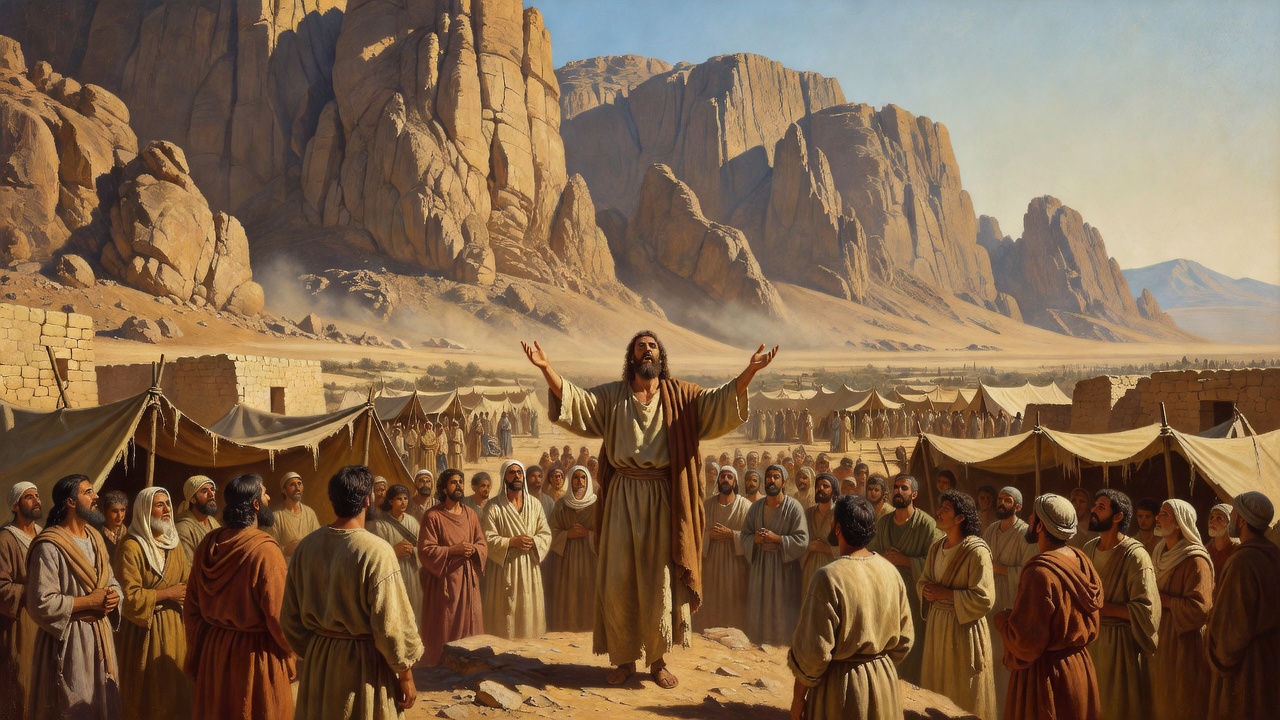
- O Salmo 106 revisita momentos decisivos do Êxodo e da peregrinação no deserto como uma confissão comunitária de pecados. O texto destaca episódios como a rebelião no mar Vermelho, o bezerro de ouro feito em Horebe e a revolta de Datã e Abirão, que foram tragados pela terra.Fontes: o próprio texto bíblico · Horeb · Dathan · Abiram (son of Eliab)
- O salmo menciona a adoração a Baal-Peor, divindade moabita associada ao monte Peor. Durante essa crise, Fineias, filho de Eleazar, interveio para conter uma praga devastadora, ato lembrado nas Escrituras como fidelidade duradoura.Fontes: o próprio texto bíblico · Baal-peor · Phinehas (Levite)
- O Egito é chamado poeticamente de terra de Cão nos versículos 21 e 22. Na genealogia bíblica, Cão era filho de Noé, cujos descendentes foram associados ao Egito e a regiões vizinhas.Fontes: o próprio texto bíblico · Ham · Egypt
Notas escritas com auxílio de IA a partir de fontes abertas (Theographic Bible Metadata, CC BY-SA 4.0; Easton’s Bible Dictionary, domínio público) e revisadas antes de publicar.
Lugares deste capítulo
- Egypt · 30.129, 31.308 · versículos 7, 21
- Mount Horeb · Hoje: Jebel Musa · 28.540, 33.973 · versículo 19
- Ham · Hoje: Egypt · 30.129, 31.308 · versículo 22
- Peor · Hoje: within 1 km of Khirbet Ayun Musa · 31.777, 35.738 · versículo 28
- Meribah · Hoje: Ain el Qudeirat · 30.648, 34.422 · versículo 32
- Canaan · 32.767, 35.333 · versículo 38
Só aparecem lugares com identificação de alta confiança (90% ou mais segundo as fontes acadêmicas reunidas pelo OpenBible). Mapa da época: DARE (Digital Atlas of the Roman Empire), CC BY 4.0; mapa atual: © colaboradores do OpenStreetMap; lugares: OpenBible.info (CC BY 4.0).
Créditos e licença desta tradução
The Orthodox Jewish Bible
The Orthodox Jewish Bible - Tanakh and Orthodox Jewish Brit Chadasha - The Holy Bible
copyright © 2002-2011, 2021, 2024 Artists for Israel International
Language: English
Contributor: Artists for Israel International
THE ORTHODOX JEWISH TANAKH
Artists For Israel Intl Inc.
This version also appears with the Orthodox Yiddish Triglot which presents the Hebrew Yiddish script in Latin script and an English word for word translation, available at afii.org/Torah
To donate PayPal.Me
This translation is made available to you under the terms of the
Creative Commons Attribution license 4.0.
You may share and redistribute this Bible translation or extracts from it in any format, provided that:
You include the above copyright and source information.
If you make any changes to the text, you must indicate that you did so in a way that makes it clear that the original licensor is not necessarily endorsing your changes.
Pictures included with Scriptures and other documents on this site are licensed just for use with those Scriptures and documents.
For other uses, please contact the respective copyright owners.
Note that in addition to the rules above, revising and adapting God's Word involves a great responsibility to be true to God's Word. See Revelation 22:18-19.
2026-01-06
Títulos de seção adaptados da Berean Standard Bible (domínio público); não fazem parte do texto bíblico desta tradução.
Fonte: http://ebible.org/engojb/ · eBible.org