Lucas 15
The Orthodox Jewish Bible · Toque num versículo para ver as referências cruzadas.
The Parable of the Lost Sheep
1Now all the mochesim (tax-collectors) and the chote'im (sinners) were coming near Rebbe, Melech HaMoshiach to listen to him. 2And both the Perushim and the Sofrim were grumbling, saying, This one gives a kabbalat panim reception to chote'im (sinners) and eats at tish with them.
3And Rebbe, Melech HaMoshiach told them this mashal, saying, 4What man of you, if he has meah kevasim (a hundred sheep) and has lost from them one, does not leave the tishim vteshah (ninety-nine) in the open pasture, and go for the one which has been lost until he finds it? 5And when he has found it, he puts it on his shoulders with lev same'ach. 6And when he returns to his bais, he calls together his chaverim and his shchenim (neighbors), saying to them, Make a simcha with me, because I have found my keves (sheep), the one that was lost! 7I say to you that in the same way there will be more simcha in Shomayim over one choteh (sinner) who becomes a baal teshuva than over tishim vteshah tzaddikim who have no need of teshuva.
The Parable of the Lost Coin
8Or what isha having asaret (ten) drachmas, if she loses one drachma, will not light a licht (light) and sweep the bais and search carefully until she finds it? 9And having found it, she calls together chaverim and shchenim saying, Have simcha with me, for I have found the drachma which I lost. 10In the same way, I say to you, there is simcha in the presence of the malachim Hashem over one choteh (sinner) who becomes a baal teshuva.
The Parable of the Prodigal Son
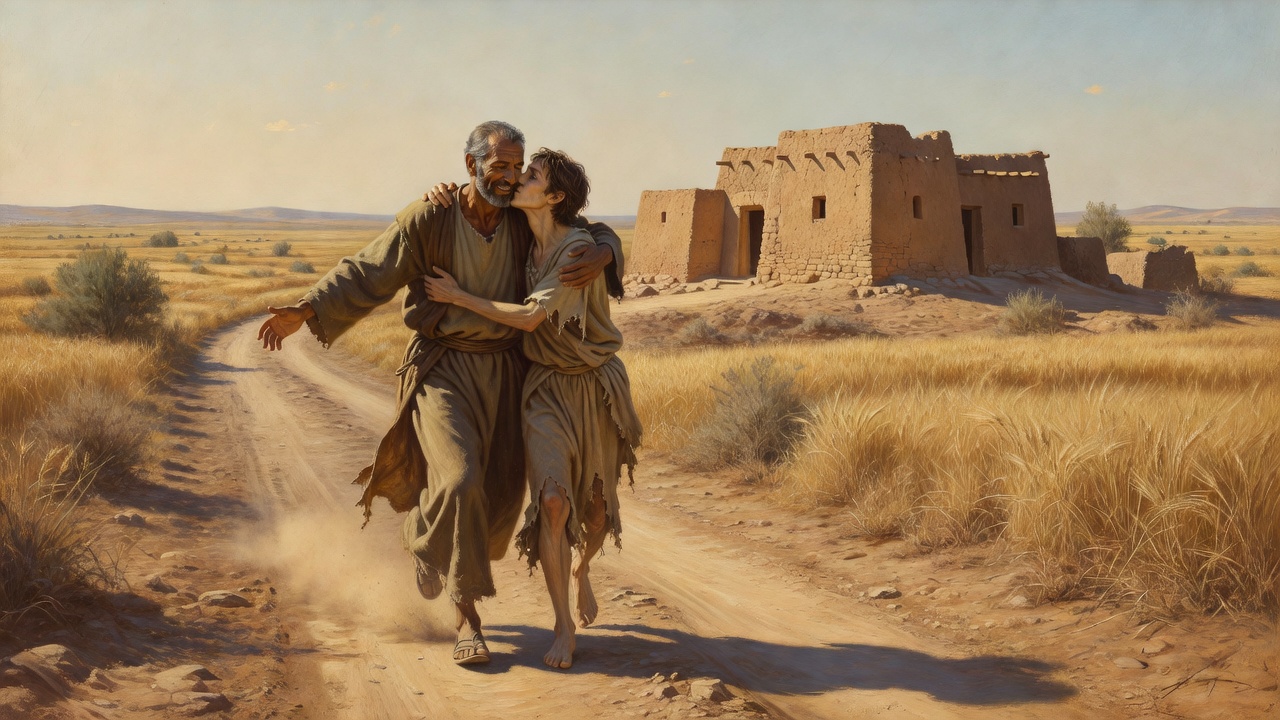
11And Rebbe, Melech HaMoshiach said, A certain ben Adam had shnei banim (two sons). 12And the younger of them said to his Abba, Avi, give to me the share of the estate that falls to me. And his Abba divided his wealth between them. 13And not many yamim later, having gathered together everything, the younger ben went on a journey to a far away country, and there he squandered his osher (riches) with gilui arayot (sexual immorality) and loose living. 14And when he had spent everything, there came a severe ra'av (famine) throughout that aretz, and he began to be nitzrach (needy). 15And he went and became associated with one of the citizens of that aretz, and he sent him into his fields to feed chazirim, 16And he was longing to fill his mogen (stomach) with the pods which the chazirim were eating, and no one was giving anything to him.
17When he came to his senses, his seichel told him, How many of my Abbaʼs sachirim (hired workers) have more than enough okhel (food) and I am perishing here with hunger. 18I will get up and go to my Abba, and I will say, Avi, I sinned against Shomayim and in your sight. 19I no longer have the zokheh (merit) worthy to be called a ben of my Abba. Make me as one of your sachirim (hired workers). 20And when he got up he came home to his own Abba. And while he was still a long way off, his Abba saw him, and was filled with rachmei Shomayim (heavenly mercy, compassion) and tears, and fell upon his neck and kissed him. 21And bno said to the Abba, Avi, I sinned against Shomayim and in your sight. No longer do I have the zokheh (merit) to be worthy to be called your ben. 22But his Abba said to his avadim, Shnel! (Quick!) Bring out the best kaftan and clothe him, and put a ring on his hand and sandals for his feet, 23And bring the fattened calf, and slaughter it, and let us eat and have a simcha, 24Because this ben of mine was dead and now he has returned l'Chayyim! He had been lost and now he is found. And they began to make a simcha.
25But the Abbaʼs alterer ben (older son) was in the sadeh (field). And as he was coming, he drew near to the bais, and he heard the zemirot (table songs), and the sound of the klezmer (musician) and the dancing, 26And having summoned one of the avadim (servants), the alterer ben (older son) was inquiring what these things might be. 27And the eved said to him, Your ach is present, and your Abba sacrificed the fattened calf, because your Abba received him back bari v'shalem (safe and sound). 28And the alterer ben was filled with ka'as (anger), and he did not want to enter. But his Abba came out and was pleading with him. 29But in reply the alterer ben said to his Abba, Hinei, so many years I serve you and never a mitzvah of you I disobeyed, and never for me did you give even a young goat that with my chaverim I might make a simcha. 30But when shows up this ben of yours, the one having devoured your property with zonot (prostitutes), you sacrificed for him the fattened calf. 31And the Abba said to him, Beni, you are always with me, and everything which is mine is yours. 32But now it was necessary for us to have lev samei'ach and make a simcha, because the ach of you was dead and he has returned l'Chayyim! He has been lost and now is found.
Você sabia?
Perdido e encontrado
- Cobradores de impostos e pecadores estavam se reunindo para ouvir Jesus, e os fariseus e os escribas começaram a murmurar que ele acolhe pecadores e come com eles. Jesus então lhes contou parábolas sobre uma ovelha perdida, uma moeda de prata perdida e um filho perdido.Fontes: o próprio texto bíblico
- O ensino e a cura na Pereia em direção a Jerusalém são registrados como começando em 30 d.C. com duração de um dia.Fontes: Teaching and Healing in Perea to Jerusalem
Notas escritas com auxílio de IA a partir de fontes abertas (Theographic Bible Metadata, CC BY-SA 4.0; Easton’s Bible Dictionary, domínio público) e revisadas antes de publicar.
Créditos e licença desta tradução
The Orthodox Jewish Bible
The Orthodox Jewish Bible - Tanakh and Orthodox Jewish Brit Chadasha - The Holy Bible
copyright © 2002-2011, 2021, 2024 Artists for Israel International
Language: English
Contributor: Artists for Israel International
THE ORTHODOX JEWISH TANAKH
Artists For Israel Intl Inc.
This version also appears with the Orthodox Yiddish Triglot which presents the Hebrew Yiddish script in Latin script and an English word for word translation, available at afii.org/Torah
To donate PayPal.Me
This translation is made available to you under the terms of the
Creative Commons Attribution license 4.0.
You may share and redistribute this Bible translation or extracts from it in any format, provided that:
You include the above copyright and source information.
If you make any changes to the text, you must indicate that you did so in a way that makes it clear that the original licensor is not necessarily endorsing your changes.
Pictures included with Scriptures and other documents on this site are licensed just for use with those Scriptures and documents.
For other uses, please contact the respective copyright owners.
Note that in addition to the rules above, revising and adapting God's Word involves a great responsibility to be true to God's Word. See Revelation 22:18-19.
2026-01-06
Títulos de seção adaptados da Berean Standard Bible (domínio público); não fazem parte do texto bíblico desta tradução.
Fonte: http://ebible.org/engojb/ · eBible.org