Levítico 15
The Orthodox Jewish Bible · Toque num versículo para ver as referências cruzadas.
The Uncleanness of Men
1And Hashem spoke unto Moshe and to Aharon, saying, 2Speak unto the Bnei Yisroel, and say unto them, When any ish hath a discharge from his basar, because of his discharge he is tamei. 3And this shall be his tumah (uncleanness) in his discharge: whether his basar run with his discharge, or his basar has stopped from his discharge, it is his tumah (uncleanness). 4Every bed, whereon he lieth that hath the discharge, is tamei; and everything, whereon he sitteth, shall be tamei. 5And whosoever toucheth his bed shall immerse his garments, and immerse himself in mayim, and be tamei until the erev. 6And he that sitteth on any thing whereon he sat that hath the discharge shall immerse his garments, and immerse himself in mayim, and be tamei until the erev. 7And he that toucheth the basar of him that hath the discharge shall immerse his garments, and immerse himself in mayim, and be tamei until the erev. 8And if he that hath the discharge spit upon him that is tahor, then he shall immerse his garments, and immerse himself in mayim, and be tamei until the erev. 9And whatsoever riding seat he rideth upon that hath the discharge shall be tamei. 10And whosoever toucheth anything that was under him shall be tamei until the erev; and he that picks up any of those things shall immerse his garments, and immerse himself in mayim, and be tamei until the erev. 11And whomsoever he toucheth that hath the discharge, and hath not rinsed his hands in mayim, he shall immerse his garments, and immerse himself in mayim, and be tamei until the erev.
12And the clay pottery, that he toucheth which hath the discharge, shall be broken; and every wooden vessel shall be rinsed in mayim.
The Cleansing of Men
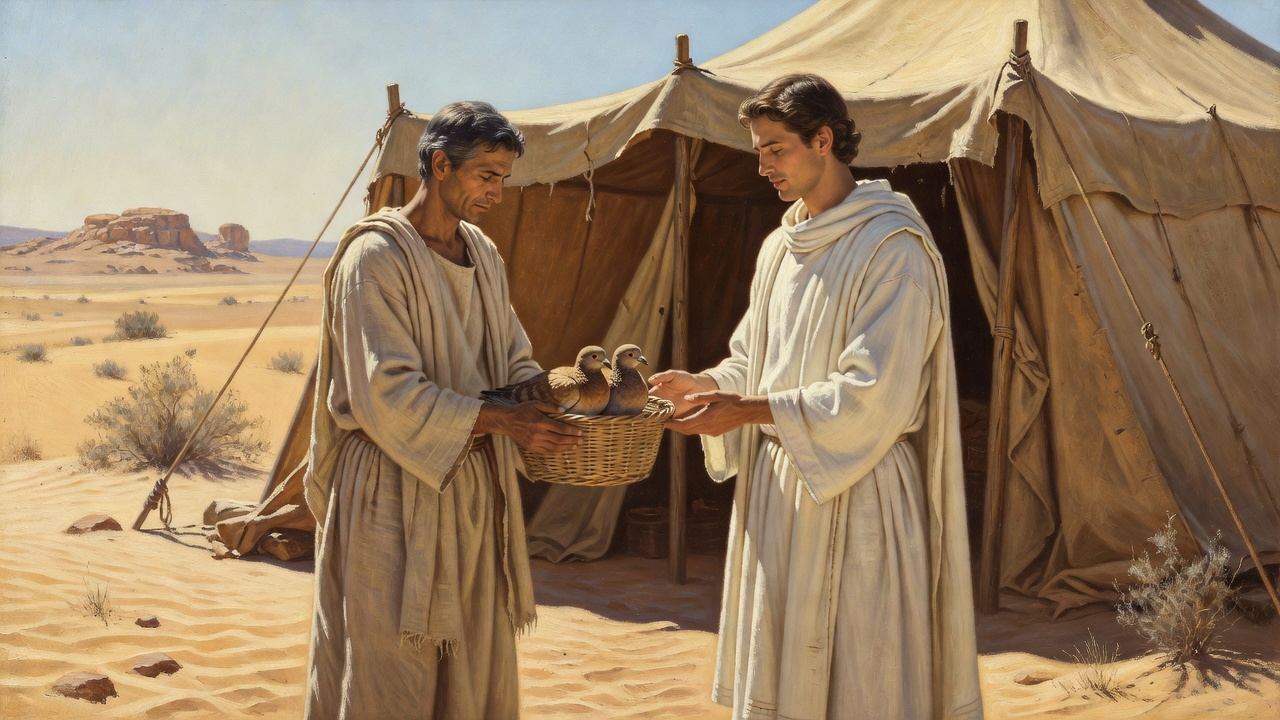
13And when he that hath a discharge is made tahor of his discharge; then he shall number to himself seven days for his tohorah (cleansing), and immerse his garments, and immerse his basar in running mayim, and shall be tahor. 14And on the yom shemini he shall take to him two turtledoves, or two young pigeons, and come before Hashem unto the entrance of the Ohel Mo'ed, and give them unto the kohen; 15And the kohen shall sacrifice them, the one for a chattat, and the other for an olah (burnt offering); and the kohen shall make kapporah for him before Hashem for his discharge.
16And if any ish, if his shikhvat zera (emission of semen) go out from him, then he shall immerse his entire body in mayim, and be tamei until the erev. 17And every garment, and every skin, whereon is the shikhvat zera, shall be immersed with mayim, and be tamei until the erev. 18The isha also with whom ish shall lie with shikhvat zera, they shall both immerse themselves in mayim, and be tamei until the erev.
The Uncleanness of Women
19And if an isha have a discharge, and her discharge in her body be dahm, she shall be in her state of niddah (state of menstrual separation) seven days; and whosoever toucheth her shall be tamei until the erev. 20And everything that she lieth upon in her niddah shall be tamei; everything also that she sitteth upon shall be tamei. 21And whosoever toucheth her bed shall immerse his garments, and immerse himself in mayim, and be tamei until the erev. 22And whosoever toucheth anything that she sat upon shall immerse his garments, and immerse himself in mayim, and be tamei until the erev. 23And if it be on her bed, or on any thing whereon she sitteth, when he toucheth it, he shall be tamei until the erev. 24And if any ish lie with her at all, and her niddah (menstrual flow) be upon him, he shall be tamei seven days; and all the bed whereon he lieth shall be tamei.
25And if an isha have a discharge of her dahm many days out of the time of her niddah, or if it run beyond the time of her niddah, all the days of the discharge of her tumah shall be as the days of her niddah; she shall be tamei. 26Every bed whereon she lieth all the days of her discharge shall be unto her as the bed of her niddah; and whatsoever she sitteth upon shall be tamei, as the tumah of her niddah. 27And whosoever toucheth those things shall be tamei, and shall immerse his garments, and immerse himself in mayim, and be tamei until the erev.
The Cleansing of Women
28But if she be tohorah of her discharge, then she shall count to herself seven days, and after that she shall be tohorah. 29And on the yom shemini she shall take unto her two turtle doves, or two young pigeons, and bring them unto the kohen, to the entrance of the Ohel Mo'ed. 30And the kohen shall sacrifice the one for a chattat, and the other for an olah (burnt offering); and the kohen shall make kapporah for her before Hashem for the discharge of her tumah.
31Thus shall ye separate the Bnei Yisroel from their tumah; that they die not in their tumah, when they defile My Mishkan that is among them.
32This is the torah of him that hath a discharge, and of him whose shikhvat zera goeth from him, and is made tamei therewith; 33And of her that suffers through her niddah, and of him that hath a discharge, of the zachar, and of the nekevah, and of him that lieth with her that is tameiah.
Você sabia?
Leis sobre Fluxos Corporais e Purificação
- As leis de pureza em Levítico 15 regulavam fluxos corporais naturais e anormais em homens e mulheres, os quais tornavam as pessoas cerimonialmente impuras. Objetos tocados por uma pessoa com fluxo, como camas, assentos e selas, transmitiam impureza, exigindo que quem os tocasse lavasse as roupas, se banhasse e ficasse impuro até o entardecer.Fontes: o próprio texto bíblico
- A purificação de fluxos prolongados exigia uma espera de sete dias após a cura, a lavagem das vestes e o banho em água corrente. No oitavo dia, a pessoa levava duas rolinhas ou dois pombinhos ao sacerdote na entrada da Tenda do Encontro para serem oferecidos como oferta pelo pecado e holocausto.Fontes: o próprio texto bíblico
- O objetivo explícito dessas normas era manter os israelitas conscientes dos limites rituais, evitando que contaminassem o tabernáculo estabelecido no meio do acampamento.Fontes: o próprio texto bíblico
Notas escritas com auxílio de IA a partir de fontes abertas (Theographic Bible Metadata, CC BY-SA 4.0; Easton’s Bible Dictionary, domínio público) e revisadas antes de publicar.
Créditos e licença desta tradução
The Orthodox Jewish Bible
The Orthodox Jewish Bible - Tanakh and Orthodox Jewish Brit Chadasha - The Holy Bible
copyright © 2002-2011, 2021, 2024 Artists for Israel International
Language: English
Contributor: Artists for Israel International
THE ORTHODOX JEWISH TANAKH
Artists For Israel Intl Inc.
This version also appears with the Orthodox Yiddish Triglot which presents the Hebrew Yiddish script in Latin script and an English word for word translation, available at afii.org/Torah
To donate PayPal.Me
This translation is made available to you under the terms of the
Creative Commons Attribution license 4.0.
You may share and redistribute this Bible translation or extracts from it in any format, provided that:
You include the above copyright and source information.
If you make any changes to the text, you must indicate that you did so in a way that makes it clear that the original licensor is not necessarily endorsing your changes.
Pictures included with Scriptures and other documents on this site are licensed just for use with those Scriptures and documents.
For other uses, please contact the respective copyright owners.
Note that in addition to the rules above, revising and adapting God's Word involves a great responsibility to be true to God's Word. See Revelation 22:18-19.
2026-01-06
Títulos de seção adaptados da Berean Standard Bible (domínio público); não fazem parte do texto bíblico desta tradução.
Fonte: http://ebible.org/engojb/ · eBible.org