Lamentações 4
The Orthodox Jewish Bible · Toque num versículo para ver as referências cruzadas.
The Distress of Zion
1How has the zahav lost its luster!
How is the most fine gold changed!
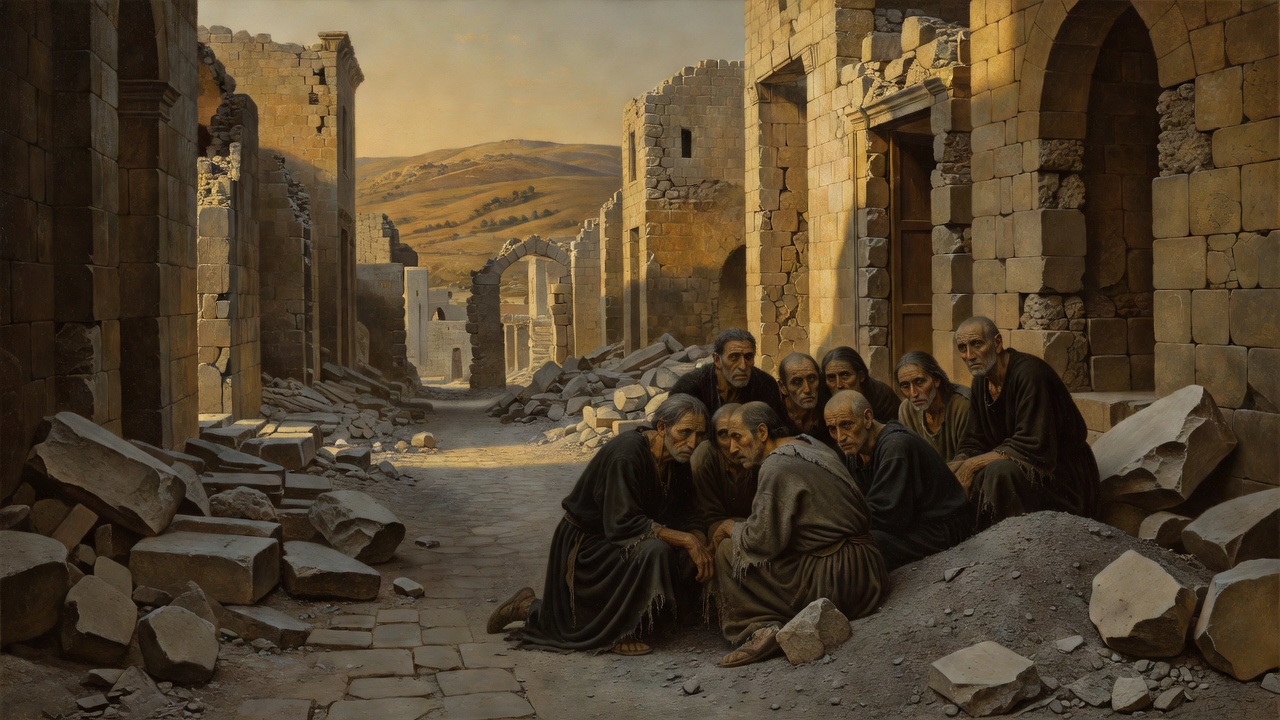
The avnei kodesh are poured out on every street corner.
2The precious Bnei Tziyon,
comparable to fine gold,
how are they esteemed as earthen pitchers,
the work of the hands of the yotzer (potter)!
3Even the jackals offer the breast;
they nurse their young ones;
the Bat Ami is become heartless,
like the ostriches in the midbar.
4The leshon of the nursing infant
cleaveth to the roof of his mouth for thirst;
the olalim beg for lechem,
and no man giveth it unto them.
5They that did feed delicately
are destitute in the chutzot;
they that were brought up in purple
lie on dunghills.
6For the punishment of the iniquity of the Bat Ami
is greater than the punishment of the sin of Sodom,
that was overthrown as in a moment,
and no hands helped her.
7Her nobles were purer than snow;
they were whiter than cholov,
they were more ruddy in body than rubies,
their appearance was of sapphire;
8Their visage is blacker than soot;
they are not known in the streets;
their skin cleaveth to their atzmot;
it is dried up, it is become like a stick.
9They that are slain with the cherev
are better than they that are slain with hunger;
for these pine away,
being pierced for want of the increase of the sadeh.
10The hands of the pitiful nashim
have cooked their own yeladim;
they were their meat
in the destruction of the Bat Ami.
11Hashem hath accomplished His fury;
He hath poured out His charon af,
and hath kindled an eish in Tziyon,
and it hath devoured the yesodot thereof.
12The malkhei eretz,
and all the inhabitants of the tevel (world),
would not have believed that the adversary and the oyev
should have entered into the sha'arei Yerushalayim.
13For the sins of her Nevi'im,
and the iniquities of her Kohanim,
that have shed the dahm of the Tzaddikim
in the midst of her.
14They have groped about like ivrim (blind men) in the streets;
they have defiled themselves with dahm,
so that men dare not touch their garments.
15They cried unto them: Go away;
tamei (unclean)!
Depart, depart, touch not;
so they fled away and wandered. They said among the Goyim:
They shall no more sojourn there.
16The anger of Hashem hath scattered them;
He will no more regard them;
they respected not the persons of the Kohanim;
they showed no favor to the Zekenim.
17As for us, our eyes failed
looking in vain for ezratenu (our help);
from our towers we have watched
for a nation that could not save us.
18They stalk our steps,
that we cannot go in our streets;
kitzeinu (our end) is near, our yamim are numbered;
for kitzeinu is come.
19Our pursuers are swifter
than the eagles of Shomayim;
they pursued us upon the mountains,
they laid wait for us in the midbar.
20The Moshiach of Hashem, who was our very life,
was taken in their traps,
of whom we said: Under his shadow [of protection]
we shall live among the Goyim.
21Rejoice and be glad, O Bat Edom,
that dwellest in Eretz Utz;
the kos (cup) also shall pass unto thee;
thou shalt be drunk, and shalt be stripped naked.
22The punishment of thine iniquity is accomplished, O Bat Tziyon;
He will no more prolong your Golus;
He will visit thine iniquity, O Bat Edom;
He will expose thy sins.
Você sabia?
A Agonia da Cidade Caída
- O poeta considera o sofrimento prolongado de Jerusalém pior do que o destino de Sodoma. Enquanto Sodoma foi destruída em um instante por fogo divino, os habitantes de Jerusalém suportaram o tormento lento e doloroso do cerco e da fome.Fontes: o próprio texto bíblico · Sodom
- Antes de sua queda, Jerusalém era amplamente vista como uma cidade montanhosa impenetrável. O texto observa que os reis estrangeiros e as nações vizinhas nunca imaginaram que um inimigo pudesse romper seus portões fortificados.Fontes: o próprio texto bíblico · Jerusalem
- O capítulo se encerra com uma mensagem dirigida a Edom, que habitava na terra de Uz, advertindo que o juízo logo a alcançaria. A terra de Uz é mencionada em apenas três livros bíblicos: Jó, Jeremias e Lamentações.Fontes: o próprio texto bíblico · Uz · Edom
Notas escritas com auxílio de IA a partir de fontes abertas (Theographic Bible Metadata, CC BY-SA 4.0; Easton’s Bible Dictionary, domínio público) e revisadas antes de publicar.
Lugares deste capítulo
- Zion · Hoje: Jerusalem · 31.777, 35.234 · versículos 2, 11, 22
- Jerusalem · 31.777, 35.234 · versículo 12
- Edom · 30.746, 35.604 · versículos 21, 22
Só aparecem lugares com identificação de alta confiança (90% ou mais segundo as fontes acadêmicas reunidas pelo OpenBible). Mapa da época: DARE (Digital Atlas of the Roman Empire), CC BY 4.0; mapa atual: © colaboradores do OpenStreetMap; lugares: OpenBible.info (CC BY 4.0).
Créditos e licença desta tradução
The Orthodox Jewish Bible
The Orthodox Jewish Bible - Tanakh and Orthodox Jewish Brit Chadasha - The Holy Bible
copyright © 2002-2011, 2021, 2024 Artists for Israel International
Language: English
Contributor: Artists for Israel International
THE ORTHODOX JEWISH TANAKH
Artists For Israel Intl Inc.
This version also appears with the Orthodox Yiddish Triglot which presents the Hebrew Yiddish script in Latin script and an English word for word translation, available at afii.org/Torah
To donate PayPal.Me
This translation is made available to you under the terms of the
Creative Commons Attribution license 4.0.
You may share and redistribute this Bible translation or extracts from it in any format, provided that:
You include the above copyright and source information.
If you make any changes to the text, you must indicate that you did so in a way that makes it clear that the original licensor is not necessarily endorsing your changes.
Pictures included with Scriptures and other documents on this site are licensed just for use with those Scriptures and documents.
For other uses, please contact the respective copyright owners.
Note that in addition to the rules above, revising and adapting God's Word involves a great responsibility to be true to God's Word. See Revelation 22:18-19.
2026-01-06
Títulos de seção adaptados da Berean Standard Bible (domínio público); não fazem parte do texto bíblico desta tradução.
Fonte: http://ebible.org/engojb/ · eBible.org