João 3
The Orthodox Jewish Bible · Toque num versículo para ver as referências cruzadas.
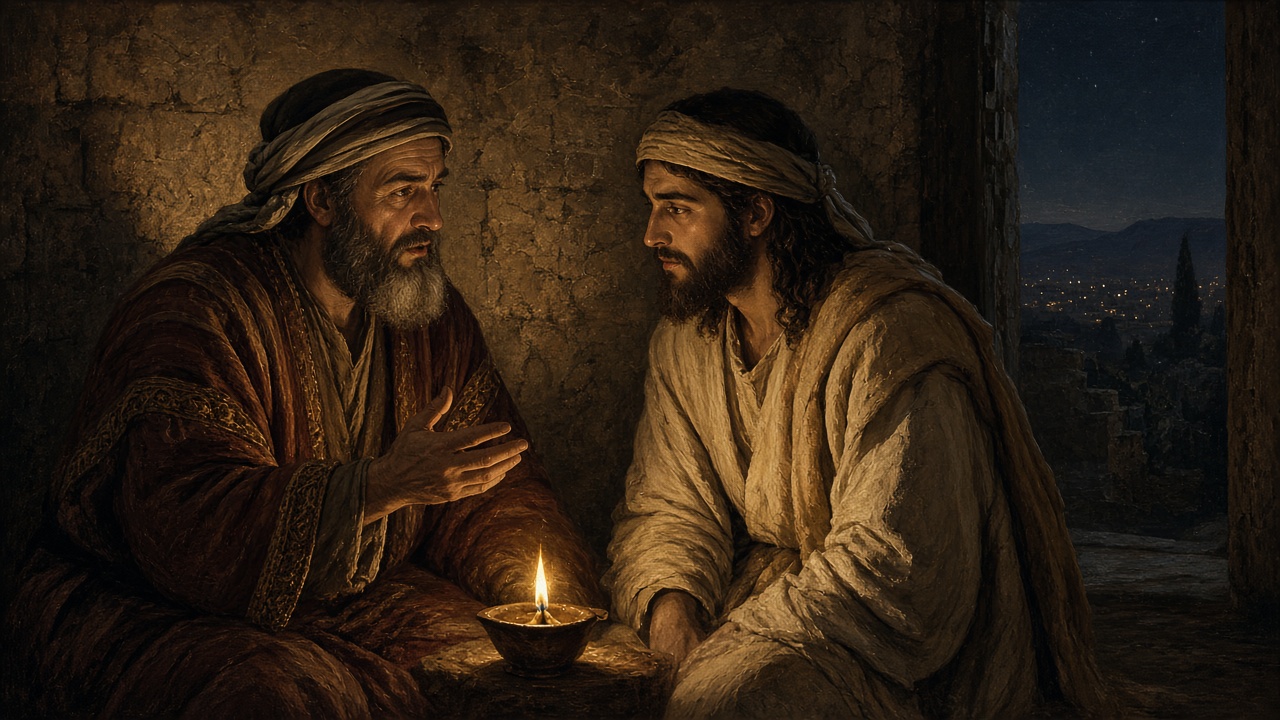
Jesus and Nicodemus
1Now there was a man of the Perushim. His name was Rav Nakdimon, a katzin (leader) of the Yehudim. 2This one came to Rebbe, Melech HaMoshiach under cover of lailah and said to him, Rabbi, we have da'as that you are a moreh from Hashem having come, for no one is able these otot (miraculous signs) to do, which you do, unless Hashem is with him. 3In reply, he said to him, Omein, omein, I say to you, unless someone is born anew, he is not able to see the Malchut Hashem. 4Rav Nakdimon says to Rebbe, Melech HaMoshiach, How is a man, being old, able to be born? Surely he is not able into the womb of immo a second time to enter and to be born? 5In reply, Rebbe, Melech HaMoshiach said, Omein, omein, I say to you: unless someone is born of mayim and Ruach Hakodesh, he is not able to enter into the Malchut Hashem. 6That which is born of basar is basar, and that which is born of the Ruach is ruach. 7Do not marvel that I said to you, It is necessary for you to be born again, born anew. 8The ruach (wind, Spirit) blows where it wishes, and the sound of it you hear, but you do not have da'as of where it comes from and where it goes; so it is with everyone having been born of the Ruach Hakodesh.
9In reply, Rav Nakdimon said to Rebbe, Melech HaMoshiach, How is it possible for these things to happen? 10In reply, he said to him, You hold the teaching office of rabbi, of moreh b'Yisroel and of these things you do not have da'as? 11Omein, omein, I say to you, that of which we have da'as we speak, and of that which we have seen, we give solemn edut (testimony), and the solemn edut of us you [pl.] do not receive. 12If I told you [pl.] about things of the Olam Hazeh and you have no emunah, how will you have emunah if I tell you about the things of the Olam Haba? 13And no one has ascended into Shomayim except the one having descended out of Shomayim, the Bar Enosh. 14And as Moshe lifted up the nachash in the wilderness, so it is necessary for there to be a hagbah (lifting up) of the Bar Enosh. 15That everyone having emunah in him may have Chayyei Olam.
16For Hashem so had ahavah (agape) for the Olam Hazeh that Hashem gave the matanah (gift) of Hashemʼs Ben Yechid, so that whosoever has emunah in him may not be ne'evad (lost, perish, be ruined with destruction), but find Chayyei Olam. 17For Hashem did not send the Ben HaElohim into the Olam Hazeh that he might judge the Olam Hazeh, but that the Olam Hazeh might be brought to the Geulah (Redemption) of the Olam Haba through him (Rebbe, Melech HaMoshiach). 18The one of emunah who is mekabel Moshiach (accepting the person of the Bar Enosh, Rebbe, Melech HaMoshiach) is not judged; but the one without emunah who is not mekabel Moshiach, already has been judged and given the psak din (verdict) of “condemned,” because he has no emunah in the Shem of the Ben Yachid of Hashem. 19And this is the psak din, that the Ohr has come into the Olam Hazeh, and Bnei Adam had ahavah for the choshech rather than for the Ohr, for their ma'asim were ra'im (evil). 20For everyone walking in the derech resha'im has sin'as chinom (baseless hatred) for the Ohr and does not come to the Ohr, lest his ma'asim be exposed. 21But the one doing HaEmes comes to the Ohr that his ma'asim hamitzot may be manifested, that they have been wrought in Hashem.
John’s Testimony about Jesus
22After these things Rebbe, Melech HaMoshiach and his talmidim came into the land of Yehudah, and there he was staying with them and was giving the mikveh mayimʼs tevilah. 23And Yochanan was also giving the tevilah near Shalem at Einayim, because there was plenty of water there for a mikveh, and the Yehudim were coming and submitting to the tevilah. 24Yochanan had not yet been incarcerated in the beit hasohar (prison).
25There was then a discussion of Yochananʼs talmidim with one of the Yehudim about the subject of tohorah (purification). 26And they came to Yochanan and said to him, Rabbi, he who was with you beyond the Yarden, the one to whom you have given solemn edut, hinei, this one gives the mikveh mayimʼs tevilah and kol Bnei Adam come to him. 27In reply, Yochanan said, A man is not able to receive anything, unless it has been given to him from Shomayim. 28You yourselves stand as eidus (witness) to me, that I said I am not the Rebbe, Melech HaMoshiach, but I have been sent gevorn forois before him (forerunner). 29The one having the Kallah (bride) is the Choson (Bridegroom), but the Shoshvin (the Chosonʼs best man), the one having stood and hearing him with simcha, rejoices because of the kol (voice) of the Choson (Bridegroom). Therefore, this simcha of mine has been made sheleimah (complete). 30It is necessary for that one to increase, but for me to decrease.
31The one coming from above (Moshiach) is over all; the one being from Olam Hazeh is of Olam Hazeh and of the Olam Hazeh he speaks; Hu Habah (He who comes), from Shomayim is over all. 32Rebbe, Melech HaMoshiach gives solemn edut (testimony) to that which he has seen and heard, yet no one receives his eidus. 33The one who is mekabel Moshiachʼs eidus has thereby set his chotam of attestation that Hashem is Emes. 34For he whom Hashem sent speaks the Divrei Hashem, for He gives the Ruach Hakodesh without measure. 35Elohim HaAv (the Father) has ahavah (love) for HaBen and has given all things into his hand. 36The one with emunah in the Ben [HaElohim] has Chayyei Olam; but the one disobeying the Ben [HaElohim] will not see Chayyim, but the Charon Af Hashem remains on him.
Você sabia?
O novo nascimento e o testemunho de João
- Nicodemos, cujo nome significa "o povo é vencedor", era fariseu e membro do Sinédrio. Ele foi a Jesus de noite para conhecer melhor o seu ensino, e o Evangelho o chama de líder dos judeus; Jesus se dirige a ele como mestre de Israel.Fontes: Nicodemus · o próprio texto bíblico
- Depois dessa conversa, Jesus e seus discípulos foram para a região rural da Judeia, que sob os romanos era a mais meridional das três divisões da Palestina. João também batizava em Enom, perto de Salim, porque ali havia água em abundância; Salim, cujo nome significa "pacífico", ficava a oeste do Jordão. Enom significa "fontes", e o Dicionário Bíblico de Easton (1897) situa o lugar provavelmente perto da nascente superior do Wady Far'ah, um vale aberto cheio de fontes que vai do monte Ebal até o Jordão.Fontes: o próprio texto bíblico · Judea · Aenon · Salim
- Neste capítulo, João diz a seus discípulos que não é o Cristo, mas que foi enviado adiante dele, e a narrativa observa que ele ainda não tinha sido preso. O Dicionário Bíblico de Easton (1897) o descreve como o precursor de Jesus, de descendência sacerdotal, e diz que sua missão foi objeto de profecia.Fontes: o próprio texto bíblico · John the Baptist
Notas escritas com auxílio de IA a partir de fontes abertas (Theographic Bible Metadata, CC BY-SA 4.0; Easton’s Bible Dictionary, domínio público) e revisadas antes de publicar.
Lugares deste capítulo
- Jerusalem · 31.777, 35.234 · versículo 22
- Judea · Hoje: Judea 1 · 31.777, 35.234 · versículo 22
- Jordan · Hoje: Jordan River · 31.761, 35.558 · versículo 26
Só aparecem lugares com identificação de alta confiança (90% ou mais segundo as fontes acadêmicas reunidas pelo OpenBible). Mapa da época: DARE (Digital Atlas of the Roman Empire), CC BY 4.0; mapa atual: © colaboradores do OpenStreetMap; lugares: OpenBible.info (CC BY 4.0).
Créditos e licença desta tradução
The Orthodox Jewish Bible
The Orthodox Jewish Bible - Tanakh and Orthodox Jewish Brit Chadasha - The Holy Bible
copyright © 2002-2011, 2021, 2024 Artists for Israel International
Language: English
Contributor: Artists for Israel International
THE ORTHODOX JEWISH TANAKH
Artists For Israel Intl Inc.
This version also appears with the Orthodox Yiddish Triglot which presents the Hebrew Yiddish script in Latin script and an English word for word translation, available at afii.org/Torah
To donate PayPal.Me
This translation is made available to you under the terms of the
Creative Commons Attribution license 4.0.
You may share and redistribute this Bible translation or extracts from it in any format, provided that:
You include the above copyright and source information.
If you make any changes to the text, you must indicate that you did so in a way that makes it clear that the original licensor is not necessarily endorsing your changes.
Pictures included with Scriptures and other documents on this site are licensed just for use with those Scriptures and documents.
For other uses, please contact the respective copyright owners.
Note that in addition to the rules above, revising and adapting God's Word involves a great responsibility to be true to God's Word. See Revelation 22:18-19.
2026-01-06
Títulos de seção adaptados da Berean Standard Bible (domínio público); não fazem parte do texto bíblico desta tradução.
Fonte: http://ebible.org/engojb/ · eBible.org