Juízes 5
The Orthodox Jewish Bible · Toque num versículo para ver as referências cruzadas.
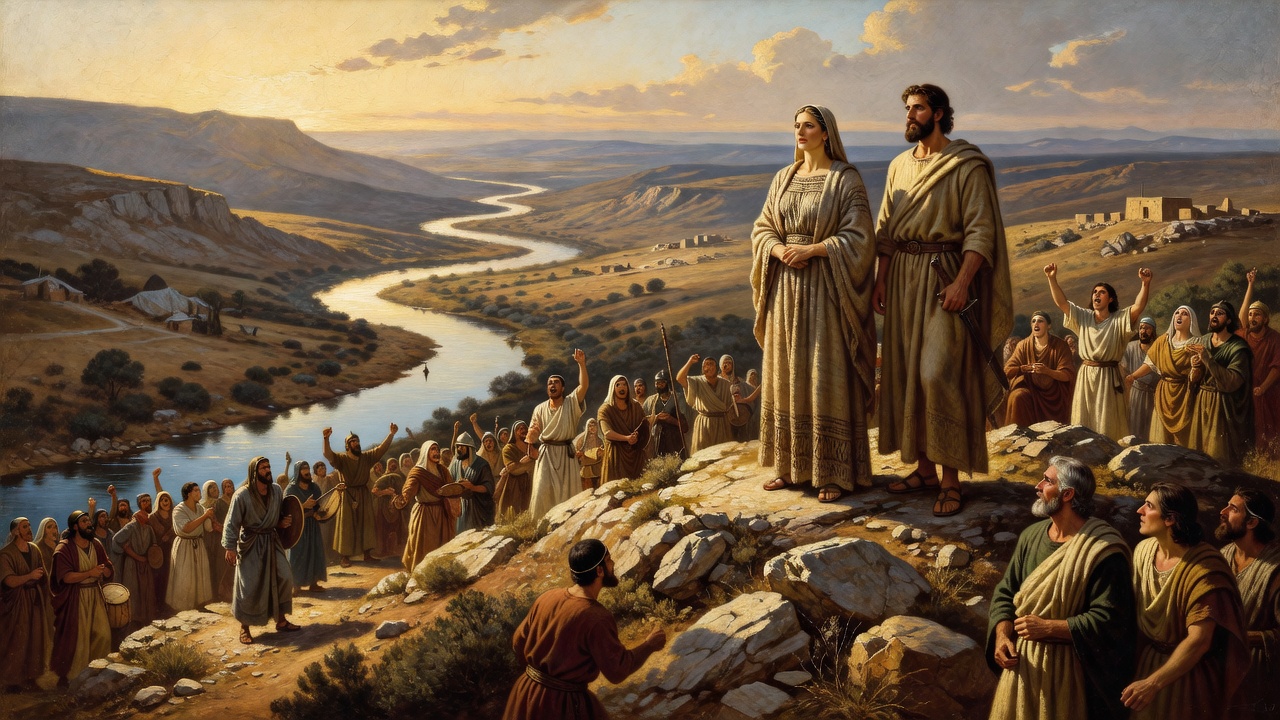
The Song of Deborah and Barak
1Then sang Devorah and Barak ben Avinoam on that day, saying,
2Barachu Hashem that
the strong in Yisroel put forth strength,
that the people willingly offered themselves.
3Hear, O ye melachim;
give ear, O ye rozenim (princes);
I, even I, will sing unto Hashem;
I will make music to Hashem Elohei Yisroel.
4Hashem, when Thou wentest out from Se'ir,
when Thou marchedst out of the sadeh Edom,
Eretz trembled,
HaShomayim poured,
clouds also poured down mayim.
5The harim quaked at the presence of Hashem,
this Sinai before Hashem Elohei Yisroel.
6In the days of Shamgar ben Anat,
in the days of Ya'el, the roads were abandoned,
and the travellers walked the byways.
7The warrior ceased, they ceased in Yisroel,
until I, Devorah, arose,
I Em B'Yisroel arose.
8They chose elohim chadashim
then was war at the she'arim (gates);
was there a mogen or spear to be seen
among forty thousand in Yisroel?
9My lev is toward the ones ruling in Yisroel,
that offered themselves willingly among the people.
Barachu Hashem.
10Reflect,
ye that ride on white donkeys,
ye that sit on carpets,
and you who walk on the derech.
11The voice of the archers
in the place of drawing mayim,
there shall they rehearse the Tzidkot Hashem,
even the Tzidkot of His warriors in Yisroel;
then shall HaAm Hashem
go down to the she'arim.
12Awake, awake, Devorah;
awake, awake, break out in song;
arise, Barak, and lead captive
thy captives, thou ben Avinoam.
13Then came down a sarid (remnant)
of the nobles to the nation;
the people of Hashem came down
to me as gibborim.
14Out of Ephrayim was their shoresh against Amalek;
after thee, Binyamin, among thy people;
out of Machir came down mekhokekim (law givers),
and out of Zevulun they that hold the shevet of the sofer (scribe).
15And the sarim of Yissakhar were with Devorah;
Yissakhar was with Barak;
he rushed at his feet into the emek.
Among the divisions of Reuven
there were gedolim chikkei lev (great indecisions of heart).
16Why abodest thou among the mishpetayim (sheepfolds),
to hear the bleatings of the flocks?
Among the divisions of Reuven
there were great indecisions of heart.
17Gil'ad abode beyond Yarden;
and why did Dan linger by oniyyot?
Asher remained on the seacoast,
and dwelt by his landings.
18Zevulun and Naphtali were a people
that risked their nefesh unto the death
in the high places of the sadeh.
19The melachim came and fought,
then fought the melachim of Kena'an
at Ta'anakh by the waters of Megiddo;
they took no plunder of kesef.
20They fought from Shomayim;
the kokhavim in their courses
fought Sisra.
21The Kishon River swept them away,
that nachal kedumim, the Kishon River.
O my nefesh, march on with oz!
22Then were the ikvei sus (horse hooves) galloping,
the prancings of hooves,
the prancings of their mighty steeds.
23Curse Meroz, said the Malach Hashem,
curse bitterly the inhabitants thereof;
because they came not to the ezrat Hashem,
to the help of Hashem, against the gibborim.
24Blessed above nashim shall Ya'el
eshet Chever the Keni be,
blessed shall she be above nashim in the ohel.
25He asked mayim, and she gave him cholov;
she brought forth curds in a nobleʼs dish.
26She put her yad to the yated,
and her right hand to the workmanʼs hammer;
and with the hammer she struck Sisra, she crushed his rosh,
when she had shattered and pierced his temple.
27At her feet he bowed,
he fell, he lay down;
at her feet he bowed, he fell;
where he bowed, sham (there) he fell down dead.
28The Em Sisra looked out through the chalon (window),
and cried through the lattice,
Why is his chariot so long in coming?
Why tarry the wheels of his marekevot (chariots)?
29Her chachemot sarot (wisest ladies) answered her,
indeed, she repeats to herself her words,
30Are they not finding and dividing the prey;
to every gever a girl or two;
for Sisra colorful garments as plunder,
a plunder of dyed work embroidered, of divers colors of needlework on both sides,
fit for the necks of them that take the spoil?
31So let all thine enemies perish, Hashem;
but let them that love Him be
as the shemesh in its gevurah.
And HaAretz had rest arba'im shanah.
Você sabia?
O Cântico de Débora e Baraque
- O cântico poético de vitória destaca as variadas reações das tribos israelitas durante a crise. Enquanto grupos como Zebulom, Naftali e Issacar arriscaram a vida na batalha, outros como Rúben, Dã, Aser e os habitantes de Gileade permaneceram entre seus rebanhos, navios e portos litorâneos.Fontes: o próprio texto bíblico · Zebulun · Gilead
- O confronto decisivo ocorreu perto de Taanaque, junto às águas de Megido, uma área na planície de Jezreel onde a torrente caudalosa do rio Quisom arrastou as forças inimigas.Fontes: o próprio texto bíblico · Taanach · Barak
- O poema cria um vívido contraste literário entre duas mulheres: Jael, a queneia habitante de tendas que abateu o comandante Sísera, e a mãe aristocrática de Sísera, que olhava pela janela gradeada à espera de despojos e de um filho que jamais retornaria.Fontes: o próprio texto bíblico · Jael · Sisera (army captain)
Notas escritas com auxílio de IA a partir de fontes abertas (Theographic Bible Metadata, CC BY-SA 4.0; Easton’s Bible Dictionary, domínio público) e revisadas antes de publicar.
Lugares deste capítulo
- Edom · 30.746, 35.604 · versículo 4
- Mount Tabor · Hoje: Jebel et Tur · 32.686, 35.393 · versículo 13
- Amalek · 30.648, 34.422 · versículo 14
- Gilead · Hoje: Gilead 1 · 32.187, 35.692 · versículo 17
- Jordan · Hoje: Jordan River · 31.761, 35.558 · versículo 17
- Canaan · 32.767, 35.333 · versículo 19
- Megiddo · Hoje: Tel Megiddo · 32.585, 35.184 · versículo 19
- Taanach · Hoje: Tell Ta’anakh · 32.522, 35.219 · versículo 19
Só aparecem lugares com identificação de alta confiança (90% ou mais segundo as fontes acadêmicas reunidas pelo OpenBible). Mapa da época: DARE (Digital Atlas of the Roman Empire), CC BY 4.0; mapa atual: © colaboradores do OpenStreetMap; lugares: OpenBible.info (CC BY 4.0).
Créditos e licença desta tradução
The Orthodox Jewish Bible
The Orthodox Jewish Bible - Tanakh and Orthodox Jewish Brit Chadasha - The Holy Bible
copyright © 2002-2011, 2021, 2024 Artists for Israel International
Language: English
Contributor: Artists for Israel International
THE ORTHODOX JEWISH TANAKH
Artists For Israel Intl Inc.
This version also appears with the Orthodox Yiddish Triglot which presents the Hebrew Yiddish script in Latin script and an English word for word translation, available at afii.org/Torah
To donate PayPal.Me
This translation is made available to you under the terms of the
Creative Commons Attribution license 4.0.
You may share and redistribute this Bible translation or extracts from it in any format, provided that:
You include the above copyright and source information.
If you make any changes to the text, you must indicate that you did so in a way that makes it clear that the original licensor is not necessarily endorsing your changes.
Pictures included with Scriptures and other documents on this site are licensed just for use with those Scriptures and documents.
For other uses, please contact the respective copyright owners.
Note that in addition to the rules above, revising and adapting God's Word involves a great responsibility to be true to God's Word. See Revelation 22:18-19.
2026-01-06
Títulos de seção adaptados da Berean Standard Bible (domínio público); não fazem parte do texto bíblico desta tradução.
Fonte: http://ebible.org/engojb/ · eBible.org