Isaías 57
The Orthodox Jewish Bible · Toque num versículo para ver as referências cruzadas.
The Blessed Death of the Righteous
1The tzaddik perisheth,
and no ish layeth it to lev;
and anshei chesed are taken away,
none considering that the tzaddik is taken away
from the ra'ah (evil, calamity) to come.
2He shall enter into shalom;
they shall rest in their mishkevot (couches, i.e., tombs),
each one walking in his nekhochah (uprightness, integrity, honesty).
God Condemns Idolatry
3But draw near to here,
ye bnei onenah (you children of a sorceress),
zera mena'ef (offspring of an adulterer) and she who plays the zonah.
4At whom are you sneering?
Against whom make ye a wide mouth,
and draw out the leshon?
Are ye not yeledim of peysha (rebellion),
zera sheker?
5Enflaming yourselves among elim (oaks, big trees)
under every spreading tree,
slaughtering the yeladim in the valleys
under the clefts of the rocks?
6Among the smooth stones of the wadi is thy chelek;
they are thy goral;
even to them hast thou poured nesekh,
thou hast offered minchah.
For these [provocations], should I relent?
7Upon a lofty and high har
hast thou set up thy mishkav (bed i.e., fertility rites);
there wentest thou up to offer zevach.
8Behind the delet also and the mezuzah (doorpost)
hast thou set up thy zikron ([pornographic and idolatrous] memorial);
deserting Me, thou hast uncovered thyself, and art gone up;
thou hast enlarged thy mishkav (bed)
and cut for thee with them [a Brit];
thou lovedst their mishkav (bed)
where thou hast looked on their yad.
9And thou wentest to Melech;
with shemen thou didst increase thy perfumes,
and didst send thy envoys far,
even down unto Sheol.
10Thou art wearied in the length of thy derech;
yet saidst thou not: It is hopeless;
thou hast found the chayyat yad (life of hand, power) of thine;
therefore thou wast not faint.
11And of whom hast thou dreaded or feared,
that thou hast lived a lie,
and hast not remembered Me,
nor laid it to thy lev (i.e., pondered it)?
Have not I held My peace me'olam (even from of old),
and thou fearest Me not?
12I will preach thy tzedakah,
and thy ma'asim, that they shall not profit thee.
13When thou criest for help, let thy kibutzim (heaps, collections) save thee;
but the ruach shall carry them all away;
hevel shall take them;
but he that putteth his trust in Me shall inherit eretz,
and shall inherit My Har Kodesh;
Healing for the Repentant
14And shall say:
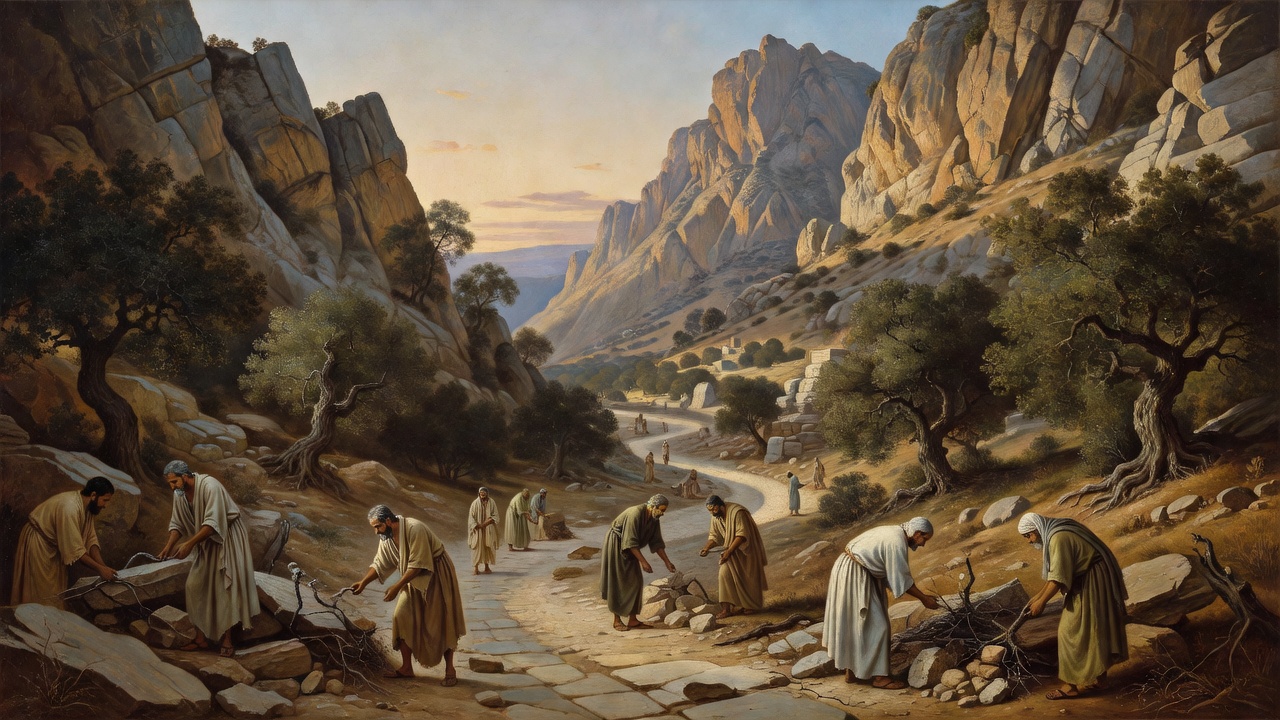
Build ye [a road], build ye [a road], prepare the Derech,
remove the michshol (stumblingblock, obstacle)
from the Derech Ami (the Way, Road of My People).
15For thus saith the High and Exalted,
Shokhen Ad (the One Who abideth forever, i.e., Who inhabits eternity), Kadosh Shmo:
I dwell in marom v'kadosh (the high and holy place),
with him also that is of a contrite and lowly ruach,
to revive the ruach of the shefalim (humble, lowly ones)
and to revive the lev nidka'im (contrite of heart).
16For I will not contend l'olam (forever),
neither will I lanetzach (always) be in wrath;
for the ruach (spirit) would grow faint before Me,
even the neshamot (souls) which I have made.
17For the avon (iniquity) of his covetousness
was I in wrath, and struck him;
I hid, and was in wrath,
and he went on shovav (backsliding)
in the derech of his lev (heart).
18I have seen the drakhim of him,
and will heal him; I will lead him also,
and restore nichumim (comforts)
unto him and to his avelim (mourners).
19I create the [repentant] fruit of the lips;
Shalom, shalom to him that is far off,
and to him that is near, saith Hashem;
and I will heal him.
20But the resha'im are like the troubled yam (sea),
when it cannot sheket (be quiet),
whose mayim cast up mire and mud.
21There is no shalom, saith Elohai,
for the resha'im.
Você sabia?
A idolatria denunciada e consolo para os contritos
- O capítulo repreende severamente práticas idólatras específicas, incluindo ritos sob carvalhos sagrados, libações a pedras lisas nos vales e sacrifícios de crianças nas fendas das rochas.Fontes: o próprio texto bíblico
- Em contraste com divindades distantes, o texto apresenta o Deus eterno e santo como Aquele que habita não apenas em um lugar alto e sagrado, mas também com os oprimidos, humildes e contritos de espírito para restaurá-los.Fontes: o próprio texto bíblico
Notas escritas com auxílio de IA a partir de fontes abertas (Theographic Bible Metadata, CC BY-SA 4.0; Easton’s Bible Dictionary, domínio público) e revisadas antes de publicar.
Créditos e licença desta tradução
The Orthodox Jewish Bible
The Orthodox Jewish Bible - Tanakh and Orthodox Jewish Brit Chadasha - The Holy Bible
copyright © 2002-2011, 2021, 2024 Artists for Israel International
Language: English
Contributor: Artists for Israel International
THE ORTHODOX JEWISH TANAKH
Artists For Israel Intl Inc.
This version also appears with the Orthodox Yiddish Triglot which presents the Hebrew Yiddish script in Latin script and an English word for word translation, available at afii.org/Torah
To donate PayPal.Me
This translation is made available to you under the terms of the
Creative Commons Attribution license 4.0.
You may share and redistribute this Bible translation or extracts from it in any format, provided that:
You include the above copyright and source information.
If you make any changes to the text, you must indicate that you did so in a way that makes it clear that the original licensor is not necessarily endorsing your changes.
Pictures included with Scriptures and other documents on this site are licensed just for use with those Scriptures and documents.
For other uses, please contact the respective copyright owners.
Note that in addition to the rules above, revising and adapting God's Word involves a great responsibility to be true to God's Word. See Revelation 22:18-19.
2026-01-06
Títulos de seção adaptados da Berean Standard Bible (domínio público); não fazem parte do texto bíblico desta tradução.
Fonte: http://ebible.org/engojb/ · eBible.org