Hebreus 11
The Orthodox Jewish Bible · Toque num versículo para ver as referências cruzadas.
Faith and Assurance
1Now Emunah is the substance of things for which we have tikvah. Emunah is the conviction of things not seen. 2For by Emunah have our Zekenim been given approval. 3By Emunah we have binah Shomayim v'ha'Aretz found their “barah” from the Dvar Hashem, so that not from anything visible has what we see come into being.
The Faith of Abel, Enoch, Noah
4By Emunah Hevel (Abel) offered to Hashem a korban that was a mincha tovah than that of Kayin. Through this he was given approval that he was a tzaddik, Hashem bearing solemn eidus (testimony) to his matanot; and by his Emunah, Hevel, though niftar (deceased), still speaks. 5By Emunah Chanokh was taken up, was translated, not to see mavet, V'EINENNU KI LAKACH OTO ELOHIM (and he was not, because G-d took him [up]). Before Chanokh was raptured in his aliyah l'Shomayim, he received solemn eidus (testimony) that he had been pleasing to Hashem. 6And without Emunah it is impossible to please Hashem. For it is necessary for the one making a kiruv approach to Hashem to have Emunah in the fact that yesh Elohim (G-d is there), and that Elohim gives sachar (reward) to those who seek him with zerizut. 7By Emunah Noach, having been warned about the things not yet visible to the eye of flesh, and being an ish of yirat Shomayim, built the Teva (Ark) for the Geulah of the Beis HaNoach. By his Emunah he condemned the Olam Hazeh and he became the yoresh (heir) of the Tzedek Hashem that is credited to Emunah.
The Faith of Abraham and Sarah
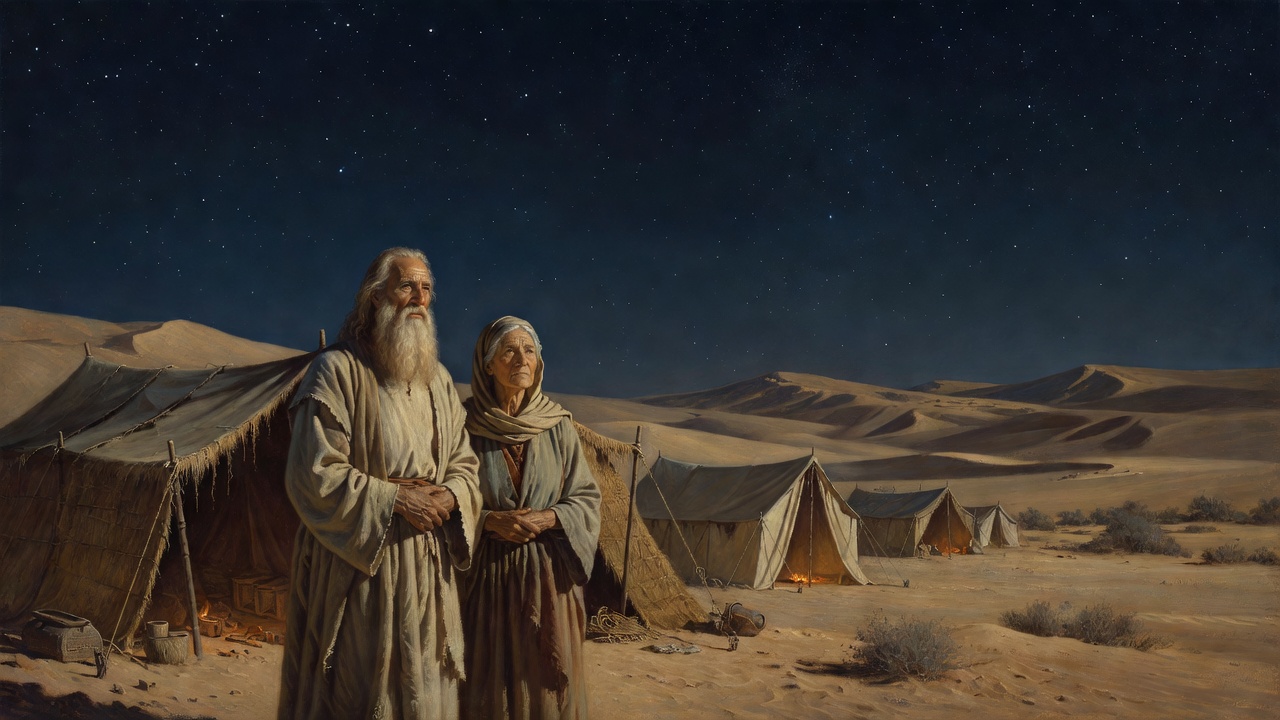
8By Emunah Avraham Avinu, when he was called to go out to a place which he was about to receive as a nachalah (inheritance), responded with mishma'at (obedience), and he went out, not having da'as of where he was going. 9By Emunah he made aliyah to HA'ARETZ ASHER DIBER (the land that He promised), Ha'aretz haHavtacha (the Promised Land), as in an eretz zarah (a strange land), living in oholim (tents), as did Yitzchak and Ya'akov, the fellow yorshim (heirs) of the same havtachah (promise); 10For Avraham Avinu was looking forward to the Shtetl having a yesod Olam (eternally firm foundation), whose Planner and Builder is Hashem. 11By Emunah also Sarah, herself barren, received the ability to found a posterity, and she did so even beyond the normal age, als (since) she considered ne'eman (faithful) the One having given the Havtachah (promise); 12therefore, also, from one man were born and indeed this man was kimat (practically, as good as) dead many, as numerous as HAKOKHAVIM in HASHOMAYIM and as innumerable as the sand ASHER AL SEFAT (“that is on the seashore”).
13Yet all of these became niftarim (deceased) in Emunah, not having received the havtachot (promises), but having seen them and, as it were, they gave the havtachot a “Baruch Habah!” welcome from a distance, and they made the Ani Ma'amin hoda'ah (confession) that they were GERIM (strangers) and TOSHAVIM (sojourners) in the Golus of the Olam Hazeh. 14For those saying such things make it clear that they are searching for an Eretz Moshav. 15And if they were remembering ha'aretz from which they made aliyah, they would have had an opportunity to make yerida (to descend back, return). 16But, as it is, they aspire for something better, an Eretz HaAvot b'Shomayim; therefore, Hashem is not ashamed to be called Ehoheihem, for he prepared for them an Ir Kodesh.
17By Emunah Avraham Avinu, when he underwent nisayon, offered up the Akedas HaYitzchak; and he who had received the Havtachot (Promises) was offering as a korban his Ben Yechid. 18This was Avraham Avinu, about whom it was said KI VEYITZCHAK YIKARE LECHA ZERA (In Yitzchak will be called your seed). 19Avraham Avinu considered that Hashem was able to bring about the Techiyas HaMesim, from which he also received back Yitzchak as a tipus (type, pattern).
The Faith of Isaac, Jacob, and Joseph
20By Emunah Yitzchak invoked brachot with respect to future events on Ya'akov and Esav. 21By Emunah Ya'akov, as he was dying, gave a bracha to each of the banim of Yosef and V'YISHTAKHU YISROEL (And Yisroel worshiped). 22By Emunah Yosef, as he was dying, dermohn (made mention) of the Yetzi'at Bnei Yisroel (the Going Out, the Exodus of Bnei Yisroel) and he gave instructions concerning his ATZMOT (bones).
The Faith of Moses
23By Emunah, Moshe Rabbeinu, when he was born, was hidden SHELOSHA CHODESHIM (three months) because they saw he was a yeled TOV and they had no pachad (terror) at the kingʼs decree. 24By Emunah, Moshe Rabbeinu, when he had grown, refused to be called the son of Pharaohʼs daughter; 25Choosing rather to endure redifah (persecution) with the Am Hashem than to enjoy the ephemeral ta'anugot (pleasures) of averos for a season. 26For Moshe Rabbeinu considered abuse and tzoros for the sake of Rebbe, Melech HaMoshiach greater osher (riches) than the otzar (treasure) of Mitzrayim (Egypt), for he had respect unto the recompense of the sachar (reward). 27By Emunah, Moshe Rabbeinu departed from Mitzrayim (Egypt), not having pachad (fear) of the ka'as (anger) of the king, for he persevered as seeing the One who is unseen. 28By Emunah, Moshe Rabbeinu kept Pesach and the sprinkling of the dahm [on the mezuzot], for fear that the Destroyer of the Bechorim might destroy them.
29By Emunah, they went through the Yam Suf as on YABASHAH (dry ground); and those of Mitzrayim (Egypt), when they attempted it, were drowned.
The Faith of Many
(Joshua–Malachi)
30By Emunah, the walls of Yericho fell down, after they had been encircled for shivat yamim. 31By Emunah, Rachav the Zonah did not perish along with the ones without mishma'at (obedience), after she gave the kabbalat panim to the spies b'shalom.
32And what more shall I say? For the time will fail me if I tell of Gid'on, Barak, Shimshon, Yiftach, Dovid, Shmuel and the Nevi'im, 33Who by Emunah conquered mamlechot (kingdoms), worked tzedek (righteousness), obtained havtachot (promises), shut the mouths of arayot (lions), 34Quenched the power of eish (fire), escaped from the edge of the cherev (sword), out of weakness found strength, became mighty in milchamah (war), put to flight tzive'ot zarim (armies of the aliens). 35Nashim received back their mesim restored to Chayyim; and others were tortured to death al kiddush ha-Shem, not accepting their release, in order that they might obtain a better Techiyas HaMesim; 36And others underwent the nisayon of cruel mockings and scourgings, also the sharsherot (chains) and the beis hasohar. 37They were killed by seqilah (stoning), they were sawn in two, they were murdered by the cherev, they went about in sheepskins, in goatskins, being nitzrach (needy) and destitute, oppressed, under redifot (persecutions), 38those of whom the Olam Hazeh was not worthy, wandering in deserts and mountains and caves of the earth.
39And all these, having Hashemʼs commendation through their Emunah, did not receive the havtachah (promise), 40Hashem having foreseen something better for us, so that, apart from us, they should not be made shleimut.
Você sabia?
Exemplos de fé ao longo da história
- Hebreus 11 define a fé como a certeza das coisas que se esperam e a convicção de fatos que não se veem, apresentando um panorama cronológico de personagens desde Gênesis até a era dos profetas.Fontes: o próprio texto bíblico
- O capítulo destaca Abraão, Isaque e Jacó habitando em tendas como forasteiros na terra prometida, retratando a vida nômade deles como sinal de expectativa por uma cidade celestial permanente.Fontes: Abraham · Isaac · Jacob (Israel) · o próprio texto bíblico
- O autor percorre momentos decisivos da história de Israel, incluindo a renúncia de Moisés às riquezas do Egito, a travessia do mar Vermelho e a queda das muralhas de Jericó.Fontes: Egypt · Red Sea · Jericho
Notas escritas com auxílio de IA a partir de fontes abertas (Theographic Bible Metadata, CC BY-SA 4.0; Easton’s Bible Dictionary, domínio público) e revisadas antes de publicar.
Lugares deste capítulo
- Egypt · 30.129, 31.308 · versículos 22, 26, 27
- Jericho · Hoje: Tell es Sultan · 31.872, 35.445 · versículo 30
Só aparecem lugares com identificação de alta confiança (90% ou mais segundo as fontes acadêmicas reunidas pelo OpenBible). Mapa da época: DARE (Digital Atlas of the Roman Empire), CC BY 4.0; mapa atual: © colaboradores do OpenStreetMap; lugares: OpenBible.info (CC BY 4.0).
Créditos e licença desta tradução
The Orthodox Jewish Bible
The Orthodox Jewish Bible - Tanakh and Orthodox Jewish Brit Chadasha - The Holy Bible
copyright © 2002-2011, 2021, 2024 Artists for Israel International
Language: English
Contributor: Artists for Israel International
THE ORTHODOX JEWISH TANAKH
Artists For Israel Intl Inc.
This version also appears with the Orthodox Yiddish Triglot which presents the Hebrew Yiddish script in Latin script and an English word for word translation, available at afii.org/Torah
To donate PayPal.Me
This translation is made available to you under the terms of the
Creative Commons Attribution license 4.0.
You may share and redistribute this Bible translation or extracts from it in any format, provided that:
You include the above copyright and source information.
If you make any changes to the text, you must indicate that you did so in a way that makes it clear that the original licensor is not necessarily endorsing your changes.
Pictures included with Scriptures and other documents on this site are licensed just for use with those Scriptures and documents.
For other uses, please contact the respective copyright owners.
Note that in addition to the rules above, revising and adapting God's Word involves a great responsibility to be true to God's Word. See Revelation 22:18-19.
2026-01-06
Títulos de seção adaptados da Berean Standard Bible (domínio público); não fazem parte do texto bíblico desta tradução.
Fonte: http://ebible.org/engojb/ · eBible.org