Gálatas 2
The Orthodox Jewish Bible · Toque num versículo para ver as referências cruzadas.
The Council at Jerusalem
1Then, after arbah esrey shanim (fourteen years), again I went up to Yerushalayim with Bar-Nabba, having taken with me also Titos. 2Yet I went up according to a chazon (revelation), and I laid before them the Besuras HaGeulah which I proclaim among the Goyim, but I did this privately to the men of repute, lest I should run, or should prove to have run, L'TOHU (in vain). 3But Titos, the one with me, a Yevani (Greek), was not compelled to undergo bris milah. 4But because of the achei sheker (false brothers) b'Moshiach, the ones secretly brought in, the ones who crept in to spy out our DEROR (freedom) which we have in Moshiach Yehoshua al menat (in order that) they might enslave us. 5To these enslavers not for one hour did we yield in subjection, that HaEmes of the Besuras HaGeulah might continue and remain with you. 6But from the men of repute whatever they once were matters nothing to me, ki ein masso panim im Hashem (for there is no respect of persons with G-d, no partiality), for to me these men of repute added nothing. 7But, on the contrary, having seen that I have been entrusted with the Besuras HaGeulah for those without the bris milah, just as Kefa was for those with the bris milah, 8For the One having worked in Kefa for a Shlichus to those with the bris milah also worked in me for a Shlichus to the Goyim. 9And realizing the Chen v'Chesed Hashem having been given to me, Ya'akov and Kefa and Yochanan, the men of repute, the ones seeming to be Ammudei HaKehillah (Pillars of the Kehillah), extended to me and to Bar-Nabba the yad yeminam (right hands) as a sign of Achavah B'Moshiach (Brotherhood in Moshiach), that we should be for those of the Goyim, but they for those of the bris milah, 10Only that we should remember the Aniyim (the Poor), the very thing which I was also eager to do.
Paul Confronts Cephas
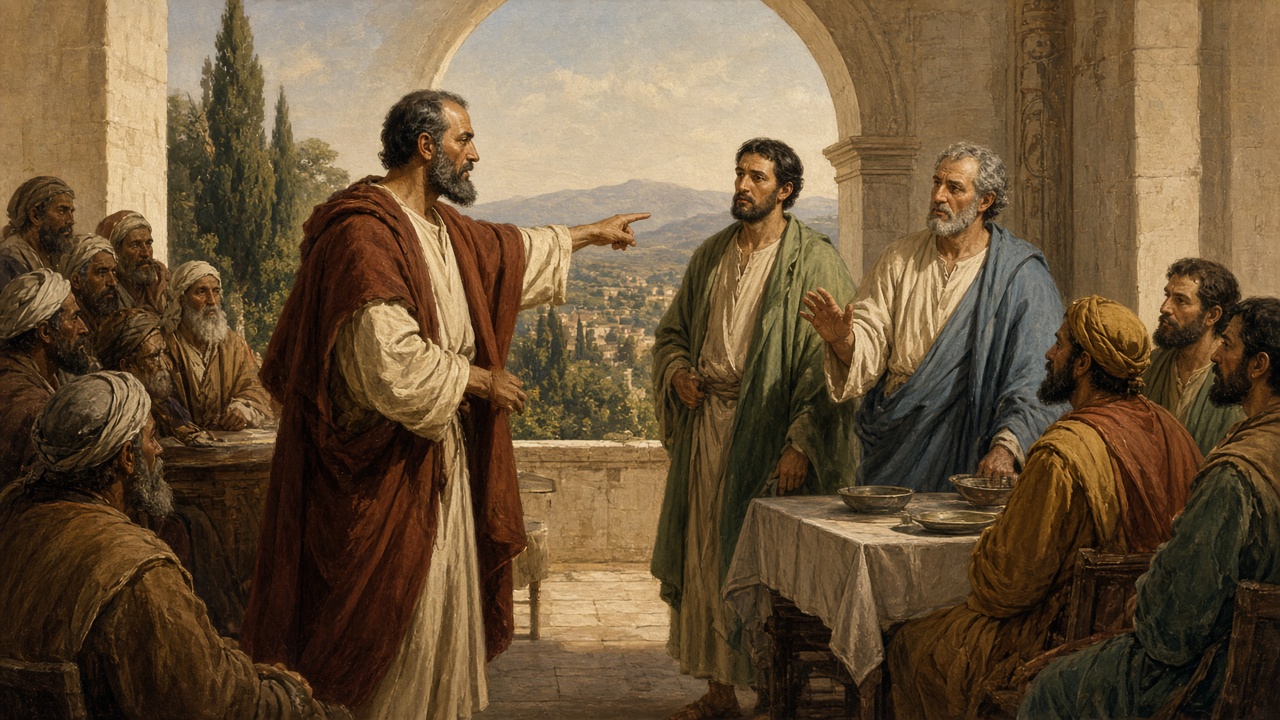
11But when Kefa came to Antioch, I stood against him to his face, because there was found in him a dvar ashmah (a thing of guilt, condemnation). 12For, before certain ones came from Ya'akov, Kefa was as a matter of course sitting at tish at betzi'at halechem (breaking of bread) at the Seudos Moshiach with the Goyim; but, when they came, Kefa drew back and was separating himself, fearing the ones of the bris milah. 13And the rest of the Yehudim who were ma'aminim b'Moshiach joined with Kefa in this dissembling, so that even Bar-Nabba was carried away with their tzevi'ut (hypocrisy). 14But when I saw that their halichah, their hitnahagut (conduct) was not the Derech HaYashar (Straight Way) with respect to HaEmes of HaBesuras HaGeulah, I said to Kefa before all, “If you, being a Yehudi, have a hitnahagut that is according to the Derech Goyim and not the Derech Yehudim, how do you compel the Goyim to live as the Yehudim?” 15We ourselves are Yehudim by birth and not Goyishe chote'im (sinners). 16Yet we have da'as that a man cannot be YITZDAK IM HASHEM (be justified with G-d) by [depending on] the ma'asim of Gezetz (Law), but through emunah in Rebbe, Melech HaMoshiach Yehoshua. And we have come to have bitachon in Rebbe, Melech HaMoshiach Yehoshua, that we can be YITZDAK IM HASHEM (be justified with G-d) by emunah in Moshiach and not by ma'asim, because by taryag mitzvot KOL CHAI LO YITZDAK (all living shall not be justified).
17Now, if, by seeking to be YITZDAK IM HASHEM in Moshiach, we ourselves were found also to be chote'im (sinners), then in that case is Moshiach a kohen for iniquity, a minister serving sin? Chas v'Shalom (G-d forbid)! 18For if what I destroyed, these things I again rebuild, I display myself to be a poshei'a (transgressor). 19For I, through the Torah, died in relation to the gezetz, so that I might live to Hashem. With Moshiach I have been talui al haetz (hanging on the tree). 20But it is no longer Anochi (I) who lives, but Moshiach who lives in me, and the Chayyim I now live in the basar, I live by emunah, emunah in the Zun fun der Oybershter, the one having ahavah (agape) for me and having given himself over, on my behalf. 21I do not set aside the Chen v'Chesed Hashem; for if the MAH (how) an ENOSH (man) is to be YITZDAK IM HASHEM is found through Gezetz chumra, then Moshiach died for nothing and L'TOHU (in vain).
Você sabia?
Gentios, comunhão e um confronto em Antioquia
- Tito foi com Paulo e Barnabé a Jerusalém. O Easton's Bible Dictionary (1897) diz que ele parece ter sido gentio e que seu nome não aparece em Atos. Paulo escreve que Tito, embora fosse grego, não foi obrigado a circuncidar-se.Fontes: Titus · o próprio texto bíblico
- O confronto posterior ocorreu em Antioquia da Síria, às margens do Orontes, a umas trezentas milhas ao norte de Jerusalém. A cidade ocupava o terceiro lugar entre as cidades do Império Romano, depois de Roma e Alexandria, e foi ali que os crentes foram chamados cristãos pela primeira vez.Fontes: Antioch (Syria) · o próprio texto bíblico
- O Easton's Bible Dictionary (1897) descreve Tiago, citado com Cefas e João como um dos pilares, como cabeça da igreja em Jerusalém, onde presidiu o concílio sobre os gentios. Paulo diz que, antes de chegarem certos homens da parte de Tiago, Cefas costumava comer com os gentios, mas depois se afastou por medo do grupo da circuncisão.Fontes: James (Brother of Jesus) · o próprio texto bíblico
Notas escritas com auxílio de IA a partir de fontes abertas (Theographic Bible Metadata, CC BY-SA 4.0; Easton’s Bible Dictionary, domínio público) e revisadas antes de publicar.
Lugares deste capítulo
- Jerusalem · 31.777, 35.234 · versículo 1
- Antioch · Hoje: Antioch on the Orontes · 36.227, 36.172 · versículo 11
Só aparecem lugares com identificação de alta confiança (90% ou mais segundo as fontes acadêmicas reunidas pelo OpenBible). Mapa da época: DARE (Digital Atlas of the Roman Empire), CC BY 4.0; mapa atual: © colaboradores do OpenStreetMap; lugares: OpenBible.info (CC BY 4.0).
Créditos e licença desta tradução
The Orthodox Jewish Bible
The Orthodox Jewish Bible - Tanakh and Orthodox Jewish Brit Chadasha - The Holy Bible
copyright © 2002-2011, 2021, 2024 Artists for Israel International
Language: English
Contributor: Artists for Israel International
THE ORTHODOX JEWISH TANAKH
Artists For Israel Intl Inc.
This version also appears with the Orthodox Yiddish Triglot which presents the Hebrew Yiddish script in Latin script and an English word for word translation, available at afii.org/Torah
To donate PayPal.Me
This translation is made available to you under the terms of the
Creative Commons Attribution license 4.0.
You may share and redistribute this Bible translation or extracts from it in any format, provided that:
You include the above copyright and source information.
If you make any changes to the text, you must indicate that you did so in a way that makes it clear that the original licensor is not necessarily endorsing your changes.
Pictures included with Scriptures and other documents on this site are licensed just for use with those Scriptures and documents.
For other uses, please contact the respective copyright owners.
Note that in addition to the rules above, revising and adapting God's Word involves a great responsibility to be true to God's Word. See Revelation 22:18-19.
2026-01-06
Títulos de seção adaptados da Berean Standard Bible (domínio público); não fazem parte do texto bíblico desta tradução.
Fonte: http://ebible.org/engojb/ · eBible.org