Ezequiel 41
The Orthodox Jewish Bible · Toque num versículo para ver as referências cruzadas.
Inside the Temple
1Afterward he brought me to the Heikhal, and measured the jambs, six cubits wide on the one side, and six cubits wide on the other side, which was the width of the Ohel. 2And the width of the Petach (Entrance) was ten cubits; and the ketefot (shoulders, sidewalls) of the Petach were five cubits on the one side, and five cubits on the other side; and he measured the depth thereof, forty cubits; and the width, twenty cubits. 3Then he went into the Penimah (the Innermost ), and measured the jamb of the Petach, two cubits; and the Petach, six cubits; and the width of the Petach, sheva (seven) cubits. 4So he measured the depth thereof, twenty cubits; and the width, twenty cubits, along the Heikhal; and he said unto me, This is the Kodesh HaKodashim.
Outside the Temple
5After he measured the wall of the Beis, six cubits; and the width of every tzela (side chamber, cell), four cubits, around the Beis on every side. 6And the tzela'ot (side chambers, cells) were tzela over tzela, thirty-three in number; and there were ledges on the wall which was of the Beis for the tzela'ot round about, that they might take hold there, but they had not hold in the wall of the Beis. 7And tzela'ot (side chambers, cells) were broader at each story; a ramp spiraled upward by stages around the Beis; therefore the width of the Beis increased as it went upward, so from the lowest to the highest through the middle. 8I saw also the height of the Beis all around; the yesodot (foundations) of the tzela'ot were a full rod of six cubits long. 9The thickness of the wall, which was for the tzela toward the outside, was five cubits; and that which was open was the space at the end of the tzela'ot of the Beis. 10And between the leshakhot was the space the width of twenty cubits around the Beis all around. 11And the petach of the tzela were toward the space that was open, one petach toward the north, and another petach toward the south; and the width of the place that was open was five cubits all around.
12Now the Binyan (building, structure) that was before the Gizrah (separation, separating courtyard, restricted space, behind the Beis HaMikdash) at the end toward the west was seventy cubits wide; and the wall of the Binyan was five cubits thick all around, and the length thereof ninety cubits.
13So he measured the Beis, a hundred cubits long; and the Gizrah, and the Binyan, with the walls thereof, a hundred cubits long; 14Also the width of the face of the Beis, and of the Gizrah toward the east, a hundred cubits.
The Interior Structures
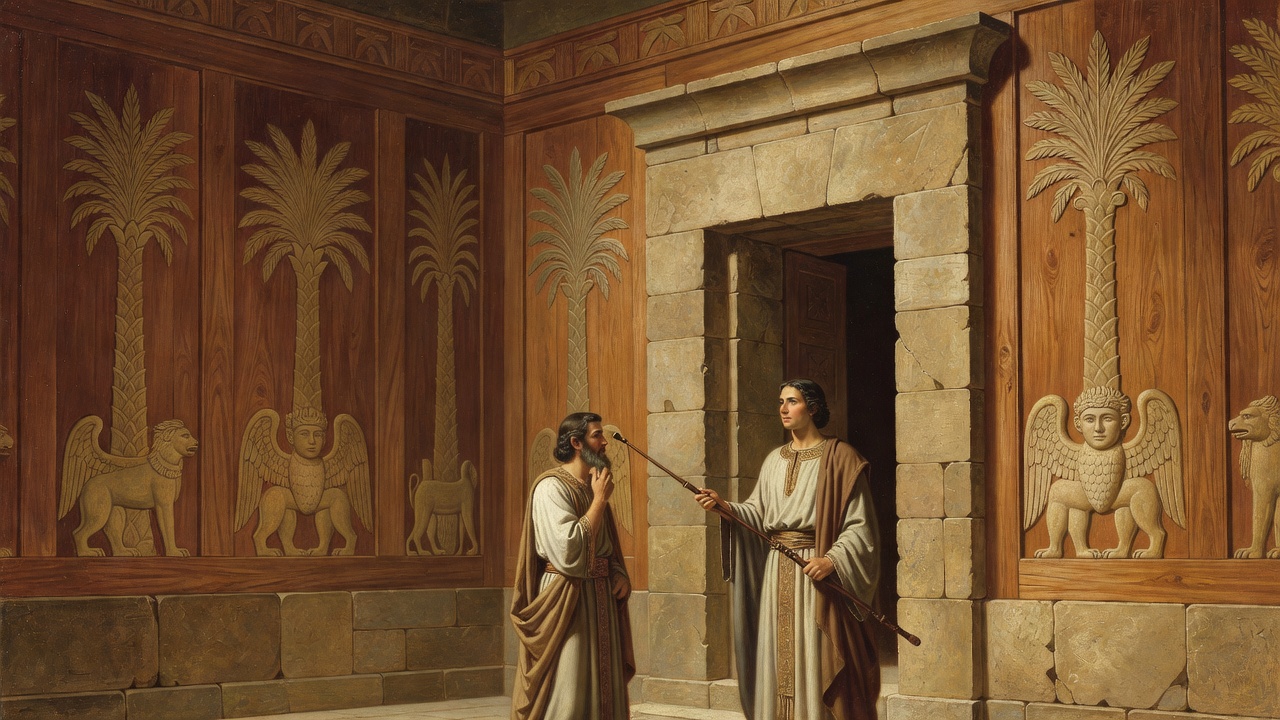
15And he measured the length of the Binyan along the front of the Gizrah which was behind it, and the atikeha (corner structures) thereof on the one side and on the other side, a hundred cubits, with the Heikhal Hapenimi, and the ulam vestibules of the Khatzer; 16The doorposts, and the narrow chalonim, and the atikim balconies around on their three stories, opposite the saf (threshold), paneled with etz all around, and from the ground up to the chalonot, and the chalonot were covered; 17To that above the Petach, even unto the Beis HaPenimi, and at the outside, and by the wall all around penimi (inner) and khitzon (outer), by measure. 18And it was carved with keruvim and timorim, so that a palm tree was between a keruv and a keruv; and every keruv had two faces; 19So that the face of an adam was toward the palm tree on the one side, and the face of a young lion toward the palm tree on the other side; it was carved throughout kol HaBeis all around. 20From the ground unto above the Petach were keruvim and timorim carved, and on the wall of the Heikhal.
21The mezuzas of the Heikhal were squared; as for the front of the Kodesh [HaKodashim], the appearance of the one [mezuzah] was like the appearance of the other. 22The Mizbe'ach was of etz and was three cubits high, and the length thereof two cubits; and the corners thereof, and the length thereof, and the sides thereof, were of etz; and he said unto me, This is the shulchan that is before Hashem. 23And the Heikhal and the Kodesh had two delatot. 24And the delatot had two doors apiece, two turning doors; two delatot for the one door, and two delatot for the other door. 25And there were carved on them, on the delatot of the Heikhal, keruvim and timorim, like those carved upon the walls; and there was a beam upon the face of the Ulam at the outside. 26And there were narrow chalonim and timorim on the one side and on the other side, on the sides of the Ulam, and upon the tzela'ot of the Beis, and thick beams.
Você sabia?
O Interior do Templo Visionário
- O santuário na visão de Ezequiel é dividido em duas seções principais: um santuário exterior medindo quarenta por vinte côvados e uma sala interior de vinte côvados quadrados, identificada como o Lugar Santíssimo.Fontes: o próprio texto bíblico · Most Holy Place
- As paredes internas e as portas duplas eram revestidas de madeira e entalhadas com palmeiras e querubins alternados. Cada querubim foi retratado com dois rostos: o de um ser humano voltado para uma palmeira e o de um leão jovem voltado para a outra.Fontes: o próprio texto bíblico
- Três andares de câmaras laterais cercavam o templo, com trinta quartos em cada nível. As estruturas apoiavam-se em saliências externas para que os suportes não precisassem ser fixados diretamente na parede do próprio templo.Fontes: o próprio texto bíblico
Notas escritas com auxílio de IA a partir de fontes abertas (Theographic Bible Metadata, CC BY-SA 4.0; Easton’s Bible Dictionary, domínio público) e revisadas antes de publicar.
Lugares deste capítulo
- Most Holy Place · Hoje: on Mount Moriah · 31.778, 35.236 · versículo 4
- Holy Place · Hoje: on Mount Moriah · 31.778, 35.236 · versículos 21, 23
Só aparecem lugares com identificação de alta confiança (90% ou mais segundo as fontes acadêmicas reunidas pelo OpenBible). Mapa da época: DARE (Digital Atlas of the Roman Empire), CC BY 4.0; mapa atual: © colaboradores do OpenStreetMap; lugares: OpenBible.info (CC BY 4.0).
Créditos e licença desta tradução
The Orthodox Jewish Bible
The Orthodox Jewish Bible - Tanakh and Orthodox Jewish Brit Chadasha - The Holy Bible
copyright © 2002-2011, 2021, 2024 Artists for Israel International
Language: English
Contributor: Artists for Israel International
THE ORTHODOX JEWISH TANAKH
Artists For Israel Intl Inc.
This version also appears with the Orthodox Yiddish Triglot which presents the Hebrew Yiddish script in Latin script and an English word for word translation, available at afii.org/Torah
To donate PayPal.Me
This translation is made available to you under the terms of the
Creative Commons Attribution license 4.0.
You may share and redistribute this Bible translation or extracts from it in any format, provided that:
You include the above copyright and source information.
If you make any changes to the text, you must indicate that you did so in a way that makes it clear that the original licensor is not necessarily endorsing your changes.
Pictures included with Scriptures and other documents on this site are licensed just for use with those Scriptures and documents.
For other uses, please contact the respective copyright owners.
Note that in addition to the rules above, revising and adapting God's Word involves a great responsibility to be true to God's Word. See Revelation 22:18-19.
2026-01-06
Títulos de seção adaptados da Berean Standard Bible (domínio público); não fazem parte do texto bíblico desta tradução.
Fonte: http://ebible.org/engojb/ · eBible.org