Ezequiel 17
The Orthodox Jewish Bible · Toque num versículo para ver as referências cruzadas.
The Parable of Two Eagles and a Vine
1And the Devar Hashem came unto me, saying: 2Ben adam, put forth an allegory, and speak a mashal unto the Bais Yisroel; 3And say, Thus saith Adonoi Hashem: A nesher hagadol with great kenafayim (wings), long pinions, full of plumage, which had various colors, came unto Levanon, and took the highest branch of the cedar. 4He broke off its topmost young twig, and carried it into an eretz kena'an (land of trade); he set it in a city of merchants. 5He took also of the zera of ha'aretz, and planted it in a fertile sadeh; he placed it by abundant mayim, and set it out like a willow tree. 6And it yitzmach (sprouted), and became a spreading gefen of low stature, whose branches turned toward him, and the roots thereof were under him; so it became a gefen (vine), and brought forth branches, and shot forth sprigs.
7There was also another nesher hagadol with great kenafayim (wings) and many feathers; and, hinei, this gefen (vine) did bend her roots toward him, and shot forth her branches toward him, that he might water it by the furrows where it had been planted. 8It was planted in a sadeh tov by mayim rabbim, that it might bring forth branches, and that it might bear p'ri, that it might be a majestic gefen.
9Say thou, Thus saith Adonoi Hashem: Shall it thrive? Shall he not pull up the shorashim (roots) thereof, and cut off the p'ri (fruit) thereof, that it wither? All of its tzemach (sprouted) leaves shall wither, even without great power or many peoples to pluck it up by the shorashim (roots) thereof. 10Indeed, hinei, being transplanted, shall it thrive? Shall it not utterly wither, when the east wind toucheth it? It shall wither in the furrows where it tzemach (sprouted).
The Parable Explained
11Moreover the Devar Hashem came unto me, saying, 12Say now to bais hameri (the rebellious house), Know ye not what these things mean? Tell them: Hinei, Melech Bavel is come to Yerushalayim, and hath taken HaMelech thereof, and the sarim thereof, and led them with him to Bavel; 13And hath taken of the royal zera, and cut a Brit with him, and hath taken an oath of him; he hath also taken away the mighty of ha'aretz; 14That the mamlachah (kingdom) might be abased, that it might not exalt itself, but that by being shomer over his brit it might stand. 15But he rebelled against him in sending his malachim into Mitzrayim, that they might give him susim and much people. Shall he prosper? Shall he escape that doeth such things? Or shall he break the brit (covenant), and be delivered?
16As I live, saith Adonoi Hashem, surely in the makom where the melech dwelleth that made him melech, whose oath he despised, whose brit he broke, even with him in the midst of Bavel he shall die. 17Neither shall Pharaoh with his mighty army and great kahal do anything for him in the milchamah, by casting up siege mounds, and building siegework, to cut off many nefashot. 18Seeing he despised the oath by breaking the brit, when, hinei, he had given his yad, and still did all these things, he shall not escape. 19Therefore thus saith Adonoi Hashem; As I live, surely Mine oath that he hath despised, and My Brit (covenant) that he hath broken, even it will I repay upon his own rosh. 20And I will spread My net upon him, and he shall be caught in My snare, and I will bring him to Bavel, and will execute justice on him there for his ma'al (unfaithfulness) that he hath been unfaithful against Me. 21And all his fugitives with all his troops shall fall by the cherev, and they that survive and remain shall be scattered toward kol ruach (all winds); and ye shall know that I Hashem have spoken it.
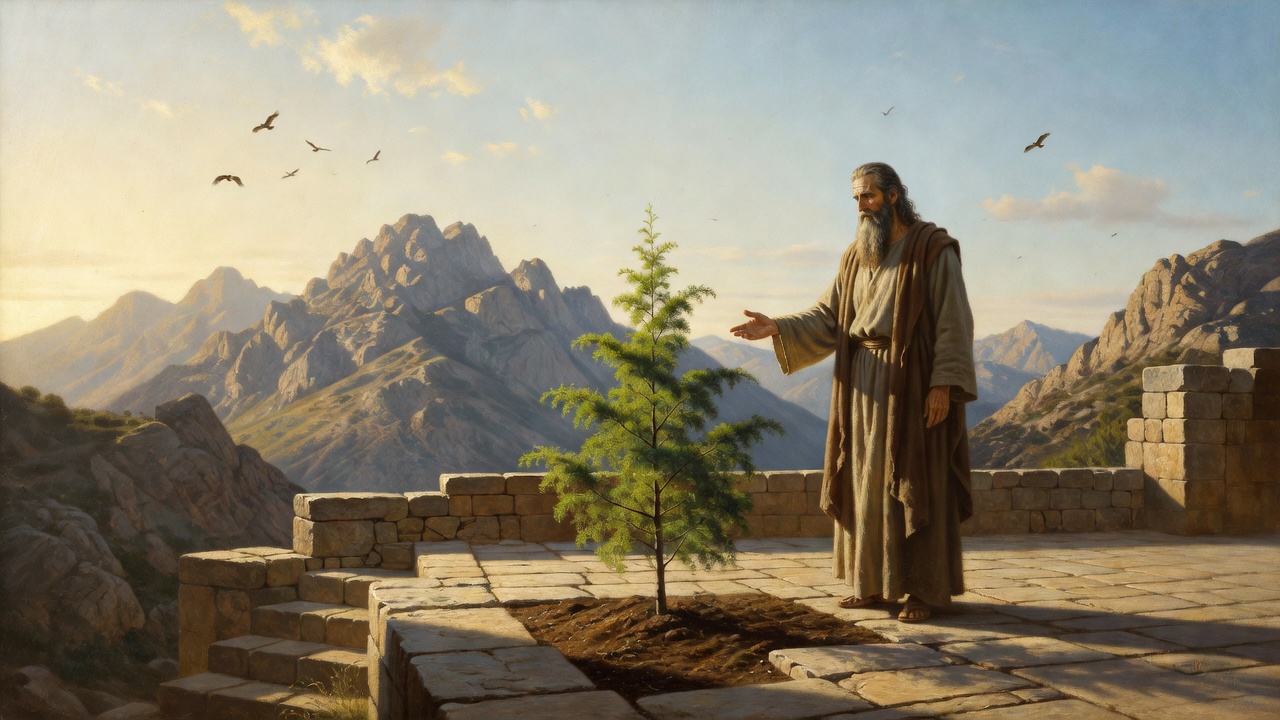
22Thus saith Adonoi Hashem: I will also take of the highest branch of the high cedar, and will plant it; I will break off from the top of its young twigs a tender one, and will plant it upon a high mountain and prominent; 23On the high mountain of Yisroel will I plant it; and it shall bring forth boughs, and bear p'ri (fruit), and be a majestic cedar; and under it shall dwell kol tzippor (every bird) of every wing; in the tzel (shadow) of the branches thereof shall they dwell. 24And all the trees of the sadeh shall know that I Hashem have brought down the high etz (tree), have exalted the low etz (tree), have dried up the green etz (tree), and have made the etz yavesh (dry tree) to flourish. I Hashem have spoken and have done it.
Você sabia?
A parábola das águias e do cedro
- Ezequiel apresenta uma alegoria política em que a primeira grande águia representa o rei da Babilônia, que levou a liderança real de Jerusalém para o cativeiro e estabeleceu um rei vassalo sob uma aliança solene. A segunda águia representa o Egito e seu faraó, a quem o governante de Judá recorreu em busca de cavalos e auxílio militar, quebrando sua aliança.Fontes: o próprio texto bíblico · Babylon · Egypt · Pharaoh
- Na mensagem profética, romper um juramento de vassalagem firmado com a Babilônia foi considerado não apenas uma rebelião diplomática, mas uma traição espiritual contra Deus, que considerava o juramento prestado como Sua própria aliança.Fontes: o próprio texto bíblico
- O capítulo se encerra revertendo os planos políticos humanos: o próprio Deus promete tirar um renovo tenro do topo do cedro e plantá-lo nas alturas montanhosas de Israel, onde ele se tornará uma árvore majestosa que dará abrigo a aves de todo tipo.Fontes: o próprio texto bíblico
Notas escritas com auxílio de IA a partir de fontes abertas (Theographic Bible Metadata, CC BY-SA 4.0; Easton’s Bible Dictionary, domínio público) e revisadas antes de publicar.
Lugares deste capítulo
- Lebanon · 33.540, 35.584 · versículo 3
- Canaan · 32.767, 35.333 · versículo 4
- Babylon · 32.543, 44.422 · versículos 12, 14, 15, 16, 17, 20
- Jerusalem · 31.777, 35.234 · versículos 12, 17
- Egypt · 30.129, 31.308 · versículo 15
Só aparecem lugares com identificação de alta confiança (90% ou mais segundo as fontes acadêmicas reunidas pelo OpenBible). Mapa da época: DARE (Digital Atlas of the Roman Empire), CC BY 4.0; mapa atual: © colaboradores do OpenStreetMap; lugares: OpenBible.info (CC BY 4.0).
Créditos e licença desta tradução
The Orthodox Jewish Bible
The Orthodox Jewish Bible - Tanakh and Orthodox Jewish Brit Chadasha - The Holy Bible
copyright © 2002-2011, 2021, 2024 Artists for Israel International
Language: English
Contributor: Artists for Israel International
THE ORTHODOX JEWISH TANAKH
Artists For Israel Intl Inc.
This version also appears with the Orthodox Yiddish Triglot which presents the Hebrew Yiddish script in Latin script and an English word for word translation, available at afii.org/Torah
To donate PayPal.Me
This translation is made available to you under the terms of the
Creative Commons Attribution license 4.0.
You may share and redistribute this Bible translation or extracts from it in any format, provided that:
You include the above copyright and source information.
If you make any changes to the text, you must indicate that you did so in a way that makes it clear that the original licensor is not necessarily endorsing your changes.
Pictures included with Scriptures and other documents on this site are licensed just for use with those Scriptures and documents.
For other uses, please contact the respective copyright owners.
Note that in addition to the rules above, revising and adapting God's Word involves a great responsibility to be true to God's Word. See Revelation 22:18-19.
2026-01-06
Títulos de seção adaptados da Berean Standard Bible (domínio público); não fazem parte do texto bíblico desta tradução.
Fonte: http://ebible.org/engojb/ · eBible.org