Ester 4
The Orthodox Jewish Bible · Toque num versículo para ver as referências cruzadas.
Mordecai Appeals to Esther
1When Mordechai perceived all that was done, Mordechai rent his garments, and put on sackcloth with ashes, and went out into the midst of the city, and cried with a zeakah gedolah umarah (loud and a bitter wailing); 2And came even before the Sha'ar HaMelech; for none might enter into the Sha'ar HaMelech clothed with sackcloth.
3And in every province, whithersoever the Devar HaMelech and his dat (decree) came, there was evel gadol (great mourning) among the Yehudim, and a tzom, and weeping, and wailing; and many lay on sackcloth and ashes.
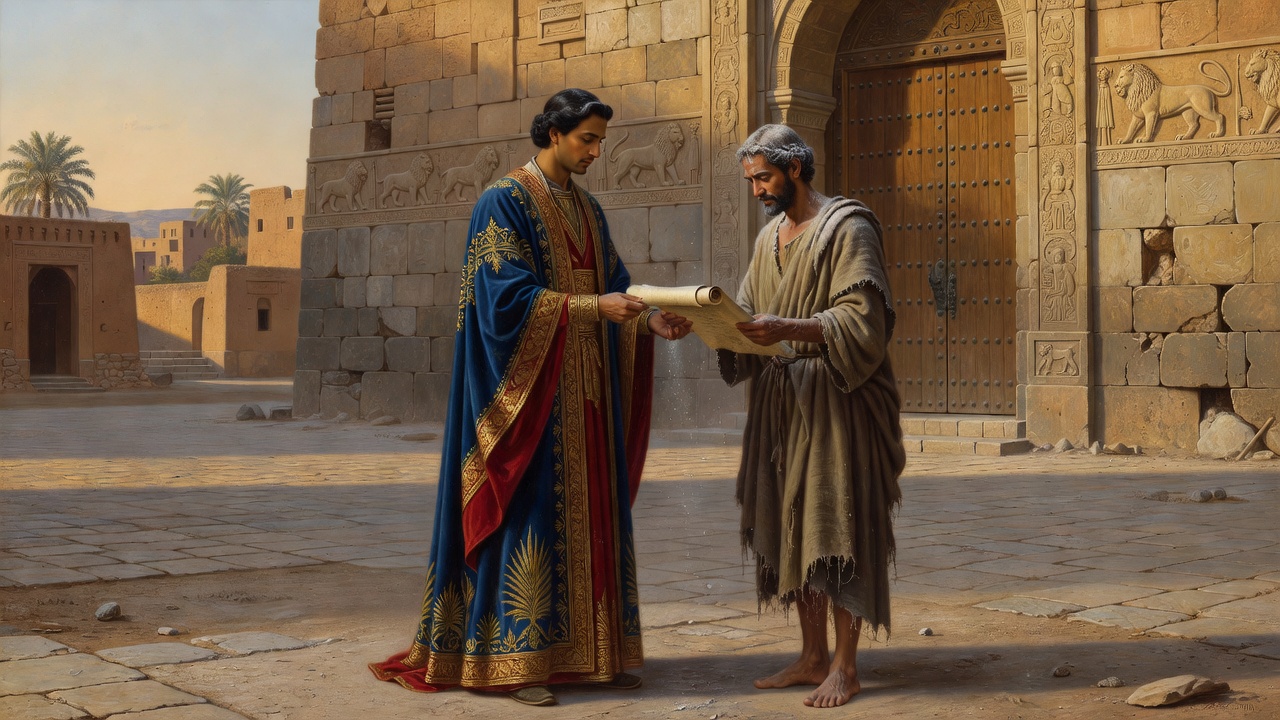
4So Esterʼs na'arot and her sarisim came and told it her. Then was HaMalkah exceedingly distressed; and she sent begadim (raiment) to clothe Mordechai, and to take away his sackcloth from him, but he received it not. 5Then called Ester for Hatach, one of the sarisim of HaMelech, whom he had appointed to attend upon her, and gave him a commandment about Mordechai, to have da'as of mah zeh (what is this?), and al mah zeh (why is this?)
6So Hatach went forth to Mordechai unto the rechov haIr (open square of the city), which was before the Sha'ar HaMelech. 7And Mordechai told him of all that had happened unto him, and of the parashat hakesef (exact amount of the money) that Haman had promised to pay to the genazim of HaMelech for the Yehudim, to destroy them. 8Also he gave him the copy of the edict of the dat (decree, Final Solution) that was published at Shushan to make them shmad, to show it unto Ester, and to declare it unto her, and to charge her that she should go in unto HaMelech, to make supplication unto him, and to make bakash (request, pleading) before him for her Am (People, the Jewish People).
9And Hatach came and told Ester the divrei Mordechai. 10Again Ester spoke unto Hatach, and gave him commandment unto Mordechai: 11All the avadim of HaMelech, and the people of the provinces of HaMelech have da'as that whosoever, whether ish or isha, shall come unto HaMelech into the pnimiyus khatzer (innermost courtyard), who is not called, there is echat dat (one law) of his to put him to death, except such to whom HaMelech shall hold out the sharvit hazahav (golden sceptre), that he may live. But I have not been called to come in unto HaMelech these shloshim yom.
12And they told to Mordechai Esterʼs words. 13Then Mordechai commanded to answer Ester, Think not with thyself that thou shalt escape in the Beis HaMelech, more than kol HaYehudim. 14For if thou altogether holdest thy peace at this time, then shall there revach (relief) and hatzalah (deliverance) arise to the Yehudim from another place; but thou and thy bais Avicha (house of thy father) shall be destroyed; and who knoweth whether thou art come to the Malkhut for such a time as this?
15Then Ester bade them return Mordechai this answer, 16Go, gather together kol HaYehudim that are found in Shushan, and declare ye a tzom for me, and neither eat nor drink shloshet yamim, lailah vayom. I also and my na'arot will undergo a tzom likewise; and so will I go in unto HaMelech, though it is not according to the dat; and if I perish, I perish.
17So Mordechai went his way, and did according to all that Ester had commanded him.
Você sabia?
A Decisão de Ester de Interceder por Seu Povo
- Ao tomar conhecimento do decreto contra os judeus, Mardoqueu vestiu-se de pano de saco e cinzas, mas a lei real proibia expressamente a entrada de qualquer pessoa com trajes de luto pelo portão do rei.Fontes: o próprio texto bíblico
- Como a rainha Ester residia no palácio real e Mardoqueu permanecia do lado de fora em roupas de luto, a comunicação entre eles foi realizada por Hatáque, um eunuco real designado para servir a rainha.Fontes: o próprio texto bíblico · Hatach
- A lei da corte persa determinava que qualquer pessoa que entrasse no pátio interno diante do rei sem ter sido chamada seria executada, a menos que o monarca lhe estendesse o cetro de ouro para poupar sua vida.Fontes: o próprio texto bíblico
Notas escritas com auxílio de IA a partir de fontes abertas (Theographic Bible Metadata, CC BY-SA 4.0; Easton’s Bible Dictionary, domínio público) e revisadas antes de publicar.
Lugares deste capítulo
Só aparecem lugares com identificação de alta confiança (90% ou mais segundo as fontes acadêmicas reunidas pelo OpenBible). Mapa da época: DARE (Digital Atlas of the Roman Empire), CC BY 4.0; mapa atual: © colaboradores do OpenStreetMap; lugares: OpenBible.info (CC BY 4.0).
Créditos e licença desta tradução
The Orthodox Jewish Bible
The Orthodox Jewish Bible - Tanakh and Orthodox Jewish Brit Chadasha - The Holy Bible
copyright © 2002-2011, 2021, 2024 Artists for Israel International
Language: English
Contributor: Artists for Israel International
THE ORTHODOX JEWISH TANAKH
Artists For Israel Intl Inc.
This version also appears with the Orthodox Yiddish Triglot which presents the Hebrew Yiddish script in Latin script and an English word for word translation, available at afii.org/Torah
To donate PayPal.Me
This translation is made available to you under the terms of the
Creative Commons Attribution license 4.0.
You may share and redistribute this Bible translation or extracts from it in any format, provided that:
You include the above copyright and source information.
If you make any changes to the text, you must indicate that you did so in a way that makes it clear that the original licensor is not necessarily endorsing your changes.
Pictures included with Scriptures and other documents on this site are licensed just for use with those Scriptures and documents.
For other uses, please contact the respective copyright owners.
Note that in addition to the rules above, revising and adapting God's Word involves a great responsibility to be true to God's Word. See Revelation 22:18-19.
2026-01-06
Títulos de seção adaptados da Berean Standard Bible (domínio público); não fazem parte do texto bíblico desta tradução.
Fonte: http://ebible.org/engojb/ · eBible.org