Eclesiastes 5
The Orthodox Jewish Bible · Toque num versículo para ver as referências cruzadas.
Approaching God with Awe
1Be not rash with thy mouth, and let not thine lev be hasty to utter any thing before HaElohim; for HaElohim is in Shomayim, and thou upon ha'aretz; therefore let thy devarim be few. 2As by a multitude of cares cometh a chalom, so by a multitude of devarim cometh the kol kesil (the voice of the fool).
3When thou vowest a neder unto Elohim, defer not to pay it; for Hashem hath no pleasure in kesilim; pay that which thou hast vowed. 4Better it is that thou shouldest not make a neder, than that thou shouldest vow and not fulfill the neder. 5Suffer not thy mouth to lead thy basar into chet (sin); neither say thou before the Malach [of G-d], that it was a mistake. Wherefore should HaElohim be angry at thy voice, and destroy the work of thine hands? 6For in the multitude of chalomot and many devarim there are also divers havalim; but fear thou HaElohim.
7If thou seest the oppression of the poor, and violent perverting of mishpat and tzedek in a province, marvel not at the matter; for he that is higher watches over him that is high; and there be higher than they.
The Futility of Wealth
8Moreover the profit of eretz is for all; Melech himself is served by the sadeh.
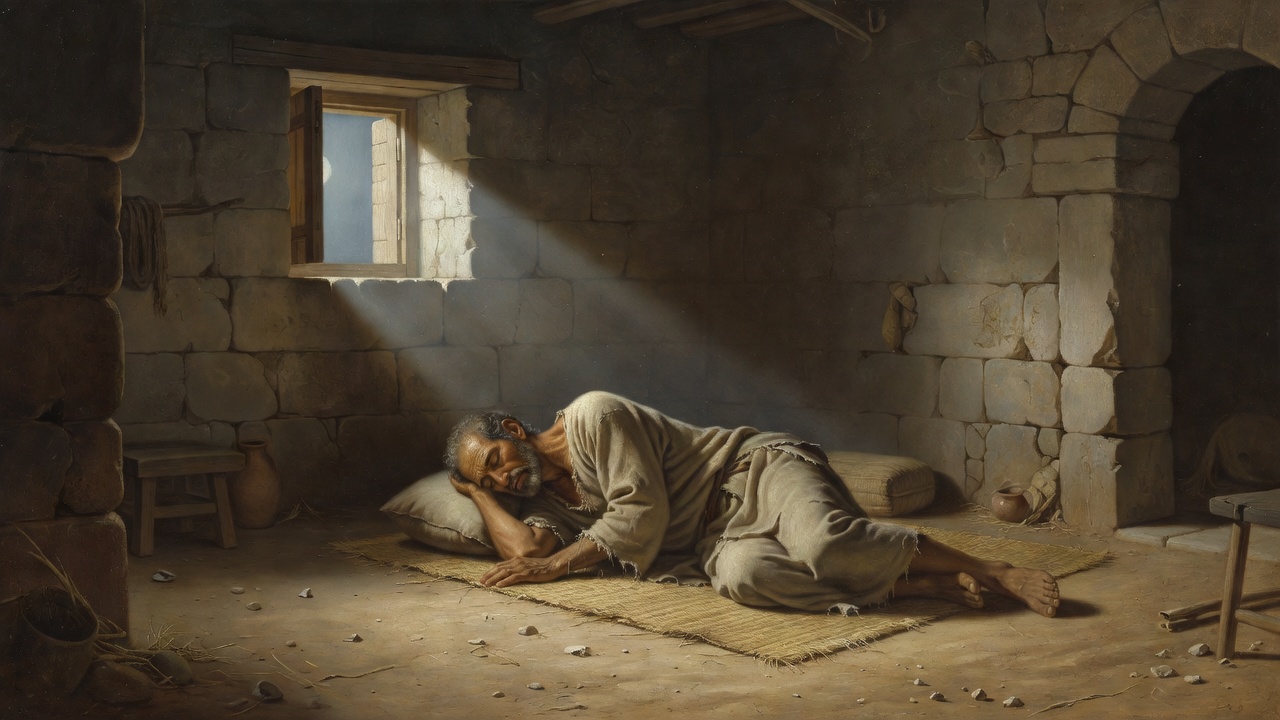
9He that loveth kesef shall never have enough kesef; nor shall he that loveth abundance have enough increase; this also is hevel. 10When hatovah (good things) increase, they are increased that consume them; and what kishron (useful result) is there to the ba'al (owner) thereof, except as an onlooker? 11The sleep of the oved (working man) is sweet, whether he eat little or much; but the abundance of the oisher (rich man) will not permit him to sleep.
12There is a grievous ra'ah which I have seen under the shemesh; osher (riches) hoarded by the ba'al thereof to his hurt; 13The same osher (riches) perish by an evil event and he begetteth a ben; thus this one hath nothing in his hand. 14As he came forth of the womb of his Em (mother), arom (naked) shall he return to go as he came, and shall take nothing of his amal (labor), which he may carry away in his hand. 15And this also is a grievous evil, that in every respect as he came, just so shall he go; and what profit hath he that hath toiled for the ruach (wind)? 16All his yamim also he eateth in choshech, and he hath much ka'as (grief, vexation) and sickness and anger.
17Hinei I have seen it is tov and yafeh for one to eat and to drink, and to find tovah in all his amal (labor) that he toils under the shemesh all the few days of his life, which HaElohim giveth him; for it is his chelek. 18Also kol ha'adam to whom HaElohim hath given osher and possessions, and hath given him power to eat thereof, and to take his chelek, and to rejoice in his amal; this is the gift of Elohim. 19For he shall not much remember the days of his life; because HaElohim keeps him occupied with simchat libbo (gladness of his heart).
Você sabia?
Reverência, justiça e os limites da riqueza
- O autor adverte contra o falar precipitado no culto, lembrando aos adoradores que Deus está nos céus enquanto os mortais estão na terra. Os votos feitos a Deus eram considerados compromissos sérios; o texto adverte que adiar ou deixar de cumprir um voto é insensatez, sendo melhor não votar do que votar e não cumprir.Fontes: o próprio texto bíblico
- Ao abordar a injustiça e a opressão dos pobres em uma província, o autor aponta para a burocracia governamental em camadas, onde cada oficial é vigiado por uma autoridade superior. Apesar dessa hierarquia administrativa, todos os níveis, inclusive o rei, dependem, em última análise, dos frutos da terra.Fontes: o próprio texto bíblico
- O capítulo contrasta a insônia inquieta dos ricos com o sono doce de um trabalhador comum, observando que a busca por riquezas não traz satisfação duradoura. O verdadeiro contentamento surge quando a pessoa aceita sua porção e desfruta de comida, bebida e trabalho honesto como dádivas de Deus.Fontes: o próprio texto bíblico
Notas escritas com auxílio de IA a partir de fontes abertas (Theographic Bible Metadata, CC BY-SA 4.0; Easton’s Bible Dictionary, domínio público) e revisadas antes de publicar.
Créditos e licença desta tradução
The Orthodox Jewish Bible
The Orthodox Jewish Bible - Tanakh and Orthodox Jewish Brit Chadasha - The Holy Bible
copyright © 2002-2011, 2021, 2024 Artists for Israel International
Language: English
Contributor: Artists for Israel International
THE ORTHODOX JEWISH TANAKH
Artists For Israel Intl Inc.
This version also appears with the Orthodox Yiddish Triglot which presents the Hebrew Yiddish script in Latin script and an English word for word translation, available at afii.org/Torah
To donate PayPal.Me
This translation is made available to you under the terms of the
Creative Commons Attribution license 4.0.
You may share and redistribute this Bible translation or extracts from it in any format, provided that:
You include the above copyright and source information.
If you make any changes to the text, you must indicate that you did so in a way that makes it clear that the original licensor is not necessarily endorsing your changes.
Pictures included with Scriptures and other documents on this site are licensed just for use with those Scriptures and documents.
For other uses, please contact the respective copyright owners.
Note that in addition to the rules above, revising and adapting God's Word involves a great responsibility to be true to God's Word. See Revelation 22:18-19.
2026-01-06
Títulos de seção adaptados da Berean Standard Bible (domínio público); não fazem parte do texto bíblico desta tradução.
Fonte: http://ebible.org/engojb/ · eBible.org