Atos 19
The Orthodox Jewish Bible · Toque num versículo para ver as referências cruzadas.
The Holy Spirit Received at Ephesus
1And it came about while Rav Apollos was in Corinth that Rav Sha'ul traveled through the upper regions and arrived at Ephesus, finding some of talmidim there. 2And Rav Sha'ul said to them, Did you receive the Ruach Hakodesh when you came to emunah? But they said to Rav Sha'ul, But we never heard that there is a Ruach Hakodesh! 3And Rav Sha'ul said, Into what then were you given tevilah? And they said, Into the tevilah of Yochanan. 4And Rav Sha'ul said, Yochanan gave a tevilah of teshuva to the people, saying that they should have emunah in Hu HaBah, the one coming after him, that is, in Yehoshua. 5And having heard this, they were given Moshiachʼs tevilah of teshuva in haShem of the Moshiach Adoneinu Yehoshua. 6And when Rav Sha'ul placed his hands upon them, the Ruach Hakodesh came upon them, and they were speaking in leshonot and they were speaking devarim hanevu'ah. 7And the anashim were about sheneym asar in number.
Paul Ministers in Ephesus
8And having joined the minyan at the shul, Rav Sha'ul was speaking with ometz lev during the course of shloshah chodashim, debating and persuading concerning the things of the Malchut Hashem. 9But when some unbelievers in the shul were being hardened and were disobeying, speaking Chillul Hashem of the Derech Hashem before the multitude, Rav Sha'ul withdrew from them. Rav Sha'ul took the Moshiachʼs talmidim and yom yom was saying shiurim in the [Messianic] yeshiva of Tyrannus. 10And this happened over a period of two years with the intended result that all the ones inhabiting Asia heard the dvar Hashem, both Yehudim and Yevanim.
11And gevaltike moftim and niflaot Hashem effected at the hands of Rav Sha'ul, 12so that when a handkerchief or an apron touched the skin of Rav Sha'ul and was brought to the cholim, the machlot (sicknesses) and the shedim (demons) left them.
Seven Sons of Sceva
13And some traveling Jewish exorcists attempted to use haShem of Rebbe, Melech HaMoshiach Adoneinu Yehoshua over the ones possessed of ruchot ra'ot, saying, I exorcize and cast you out by the Yehoshua whom Rav Sha'ul preaches! 14And there were doing this very thing shivat banim of a certain Skeva, a Jewish “Kohen Gadol.” 15And in reply the ruach hara'ah (the shed, demon) said to them, I am acquainted with Yehoshua, I have da'as of Sha'ul, but, you, who are you?! 16And the ish in whom was the ruach hara'ah leaped upon them and subdued all [shivah] of them, and overpowered them, so that they fled, naked and wounded, from the bais. 17And this became known to all the Yehudim and also the Yevanim inhabiting Ephesus, and pachad (terror) fell upon all of them, and they were exalting haShem of Adoneinu Yehoshua. 18And many of the ones having come to emunah were making vidduy of their ma'asim, disclosing them. 19And a number of the ones who had practiced kishshuf (magic, sorcery) brought together their occult sfarim and were burning them publicly; and they added up the price of these occult sfarim, and they found it to be fifty thousand silver pieces. 20So the dvar Hashem, the Besuras HaGeulah, was growing with ko'ach and was prevailing.
The Riot in Ephesus
21And when these things were fulfilled, Rav Sha'ul resolved in his ruach to travel through Macedonia and Achaia and go to Yerushalayim, saying After I have gone there, it is necessary for me also to see Rome. 22So Rav Sha'ul sent to Macedonia two of the mesharetim (ministers, servants) with him — Timotiyos and Erastus, while he stayed a little while longer in Asia.
23Now during that time there was no small disturbance concerning the Derech Hashem. 24For a certain one, Demetrius by name, a silversmith and maker of silver idol shrines for Artemis, was providing no small revach (profit) for the craftsmen. 25Demetrius also assembled the craftsmen occupied with that trade and he said, Anashim, you have da'as that our prosperity is from this trade, 26And you see and hear that not only here in Ephesus but in almost all of Asia this Rav Sha'ul has persuaded and drawn away a large multitude saying, Elilim made with human hands are not Elohim. 27And this is not only a danger to us, that our part, our trade, will fall into disrepute, but also the temple of the elah hagedolah Artemis may be considered as nothing, and also may be about to suffer the loss of her majesty, which all Asia and the Olam Hazeh worship.
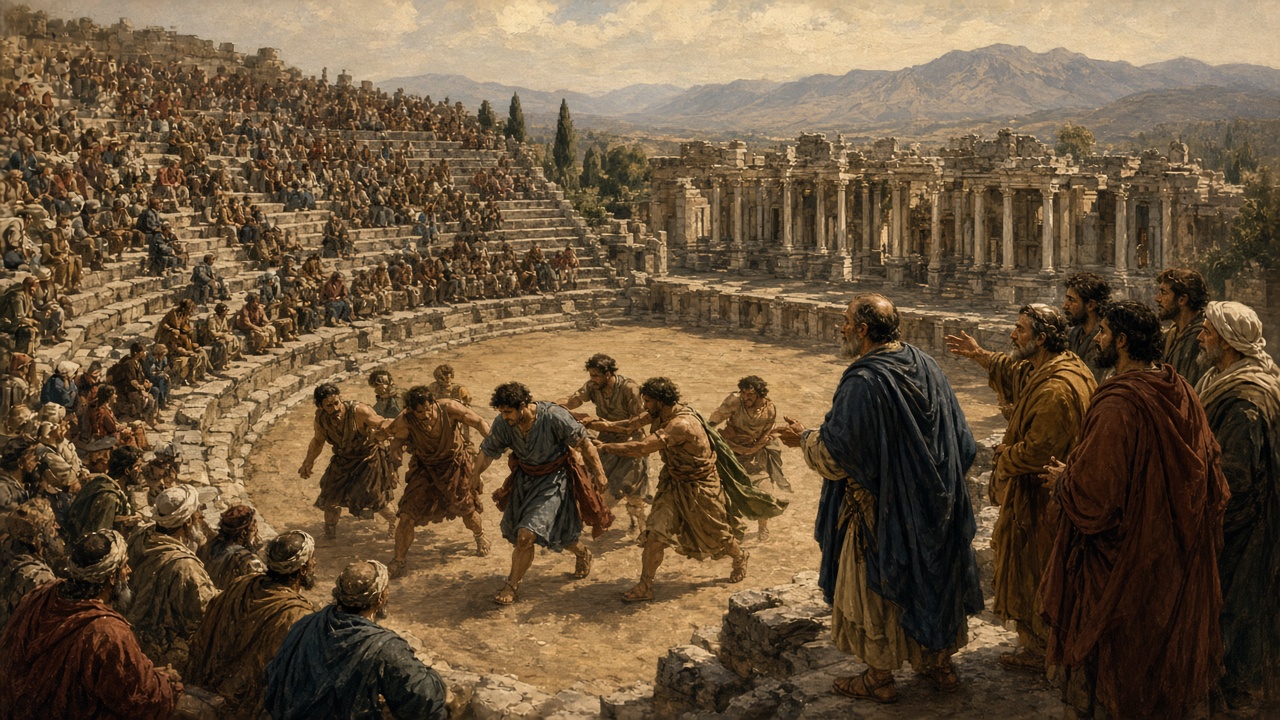
28And having listened and having become full of ka'as, the idol makers were crying out, saying, Gedolah is Artemis of the Ephesians! 29And the city was filled with tohu, and they rushed with one impulse into the theater, having seized Gaius and Aristarchus, who were Macedonians and traveling fellow po'alim of Rav Sha'ul. 30And Rav Sha'ul desired to enter into the crowd in the theater, but the talmidim were not allowing him. 31And also some of the Asiarchs who were his chaverim, sent to him, begging him not to venture into the theater. 32Then some began shouting one thing, some another, in the theater, for the kahal was in confusion, and most had no da'as of the purpose of the kahal (assembly). 33And from the multitude Alexander was pushed forward by Yehudim and some prompted him with shouts, while Alexander waved his hand, wanting to defend himself to the kahal. 34But having known what the man was, that he was a Yehudi, all in the theater shouted in unison for lav davka two hours crying out, Gedolah is Artemis of the Ephesians.
35And the town clerk, when he had restrained the crowd, said, Anashim, citizens of Ephesus, who indeed is there among Bnei Adam who does not have da'as that the city of Ephesus is the guardian of the temple of the great Artemis and of the tzelem (image) that fell from Shomayim? 36Since these things are undeniable, it is necessary for you to calm down and to do nothing reckless. 37For you brought these anashim here who are neither temple robbers nor speakers of evil against our religion. 38Therefore, if Demetrius and the craftsmen with him have a tainah (grievance) against anyone, the civil courts are in session and there are proconsuls. Let it be there that they bring charges against one another. 39And if you seek anything further, let your settlement be obtained in the lawful assembly. 40For indeed we are in danger of being indicted for an intifadah (uprising) today, for there is no justification we can render to excuse this disorder and commotion. 41And having said these things, the town clerk dismissed the kahal (assembly).
Você sabia?
Paulo, o Caminho e Ártemis em Éfeso
- Éfeso era a capital da Ásia proconsular, a província romana que abrangia a parte ocidental da Ásia Menor, e nos tempos romanos ostentava o título de primeira e maior metrópole da Ásia. A cidade distinguia-se pelo templo de Ártemis, a quem os romanos chamavam Diana, construído fora das muralhas e contado entre as sete maravilhas do mundo antigo. No centro ficava uma imagem antiga da deusa, da qual se dizia que tinha caído do céu.Fontes: Ephesus · Diana · Asia
- Demétrio, um ourives de Éfeso, fazia santuários de prata de Ártemis, modelos do templo ou da estátua da deusa, que se vendiam com facilidade aos visitantes vindos de toda a Ásia Menor. Atos diz que esse comércio era a fonte de prosperidade dos artesãos e que Demétrio os alertou sobre o perigo para o negócio e para a honra do templo de Ártemis, a deusa que, segundo ele, era adorada em toda a província da Ásia e no mundo inteiro.Fontes: Demetrius · o próprio texto bíblico
- A multidão correu para o teatro de Éfeso, que o Dicionário Bíblico de Easton (1897) descreve como o maior do mundo, a céu aberto e capaz de abrigar 50.000 espectadores. Amigos de Paulo entre os chefes da Ásia, cidadãos ricos eleitos a cada ano para presidir os jogos e as festas religiosas de suas cidades, pediram que ele não entrasse. O escrivão da cidade lembrou então à assembleia que Éfeso era guardiã do templo da grande Ártemis e da imagem que, segundo se dizia, caíra do céu.Fontes: Ephesus · Asia · o próprio texto bíblico
Notas escritas com auxílio de IA a partir de fontes abertas (Theographic Bible Metadata, CC BY-SA 4.0; Easton’s Bible Dictionary, domínio público) e revisadas antes de publicar.
Lugares deste capítulo
- Corinth · 37.906, 22.879 · versículo 1
- Ephesus · 37.939, 27.341 · versículos 1, 17, 23, 26, 35
- Asia · 38.400, 28.300 · versículos 10, 22, 26, 27, 31
- Achaia · 38.720, 22.540 · versículo 21
- Jerusalem · 31.777, 35.234 · versículo 21
- Macedonia · 41.600, 22.540 · versículos 21, 22, 29
- Rome · 41.892, 12.485 · versículos 21, 40
Só aparecem lugares com identificação de alta confiança (90% ou mais segundo as fontes acadêmicas reunidas pelo OpenBible). Mapa da época: DARE (Digital Atlas of the Roman Empire), CC BY 4.0; mapa atual: © colaboradores do OpenStreetMap; lugares: OpenBible.info (CC BY 4.0).
Créditos e licença desta tradução
The Orthodox Jewish Bible
The Orthodox Jewish Bible - Tanakh and Orthodox Jewish Brit Chadasha - The Holy Bible
copyright © 2002-2011, 2021, 2024 Artists for Israel International
Language: English
Contributor: Artists for Israel International
THE ORTHODOX JEWISH TANAKH
Artists For Israel Intl Inc.
This version also appears with the Orthodox Yiddish Triglot which presents the Hebrew Yiddish script in Latin script and an English word for word translation, available at afii.org/Torah
To donate PayPal.Me
This translation is made available to you under the terms of the
Creative Commons Attribution license 4.0.
You may share and redistribute this Bible translation or extracts from it in any format, provided that:
You include the above copyright and source information.
If you make any changes to the text, you must indicate that you did so in a way that makes it clear that the original licensor is not necessarily endorsing your changes.
Pictures included with Scriptures and other documents on this site are licensed just for use with those Scriptures and documents.
For other uses, please contact the respective copyright owners.
Note that in addition to the rules above, revising and adapting God's Word involves a great responsibility to be true to God's Word. See Revelation 22:18-19.
2026-01-06
Títulos de seção adaptados da Berean Standard Bible (domínio público); não fazem parte do texto bíblico desta tradução.
Fonte: http://ebible.org/engojb/ · eBible.org