Atos 17
The Orthodox Jewish Bible · Toque num versículo para ver as referências cruzadas.
The Uproar in Thessalonica
1Now having passed through Amphipolis and Apollonia, they came to Thessalonika, where there was a shul. 2And as he did bekvius (regularly), Rav Sha'ul joined their minyan, and on shloshah Shabbatot, he gave them drashot from the Kitvei HaKodesh, 3Making a Messianic midrash (homiletical interpretation of the Scriptures) and giving the pshat (rationale) for the yissurim of Rebbe, Melech HaMoshiach, that it was necessary for him to suffer and to stand up alive from the Mesim, saying, This one is the Rebbe, Melech HaMoshiach, this Yehoshua whom I am proclaiming to you. 4And some of them were persuaded and were being mishtatef (join, become involved) in a chavurah with Rav Sha'ul and Sila, as did a large number of yirei Elohim (Yevanim) and not a few of the chashuve nashim. 5And the Yehudim without emunah, being filled with kinah, and having rounded up from the people of the market the gornisht and the no-goodniks, and having formed a mob, were throwing the city into an uproar. And the crowd was seeking to bring out Moshiachʼs Shlichim and throw them to the mob, so they attacked the bais of Jason. 6But not having found the Moshiachʼs Shlichim, they were dragging Jason and some other Achim b'Moshiach to the city manhigim, shouting, These, who have been turning the Olam Hazeh upside down, have come here also! 7And Jason is the one who has received them into his bais! And all these ones are acting against the decrees of Caesar, saying that there is a king other than Caesar, this Rebbe, Melech HaMoshiach Yehoshua! 8And they stirred up the mob and also the city manhigim who heard them saying these things. 9And having taken the bond money from Jason and the rest, they released them.
The Character of the Bereans
10And, immediately during the lailah, the Achim b'Moshiach sent both Rav Sha'ul and Sila to Berea. When Moshiachʼs Shlichim arrived, they joined the minyan in the shul. 11But these Bereans were more noble-minded than the Thessalonians. The Berean Yehudim received the dvar Hashem with all readiness, yom yom (daily) making a chazora (review) and examining and horiva over (analyzing) the Kitvei HaKodesh, to see if these things might be so. 12Therefore, many of them became Messianic Jews, and also of the chashuve Yevanim, not a few nashim and anashim came to emunah. 13But when the Yehudim without emunah from Thessalonika realized that also in Berea the dvar Hashem was being proclaimed by Rav Sha'ul, they came also to Berea, agitating and stirring up mobs. 14And immediately, then, the Achim b'Moshiach sent away Rav Sha'ul to go as far as to the sea, but both Sila and Timotiyos remained in Berea. 15Now the ones escorting Rav Sha'ul brought him as far as Athens, and after receiving instructions to have Sila and Timotiyos come to Rav Sha'ul in Athens as quickly as possible, the ones escorting him departed.
Paul in Athens
16And awaiting them in Athens, the ruach of Rav Sha'ul was being distressed within him as he observed the city being full of elilim. 17Therefore, Rav Sha'ul was dialoguing and arguing in the shul with the Yehudim and with the yirei Elohim and also in the marketplace yom yom to the ones who happened to be there. 18Also some of the Apikoros (Epicurean) and Stoic philosophers started conversing with Rav Sha'ul, and some were saying, What might this babbler wish to say? And others said, He seems to be a proclaimer of foreign deities. They said this because of what Rav Sha'ul was proclaiming: Yehoshua and the Techiyas HaMesim. 19And having taken hold of Rav Sha'ul, they brought him to the Areopagus, saying, Are we able to have da'as of what this new teaching is, which is being spoken by you? 20For some surprising things you bring to our hearing. Therefore, we desire to have da'as of what these things mean. 21Now all the Athenians and the visiting foreigners and tourists in Athens used to spend time doing nothing but shmoozing about the latest novelty in the news.
Paul’s Address in the Areopagus
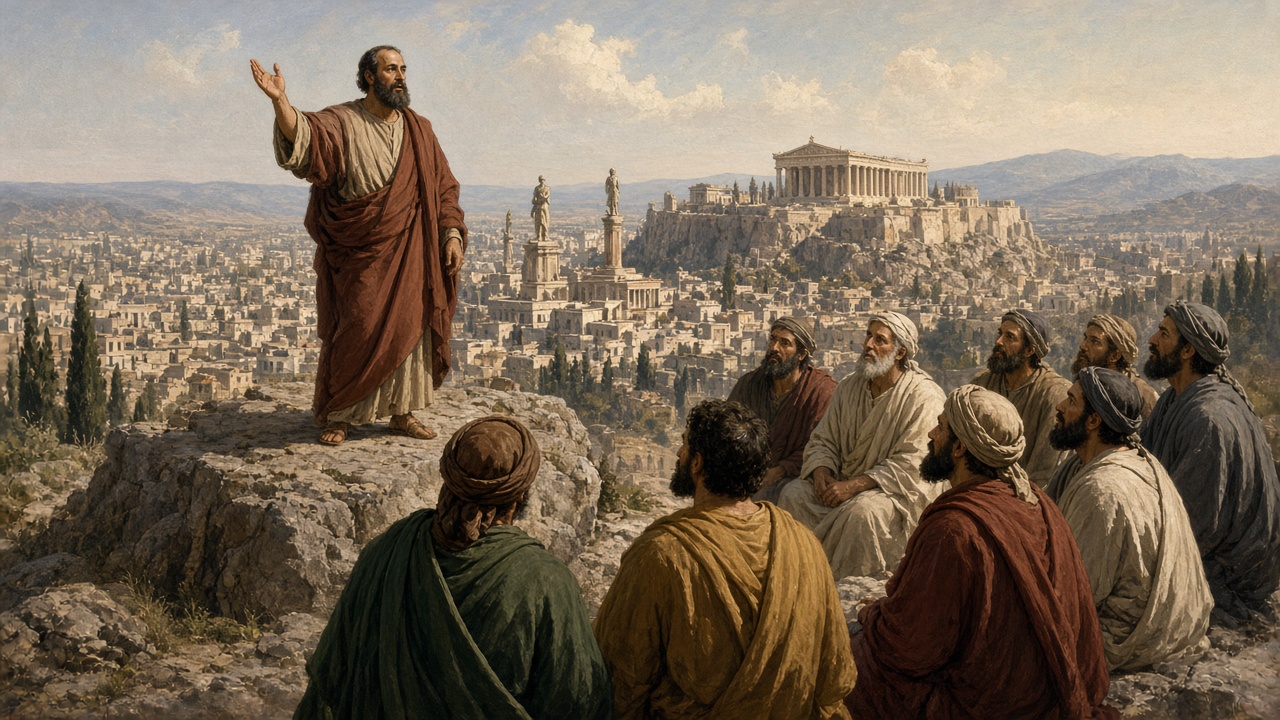
22And Rav Sha'ul, taking his stand in the middle of the Areopagus, said, Anashim, Athenians, with respect to everything how very religious indeed I observe you to be. 23For passing through and looking carefully at your objects of worship, I found also an altar on which had been inscribed “To the unknown g-d.” Therefore, what you worship without da'as, this I proclaim to you. 24Hashem, the One having made HaOlam and all the things in it, this One being Adon HaShomayim vaHaAretz, does not dwell in temples made by human hands. 25Nor is Hashem served by human hands, as if Hashem were in need of something, since He gives to all Chayyim and breath and everything. 26And Hashem made from one ancestor every nation of anashim dwelling pnei kol haAretz. And Hashem has set the zmanim and the fixed boundaries of their habitations, 27So that they would seek Hashem, if efsher (perhaps) they might grope for Him and might find Him, though Hashem is not far from each one of us. 28For “we live in Him and in Him we move and have our being,” as also some of your poets have said, “For we are all His offspring.” 29Therefore, being offspring of Hashem, we ought not to think that Hashemʼs essence is like gold or silver or stone, a tzelem (image) made by the skill and thought of Bnei Adam. 30While Hashem has disregarded and let pass the Am HaAretz times of ignorance, now, however, Hashem proclaims to kol bnei Adam everywhere, Make teshuva, 31Because he set a day in which he is about to bring MISHPAT on the Olam Hazeh in tzedek by an ISH whom he appointed, having furnished proof to all by having made him to stand up alive again from the Mesim.
32And when they heard of the Techiyas HaMesim, some were mocking Rav Sha'ul. But others said, We will hear you again about this. 33Thus did Rav Sha'ul go out from the midst of them. 34And some anashim became mishtatef in the chavurah of Rav Sha'ul, in that they had emunah, among whom were both Dionysius, a member of the Athenian Council of the Areopagus, and an isha by name Damaris, and others with them.
Você sabia?
Da sinagoga ao Areópago
- Tessalônica era uma cidade grande e populosa à beira do golfo Termaico, capital de um dos quatro distritos romanos da Macedônia, governada por um pretor. Jasom hospedou Paulo e Silas ali; uma multidão invadiu sua casa e, como os dois não foram encontrados, Jasom e alguns outros irmãos foram arrastados perante as autoridades da cidade. Foram acusados de acolher homens que desrespeitavam os decretos de César e falavam de outro rei, Jesus, e as autoridades só os soltaram depois de receber fiança.Fontes: Thessalonica · Jason · o próprio texto bíblico
- Atenas, capital da Ática, era celebrada como sede da literatura e da arte gregas, e seus habitantes gostavam de novidades e se destacavam pelo zelo no culto aos deuses. Um satírico romano dizia que era mais fácil encontrar um deus em Atenas do que um homem. O Areópago, colina rochosa a noroeste da Acrópole, era o lugar onde funcionavam o tribunal supremo ateniense e o tribunal dos costumes, e Paulo proferiu o discurso deste capítulo de algum ponto dessa colina.Fontes: Athens · Areopagus · o próprio texto bíblico
- Paulo e Silas chegaram a Tessalônica só depois de passar por Anfípolis, cidade macedônia e grande estação militar romana, a trinta e três milhas romanas de Filipos, e por Apolônia, a cerca de trinta e seis milhas de Tessalônica. Quando a agitação os seguiu até Bereia, outra cidade da Macedônia, os irmãos enviaram Paulo ao litoral, e os que o escoltaram o levaram até Atenas. Silas e Timóteo ficaram em Bereia, com a instrução de se juntar a Paulo assim que pudessem.Fontes: Amphipolis · Apollonia · Berea · o próprio texto bíblico
Notas escritas com auxílio de IA a partir de fontes abertas (Theographic Bible Metadata, CC BY-SA 4.0; Easton’s Bible Dictionary, domínio público) e revisadas antes de publicar.
Lugares deste capítulo
- Amphipolis · 40.820, 23.847 · versículo 1
- Apollonia · 40.624, 23.470 · versículo 1
- Thessalonica · Hoje: Thessaloniki · 40.638, 22.946 · versículos 1, 11, 13
- Berea · Hoje: Veria · 40.518, 22.200 · versículos 10, 11, 13, 14, 15
- Athens · 37.972, 23.727 · versículos 15, 16, 21, 22
- Areopagus · 37.972, 23.724 · versículos 19, 22, 33
Só aparecem lugares com identificação de alta confiança (90% ou mais segundo as fontes acadêmicas reunidas pelo OpenBible). Mapa da época: DARE (Digital Atlas of the Roman Empire), CC BY 4.0; mapa atual: © colaboradores do OpenStreetMap; lugares: OpenBible.info (CC BY 4.0).
Créditos e licença desta tradução
The Orthodox Jewish Bible
The Orthodox Jewish Bible - Tanakh and Orthodox Jewish Brit Chadasha - The Holy Bible
copyright © 2002-2011, 2021, 2024 Artists for Israel International
Language: English
Contributor: Artists for Israel International
THE ORTHODOX JEWISH TANAKH
Artists For Israel Intl Inc.
This version also appears with the Orthodox Yiddish Triglot which presents the Hebrew Yiddish script in Latin script and an English word for word translation, available at afii.org/Torah
To donate PayPal.Me
This translation is made available to you under the terms of the
Creative Commons Attribution license 4.0.
You may share and redistribute this Bible translation or extracts from it in any format, provided that:
You include the above copyright and source information.
If you make any changes to the text, you must indicate that you did so in a way that makes it clear that the original licensor is not necessarily endorsing your changes.
Pictures included with Scriptures and other documents on this site are licensed just for use with those Scriptures and documents.
For other uses, please contact the respective copyright owners.
Note that in addition to the rules above, revising and adapting God's Word involves a great responsibility to be true to God's Word. See Revelation 22:18-19.
2026-01-06
Títulos de seção adaptados da Berean Standard Bible (domínio público); não fazem parte do texto bíblico desta tradução.
Fonte: http://ebible.org/engojb/ · eBible.org