1 Coríntios 10
Open English Bible (U. S. spelling) · Toque num versículo para ver as referências cruzadas.
Warnings from Israel’s Past
1I want you to bear in mind, friends, that all our ancestors were beneath the cloud, and all passed through the sea; 2that in the cloud and in the sea they all underwent baptism as followers of Moses; 3and that they all ate the same supernatural food, 4and all drank the same supernatural water, for they used to drink from a supernatural rock which followed them, and that rock was the Christ. 5Yet with most of them God was displeased; for they were struck down in the desert. 6Now these things happened as warnings to us, to teach us not to long for evil things as our ancestors longed. 7Do not become idolaters, as some of them became. Scripture says –
‘The people sat down to eat and drink, and stood up to dance.’
8Nor let us act immorally, as some of them acted, with the result that twenty-three thousand of them fell dead in a single day. 9Nor let us try the patience of the Lord too far, as some of them tried it, with the result that they were, one after another, destroyed by snakes. 10And do not murmur, as some of them murmured, and so were destroyed by the angel of death. 11These things happened to them by way of warning, and were recorded to serve as a caution to us, in whose days the close of the ages has come.
12Therefore let the person who thinks that they stand take care that they do not fall. 13No temptation has come upon you that is not common to all humanity. God will not fail you, and he will not allow you to be tempted beyond your strength; but, when he sends the temptation, he will also provide the way of escape, so that you may have strength to endure.
Flee from Idolatry
14Therefore, my dear friends, shun the worship of idols. 15I am speaking to you as sensible people; form your own judgment about what I am saying. 16In the cup of blessing which we bless, is not there a sharing in the blood of the Christ? And in the bread which we break, is not there a sharing in the body of the Christ? 17The bread is one, and we, though many, are one body; for we all partake of that one bread. 18Look at the people of Israel. Do not those who eat the sacrifices share with the altar? 19What do I mean? That an offering made to an idol, or the idol itself, is anything? 20No; what I say is that the sacrifices offered by the Gentiles are offered to demons and to a being who is no God, and I do not want you to share with demons. 21You cannot drink both the cup of the Lord and the cup of demons. You cannot partake at the table of the Lord and at the table of demons. 22Or are we to rouse the jealousy of the Lord? Are we stronger than he?
All to God’s Glory
23Everything is allowable! Yes, but everything is not profitable. Everything is allowable! Yes, but everything does not build up character. 24A person must not study their own interests, but the interests of others.
25Eat anything that is sold in the market, without making inquiries to satisfy your scruples; 26for the earth, with all that is in it, belongs to the Lord. 27If an unbeliever invites you to his house and you consent to go, eat anything that is put before you, without making inquiries to satisfy your scruples. 28But, if anyone should say to you ‘This has been offered in sacrifice to an idol,’ then, for the sake of the speaker and his scruples, do not eat it. 29I do not say your scruples, but his. For why should the freedom that I claim be condemned by the scruples of another? 30If, for my part, I take the food thankfully, why should I be abused for eating that for which I give thanks?
31Whether, then, you eat or drink or whatever you do, do everything to the honor of God. 32Do not cause offense either to Jews or Greeks or to the church of God; 33for I, also, try to please everybody in everything, not seeking my own advantage, but do what is best for others, so that they may be saved.
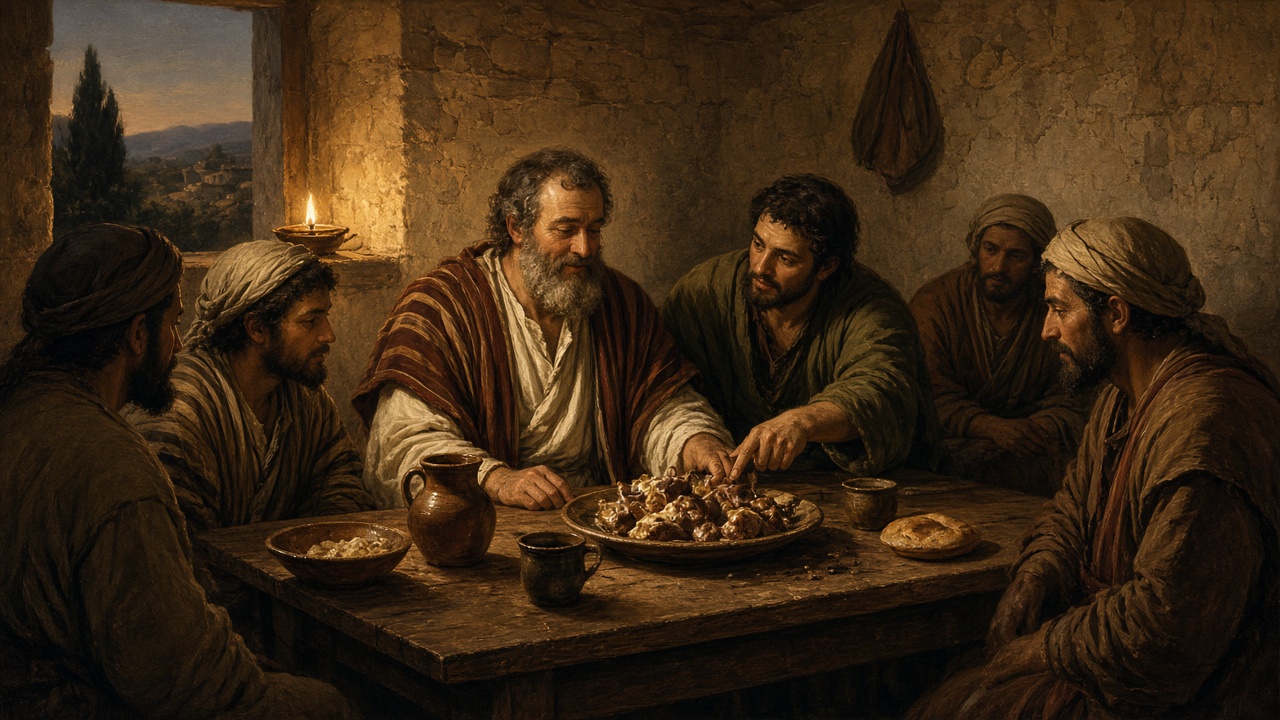
Você sabia?
Advertências do deserto e a mesa do Senhor
- Paulo diz que não quer que os coríntios ignorem que os antepassados estiveram todos debaixo da nuvem e passaram todos pelo mar, e que foram batizados em Moisés na nuvem e no mar. Todos comeram o mesmo alimento espiritual e beberam a mesma bebida espiritual da rocha espiritual que os acompanhava, e ele afirma que essa rocha era Cristo.Fontes: o próprio texto bíblico
- Paulo diz que Deus não se agradou da maioria deles, pois foram abatidos no deserto. Ele menciona a idolatria, a imoralidade sexual em que vinte e três mil morreram num só dia, o ato de pôr Cristo à prova, que trouxe morte por serpentes, e as queixas, punidas pelo anjo destruidor, e chama esses fatos de exemplos registrados como advertências.Fontes: o próprio texto bíblico
- Ele chama o cálice da bênção e o pão que é partido de participação no sangue e no corpo de Cristo, e afirma que os sacrifícios dos pagãos são oferecidos a demônios, não a Deus, de modo que as duas mesas não podem ser partilhadas. O que se vende no mercado de carne pode ser comido sem levantar questões de consciência, pois "Do Senhor é a terra e a sua plenitude", mas, se alguém disser que foi oferecido a ídolos, convém recusar por causa da consciência dessa pessoa.Fontes: o próprio texto bíblico
Notas escritas com auxílio de IA a partir de fontes abertas (Theographic Bible Metadata, CC BY-SA 4.0; Easton’s Bible Dictionary, domínio público) e revisadas antes de publicar.
Créditos e licença desta tradução
Open English Bible (U. S. spelling)
The Holy Bible, Open English Bible translation, U. S. spelling edition
Public Domain
Language: English
Translation by: OpenEnglishBible.org
Please see OpenEnglishBible.org/ for information about this translation.
2026-10-02
Títulos de seção adaptados da Berean Standard Bible (domínio público); não fazem parte do texto bíblico desta tradução.
Fonte: http://ebible.org/engoebus/ · eBible.org