Atos 7
George Noyes Bible · Toque num versículo para ver as referências cruzadas.
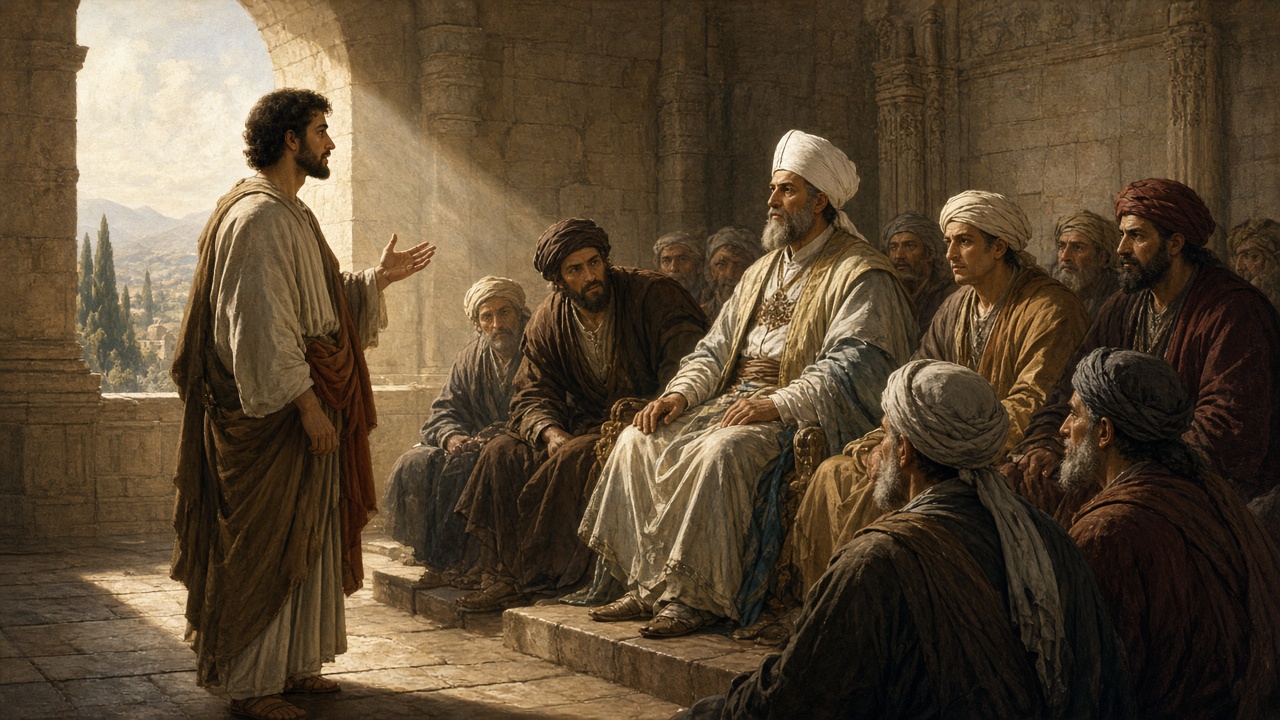
Stephen’s Address: The Call of Abraham
1And the high-priest said, Are then these things so? 2And he said, Brethren and fathers, hearken. The God of glory appeared to our father Abraham, when he was in Mesopotamia, before he dwelt in Haran, 3and said to him, “Go forth from thy country and thy kindred, and come into the land which I will show thee.” 4Then came he out of the land of the Chaldaeans, and dwelt in Haran; and from thence, after his father was dead, he caused him to remove into this land wherein ye now dwell; 5and he gave him no inheritance in it, no, not so much as to set his foot on; and he promised to give it to him for a possession, and to his posterity after him, when as yet he had no child. 6And God spoke in this manner: “That his posterity should sojourn in a foreign land, and that they would bring them into bondage, and ill-treat them four hundred years; 7and the nation to which they shall be in bondage will I judge,” said God; “and after that they shall come forth, and shall worship me in this place.” 8And he gave him the covenant of circumcision; and so he begat Isaac, and circumcised him on the eighth day; and Isaac begat Jacob, and Jacob the twelve patriarchs.
Joseph Sold into Egypt
9And the patriarchs, moved with envy, sold Joseph into Egypt; and God was with him, 10and delivered him out of all his afflictions, and gave him favor and wisdom in the sight of Pharaoh king of Egypt; and he made him governor over Egypt, and all his house. 11Now there came a famine over all the land of Egypt and Canaan, and great distress; and our fathers found no Sustenance. 12But Jacob, hearing that there was grain in Egypt, sent out our fathers first. 13And at the second time Joseph was recognized by his brothers, and the kindred of Joseph became known to Pharaoh. 14Then Joseph sent and called his father Jacob to him, and all his kindred, seventy five souls.
Israel Oppressed in Egypt
15And Jacob went down [[into Egypt]], and died, he and our fathers. 16And they were removed to Shechem, and laid in the tomb that Abraham bought for a sum of money of the sons of Hamor, the father of Shechem. 17But as the time of the promise drew near, which God solemnly made to Abraham, the people grew and multiplied in Egypt, 18until another king arose, who knew not Joseph. 19The same dealt subtly with our race, and ill-treated our fathers, so that they should cast out their infants, that they might not be preserved alive.
The Birth and Adoption of Moses
20In which time Moses was born, and was exceedingly fair; who was nourished in his father's house three months. 21And when he was cast out, Pharaoh's daughter took him up, and nourished him for herself as a son. 22And Moses was instructed in all the wisdom of the Egyptians, and was mighty in his worlds and deeds.
The Rejection and Flight of Moses
23And when he was forty years old, it came into his heart to visit his brethren, the sons of Israel. 24And seeing one of them suffer wrong, he defended him, and avenged him that was oppressed by smiting the Egyptian. 25For he supposed his brethren would understand that God through his hand would give them salvation; but they understood not. 26And the next day he showed himself to them as they were contending, and urged them to peace, saying, Ye are brethren; why do ye wrong one another? 27But he who was wronging his neighbor thrust him away, saying, “Who made thee a ruler and a judge over us? 28Dost thou mean to kill me, as thou didst kill the Egyptian yesterday?” 29And Moses fled at this saying, and became a sojourner in the land of Midian, where he begat two sons.
The Call of Moses
30And when forty years were completed, there appeared to him in the wilderness of Mount Sinai an angel in the flaming fire of a bush. 31And Moses seeing it wondered at the sight; and as he drew near to behold it, the voice of the Lord came [[to him]], 32saying, “I am the God of thy fathers, the God of Abraham and Isaac and Jacob.” And Moses trembled and durst not behold. 33And the Lord said to him, “Loose the sandals from thy feet; for the place where thou standest is holy ground. 34I have surely seen the oppression of my people in Egypt, and I have heard their groaning, and am come down to deliver them; and now, come, I will send thee into Egypt.” 35This Moses, whom they denied, saying, “Who made thee a ruler and a judge?” this very man did God send both as a ruler and a redeemer with the hand of the angel who appeared to him in the bush. 36This very man brought them out, working wonders and signs in the land of Egypt, and in the Red Sea, and in the wilderness forty years. 37This is the Moses who said to the sons of Israel, “A prophet will God raise up to you from among your brethren, as he raised up me.” 38This is he that was in the assembly in the wilderness with the anger who spake to him on Mount Sinai, and with our fathers; who received the living oracles to give to us;
The Rebellion of Israel
39to whom our fathers would not be obedient, but thrust him from them, and in their hearts turned back into Egypt, 40saying to Aaron, “Make us gods who shall go before us; for as for this Moses, who brought us out of the land of Egypt, we know not what is become of him.” 41And they made a calf in those days, and offered sacrifice to the idol, and rejoiced in the works of their own hands. 42But God turned away, and gave them up to worship the host of heaven; as it is written in the book of the Prophets, “Did ye offer to me slain beasts and sacrifices for forty years in the wilderness, O house of Israel? 43And ye took up the tabernacle of Moloch, and the star of the god Rephan, the figures which ye made to worship them; and I will carry you away beyond Babylon.”
The Tabernacle of the Testimony
44Our fathers had the tabernacle of the testimony in the wilderness, as he that spoke to Moses commanded that he should make it according to the pattern that he had seen; 45which also our fathers received and brought in with Joshua, at their taking possession of the gentiles whom God drove out from before our fathers, until the days of David; 46who found favor before God, and asked that he might find a habitation for the God of Jacob. 47But Solomon built him a house. 48Yet the Most High dwelleth not in [[temples]] made with hands; as saith the prophet, 49“Heaven is my throne, and the earth is my footstool. What house will ye build for me? saith the Lord; or what is the place of my rest? 50Did not my hands make all these things?” 51Stiffnecked, and uncircumcised in heart and ears! ye do always resist the Holy Spirit; as your fathers did, so do ye. 52Which of the prophets did not your fathers persecute? And they slew those who foretold the coming of the righteous one, of whom ye have now become the betrayers and murderers; 53ye who received the Law as ordained through angels, and did not keep it.
The Stoning of Stephen
54But when they heard these things, their hearts were filled with rage, and they gnashed their teeth at him. 55But, being full of the Holy Spirit, he looked up earnestly into heaven, and saw the glory of God, and Jesus standing on the right hand of God, 56and said, Lo, I behold the heavens opened, and the Son of man standing on the right hand of God. 57And they cried out with a loud voice, and stopped their ears, and rushed upon him with one accord; 58and having cast him out of the city, they stoned him. And the witnesses laid down their garments at the feet of a young man named Saul; 59and they stoned Stephen, making supplication, and saying, Lord Jesus, receive my spirit. 60And kneeling down he cried with a loud voice, Lord, lay not this sin to their charge. And saying this, he fell asleep.
Você sabia?
Estêvão reconta a história de Israel
- Estêvão abre o discurso com Abraão ainda na Mesopotâmia, antes de se estabelecer em Harã, quando recebeu a ordem de deixar sua terra e seus parentes. Mesopotâmia — em hebraico Aram-naharaim, “Síria dos dois rios” — era o nome que gregos e romanos davam à região entre o Eufrates e o Tigre; no Antigo Testamento ela também se chama Padan-aram, “a planície de Arã”, e o norte desse planalto foi o lar antigo dos antepassados dos hebreus. O Easton's Bible Dictionary (1897) observa que esse primeiro chamado não aparece no Antigo Testamento, embora Gênesis 12 o deixe implícito, e que Abraão saiu de Ur, na Caldeia, e percorreu cerca de 300 milhas ao norte, até Harã.Fontes: o próprio texto bíblico · Mesopotamia · Abraham
- Estêvão afirma que os ossos de Jacó e dos pais foram levados de volta a Siquém e depositados no túmulo que Abraão comprara aos filhos de Hamor. O Easton's Bible Dictionary (1897) identifica Hamor como um heveu cujo nome significa “jumento”, nota que em Atos 7:16 ele é chamado Emmor e diz que Jacó lhe comprou o terreno de Siquém em que José foi sepultado mais tarde. O verbete acrescenta que Siquém, filho de Hamor, fundou a cidade que recebeu o seu nome.Fontes: o próprio texto bíblico · Hamor
- Estêvão localiza a sarça ardente no deserto, perto do monte Sinai, e diz que Moisés recebeu ali palavras vivas da parte do anjo que lhe falou no monte. O Easton's Bible Dictionary (1897) trata Sinai — nome ligado a Sin, um deus da lua — como o mesmo distrito montanhoso também chamado Horebe. Segundo o verbete, os hebreus chegaram a essa região no terceiro mês após o Êxodo, depois de uma viagem de cerca de 150 milhas desde o mar Vermelho, com todas as voltas do caminho, e ficaram acampados cerca de um ano.Fontes: o próprio texto bíblico · Mount Sinai
Notas escritas com auxílio de IA a partir de fontes abertas (Theographic Bible Metadata, CC BY-SA 4.0; Easton’s Bible Dictionary, domínio público) e revisadas antes de publicar.
Lugares deste capítulo
- Haran · Hoje: Harran · 36.864, 39.033 · versículos 2, 4
- Mesopotamia · Hoje: Aram-naharaim · 36.864, 39.033 · versículo 2
- Chaldea · 30.962, 46.104 · versículo 4
- Egypt · 30.129, 31.308 · versículos 9, 10, 11, 12, 14, 15, 17, 18, 34, 36, 39, 40
- Canaan · 32.767, 35.333 · versículo 11
- Shechem · Hoje: Tell Balatah · 32.214, 35.282 · versículo 16
- Nile · Hoje: Nile River · 31.465, 30.367 · versículo 19
- Midian · 28.495, 35.012 · versículo 29
- Babylon · 32.543, 44.422 · versículo 43
Só aparecem lugares com identificação de alta confiança (90% ou mais segundo as fontes acadêmicas reunidas pelo OpenBible). Mapa da época: DARE (Digital Atlas of the Roman Empire), CC BY 4.0; mapa atual: © colaboradores do OpenStreetMap; lugares: OpenBible.info (CC BY 4.0).
Créditos e licença desta tradução
George Noyes Bible
The Holy Bible, translated into English by George Noyes (1869)
Public Domain
Language: English
Dialect: archaic British
Translation by: George Noyes
2019-10-24
Títulos de seção adaptados da Berean Standard Bible (domínio público); não fazem parte do texto bíblico desta tradução.
Fonte: http://ebible.org/engnoy/ · eBible.org