Juízes 8
NET Bible · Toque num versículo para ver as referências cruzadas.
1The Ephraimites said to him, “Why have you done such a thing to us? You did not summon us when you went to fight the Midianites!” They argued vehemently with him. 2He said to them, “Now what have I accomplished compared to you? Even Ephraim’s leftover grapes are better quality than Abiezer’s harvest! 3It was to you that God handed over the Midianite generals, Oreb and Zeeb! What did I accomplish to rival that?” When he said this, they calmed down.
Gideon Tracks Down the Midianite Kings
4Now Gideon and his three hundred men had crossed over the Jordan River, and even though they were exhausted, they were still chasing the Midianites. 5He said to the men of Succoth, “Give some loaves of bread to the men who are following me, because they are exhausted. I am chasing Zebah and Zalmunna, the kings of Midian.” 6The officials of Succoth said, “You have not yet overpowered Zebah and Zalmunna. So why should we give bread to your army?” 7Gideon said, “Since you will not help, after the Lord hands Zebah and Zalmunna over to me, I will thresh your skin with desert thorns and briers.” 8He went up from there to Penuel and made the same request. The men of Penuel responded the same way the men of Succoth had. 9He also threatened the men of Penuel, warning, “When I return victoriously, I will tear down this tower.”
10Now Zebah and Zalmunna were in Karkor with their armies. There were about fifteen thousand survivors from the army of the eastern peoples; a hundred and twenty thousand sword-wielding soldiers had been killed. 11Gideon went up the road of the nomads east of Nobah and Jogbehah and ambushed the surprised army. 12When Zebah and Zalmunna ran away, Gideon chased them and captured the two Midianite kings, Zebah and Zalmunna. He had surprised their entire army.
13Gideon son of Joash returned from the battle by the pass of Heres. 14He captured a young man from Succoth and interrogated him. The young man wrote down for him the names of Succoth’s officials and city leaders – seventy-seven men in all. 15He approached the men of Succoth and said, “Look what I have! Zebah and Zalmunna! You insulted me, saying, ‘You have not yet overpowered Zebah and Zalmunna. So why should we give bread to your exhausted men?’” 16He seized the leaders of the city, along with some desert thorns and briers; he then “threshed” the men of Succoth with them. 17He also tore down the tower of Penuel and executed the city’s men.
18He said to Zebah and Zalmunna, “Describe for me the men you killed at Tabor.” They said, “They were like you. Each one looked like a king’s son.” 19He said, “They were my brothers, the sons of my mother. I swear, as surely as the Lord is alive, if you had let them live, I would not kill you.” 20He ordered Jether his firstborn son, “Come on! Kill them!” But Jether was too afraid to draw his sword, because he was still young. 21Zebah and Zalmunna said to Gideon, “Come on, you strike us, for a man is judged by his strength.” So Gideon killed Zebah and Zalmunna, and he took the crescent-shaped ornaments which were on the necks of their camels.
Gideon Rejects a Crown but Makes an Ephod
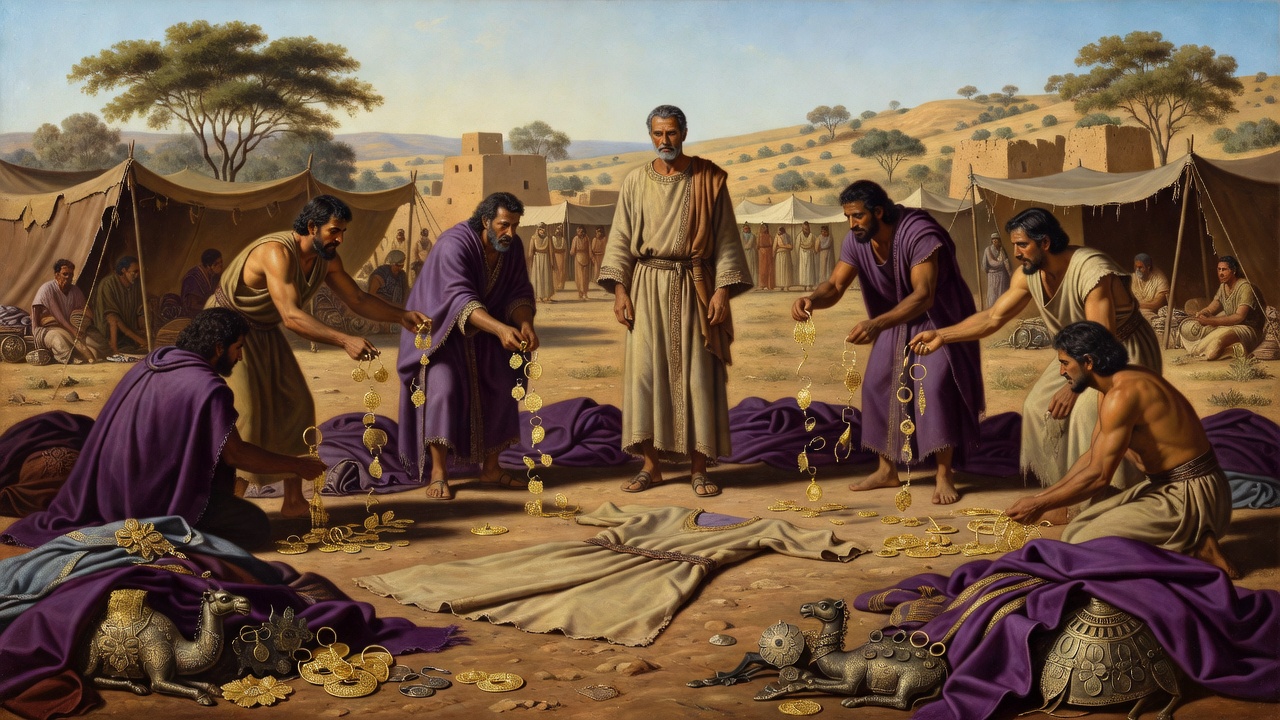
22The men of Israel said to Gideon, “Rule over us – you, your son, and your grandson. For you have delivered us from Midian’s power.” 23Gideon said to them, “I will not rule over you, nor will my son rule over you. The Lord will rule over you.” 24Gideon continued, “I would like to make one request. Each of you give me an earring from the plunder you have taken.” (The Midianites had gold earrings because they were Ishmaelites.) 25They said, “We are happy to give you earrings.” So they spread out a garment, and each one threw an earring from his plunder onto it. 26The total weight of the gold earrings he requested came to seventeen hundred gold shekels. This was in addition to the crescent-shaped ornaments, jewelry, purple clothing worn by the Midianite kings, and the necklaces on the camels. 27Gideon used all this to make an ephod, which he put in his hometown of Ophrah. All the Israelites prostituted themselves to it by worshiping it there. It became a snare to Gideon and his family.
Gideon’s Story Ends
28The Israelites humiliated Midian; the Midianites’ fighting spirit was broken. The land had rest for forty years during Gideon’s time. 29Then Jerub-Baal son of Joash went home and settled down. 30Gideon fathered seventy sons through his many wives. 31His concubine, who lived in Shechem, also gave him a son, whom he named Abimelech. 32Gideon son of Joash died at a very old age and was buried in the tomb of his father Joash located in Ophrah of the Abiezrites.
Israel Returns to Baal-Worship
33After Gideon died, the Israelites again prostituted themselves to the Baals. They made Baal-Berith their god. 34The Israelites did not remain true to the Lord their God, who had delivered them from all the enemies who lived around them. 35They did not treat the family of Jerub-Baal (that is, Gideon) fairly in return for all the good he had done for Israel.
Você sabia?
A perseguição a Midiã e os últimos anos de Gideão
- Quando a tribo de Efraim reclamou asperamente por não ter sido chamada antes para a batalha, Gideão apaziguou o conflito com uma metáfora diplomática. Ele comparou os 'rabiscos de Efraim'—a captura dos príncipes midianitas Orebe e Zeebe—favoravelmente a toda a 'vindima' do seu próprio clã, Abiezer.Fontes: o próprio texto bíblico · Gideon · Abiezer · Oreb
- As cidades de Sucote e Penuel, situadas a leste do rio Jordão, recusaram fornecer pão aos trezentos soldados exaustos de Gideão. Temendo represálias caso os reis midianitas Zeba e Zalmuna triunfassem, seus líderes negaram auxílio, o que levou Gideão a castigar duramente ambas as cidades após a vitória.Fontes: o próprio texto bíblico · Succoth · Penuel · Zebah
- Embora Gideão tenha recusado a oferta de um reinado dinástico sobre Israel, afirmando que somente Deus governaria, ele pediu os brincos de ouro recolhidos como despojo dos invasores. Com esse ouro ele fez um éfode para a sua cidade natal, Ofra, o qual acabou se tornando um laço de culto idólatra para Israel.Fontes: o próprio texto bíblico · Ophrah · Gideon
Notas escritas com auxílio de IA a partir de fontes abertas (Theographic Bible Metadata, CC BY-SA 4.0; Easton’s Bible Dictionary, domínio público) e revisadas antes de publicar.
Lugares deste capítulo
- Midian · 28.495, 35.012 · versículos 1, 3, 5, 12, 22, 26, 28
- Abiezer · Hoje: about 15 km around Afula · 32.606, 35.290 · versículo 2
- Jordan · Hoje: Jordan River · 31.761, 35.558 · versículo 4
- East · Hoje: region around Amman · 31.955, 35.934 · versículo 10
- Mount Tabor · Hoje: Jebel et Tur · 32.686, 35.393 · versículo 18
- Shechem · Hoje: Tell Balatah · 32.214, 35.282 · versículo 31
Só aparecem lugares com identificação de alta confiança (90% ou mais segundo as fontes acadêmicas reunidas pelo OpenBible). Mapa da época: DARE (Digital Atlas of the Roman Empire), CC BY 4.0; mapa atual: © colaboradores do OpenStreetMap; lugares: OpenBible.info (CC BY 4.0).
Créditos e licença desta tradução
NET Bible
NET Bible®, New English Translation (NET)
copyright © 1996-2016 Biblical Studies Press, L. L. C.
Please see https://netbible.com/copyright/ for full NET Bible copyright and permissions information. You can also read the NET Bible at http://NETBible.org .
Language: English
Dialect (if applicable): American
Language in English: English
Translation by:
Please see https://netbible.com/copyright/ for full NET Bible copyright and permissions information. You can also read the NET Bible at http://NETBible.org .
The NET Bible (New English Translation) is a completely new translation of the Bible with 58,506 translators’ notes ! It was completed by more than 25 scholars – experts in the original biblical languages – who worked directly from the best currently available Hebrew, Aramaic, and Greek texts. Turn the pages and see the breadth of the translators’ notes, documenting their decisions and choices as they worked.
The translators’ notes make the original languages far more accessible, allowing you to look over the translator’s shoulder at the very process of translation. This level of documentation is a first for a Bible translation, making transparent the textual basis and the rationale for key renderings (including major interpretive options and alternative translations).
This unparalleled level of detail helps connect people to the Bible in the original languages in a way never before possible without years of study of Hebrew, Aramaic, and Greek. It unlocks the riches of the Bible’s truth from entirely new perspectives.
A donation is appreciated. Donate at Bible.org/donations_form so we can continue to provide our material for free for our 16,000+ articles on Bible.org and our world class Bible Study tool at lumina.bible.org .
2026-10-02
Fonte: http://ebible.org/engnet/ · eBible.org