Ezequiel 17
NET Bible · Toque num versículo para ver as referências cruzadas.
The Parable of Two Eagles and a Vine
1The word of the Lord came to me: 2“Son of man, offer a riddle, and tell a parable to the house of Israel. 3Say to them: ‘This is what the sovereign Lord says:
“‘A great eagle with broad wings, long feathers,
with full plumage which was multi-hued,
came to Lebanon and took the top of the cedar.
4He plucked off its topmost shoot;
he brought it to a land of merchants
and planted it in a city of traders.
5He took one of the seedlings of the land,
placed it in a cultivated plot;
a shoot by abundant water,
like a willow he planted it.
6It sprouted and became a vine,
spreading low to the ground;
its branches turning toward him, its roots were under itself.
So it became a vine; it produced shoots and sent out branches.
7“‘There was another great eagle
with broad wings and thick plumage.
Now this vine twisted its roots toward him
and sent its branches toward him
to be watered from the soil where it was planted.
8In a good field, by abundant waters, it was planted
to grow branches, bear fruit, and become a beautiful vine.
9“‘Say to them: This is what the sovereign Lord says:
“‘Will it prosper?
Will he not rip out its roots
and cause its fruit to rot and wither?
All its foliage will wither.
No strong arm or large army
will be needed to pull it out by its roots.
10Consider! It is planted, but will it prosper?
Will it not wither completely when the east wind blows on it?
Will it not wither in the soil where it sprouted?’”
The Parable Explained
11Then the word of the Lord came to me: 12“Say to the rebellious house of Israel: ‘Don’t you know what these things mean?’ Say: ‘See here, the king of Babylon came to Jerusalem and took her king and her officials prisoner and brought them to himself in Babylon. 13He took one from the royal family, made a treaty with him, and put him under oath. He then took the leaders of the land 14so it would be a lowly kingdom which could not rise on its own but must keep its treaty with him in order to stand. 15But this one from Israel’s royal family rebelled against the king of Babylon by sending his emissaries to Egypt to obtain horses and a large army. Will he prosper? Will the one doing these things escape? Can he break the covenant and escape?
16“‘As surely as I live, declares the sovereign Lord, surely in the city of the king who crowned him, whose oath he despised and whose covenant he broke – in the middle of Babylon he will die! 17Pharaoh with his great army and mighty horde will not help him in battle, when siege ramps are erected and siege-walls are built to kill many people. 18He despised the oath by breaking the covenant. Take note – he gave his promise and did all these things – he will not escape!
19“‘Therefore this is what the sovereign Lord says: As surely as I live, I will certainly repay him for despising my oath and breaking my covenant! 20I will throw my net over him and he will be caught in my snare; I will bring him to Babylon and judge him there because of the unfaithfulness he committed against me. 21All the choice men among his troops will die by the sword and the survivors will be scattered to every wind. Then you will know that I, the Lord, have spoken!
22“‘This is what the sovereign Lord says:
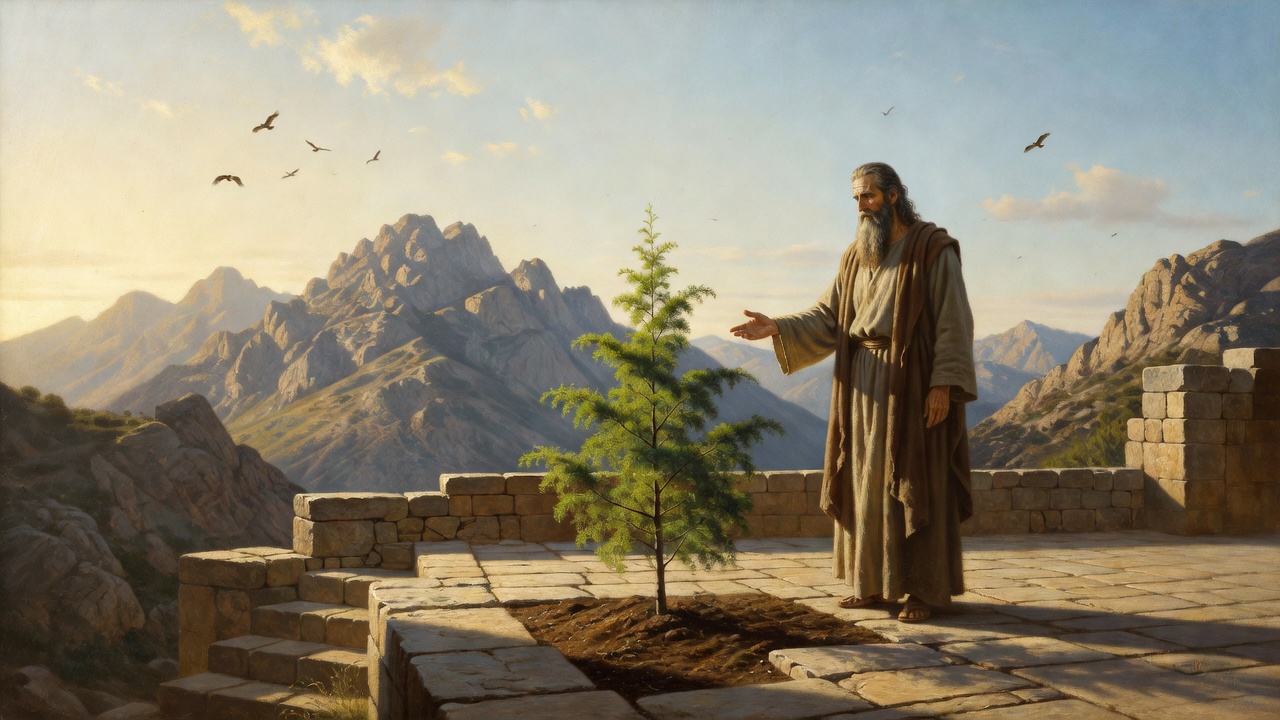
“‘I will take a sprig from the lofty top of the cedar and plant it.
I will pluck from the top one of its tender twigs;
I myself will plant it on a high and lofty mountain.
23I will plant it on a high mountain of Israel,
and it will raise branches and produce fruit and become a beautiful cedar.
Every bird will live under it;
Every winged creature will live in the shade of its branches.
24All the trees of the field will know that I am the Lord.
I make the high tree low; I raise up the low tree.
I make the green tree wither, and I make the dry tree sprout.
I, the Lord, have spoken, and I will do it!’”
Você sabia?
A parábola das águias e do cedro
- Ezequiel apresenta uma alegoria política em que a primeira grande águia representa o rei da Babilônia, que levou a liderança real de Jerusalém para o cativeiro e estabeleceu um rei vassalo sob uma aliança solene. A segunda águia representa o Egito e seu faraó, a quem o governante de Judá recorreu em busca de cavalos e auxílio militar, quebrando sua aliança.Fontes: o próprio texto bíblico · Babylon · Egypt · Pharaoh
- Na mensagem profética, romper um juramento de vassalagem firmado com a Babilônia foi considerado não apenas uma rebelião diplomática, mas uma traição espiritual contra Deus, que considerava o juramento prestado como Sua própria aliança.Fontes: o próprio texto bíblico
- O capítulo se encerra revertendo os planos políticos humanos: o próprio Deus promete tirar um renovo tenro do topo do cedro e plantá-lo nas alturas montanhosas de Israel, onde ele se tornará uma árvore majestosa que dará abrigo a aves de todo tipo.Fontes: o próprio texto bíblico
Notas escritas com auxílio de IA a partir de fontes abertas (Theographic Bible Metadata, CC BY-SA 4.0; Easton’s Bible Dictionary, domínio público) e revisadas antes de publicar.
Lugares deste capítulo
- Lebanon · 33.540, 35.584 · versículo 3
- Canaan · 32.767, 35.333 · versículo 4
- Babylon · 32.543, 44.422 · versículos 12, 14, 15, 16, 17, 20
- Jerusalem · 31.777, 35.234 · versículos 12, 17
- Egypt · 30.129, 31.308 · versículo 15
Só aparecem lugares com identificação de alta confiança (90% ou mais segundo as fontes acadêmicas reunidas pelo OpenBible). Mapa da época: DARE (Digital Atlas of the Roman Empire), CC BY 4.0; mapa atual: © colaboradores do OpenStreetMap; lugares: OpenBible.info (CC BY 4.0).
Créditos e licença desta tradução
NET Bible
NET Bible®, New English Translation (NET)
copyright © 1996-2016 Biblical Studies Press, L. L. C.
Please see https://netbible.com/copyright/ for full NET Bible copyright and permissions information. You can also read the NET Bible at http://NETBible.org .
Language: English
Dialect (if applicable): American
Language in English: English
Translation by:
Please see https://netbible.com/copyright/ for full NET Bible copyright and permissions information. You can also read the NET Bible at http://NETBible.org .
The NET Bible (New English Translation) is a completely new translation of the Bible with 58,506 translators’ notes ! It was completed by more than 25 scholars – experts in the original biblical languages – who worked directly from the best currently available Hebrew, Aramaic, and Greek texts. Turn the pages and see the breadth of the translators’ notes, documenting their decisions and choices as they worked.
The translators’ notes make the original languages far more accessible, allowing you to look over the translator’s shoulder at the very process of translation. This level of documentation is a first for a Bible translation, making transparent the textual basis and the rationale for key renderings (including major interpretive options and alternative translations).
This unparalleled level of detail helps connect people to the Bible in the original languages in a way never before possible without years of study of Hebrew, Aramaic, and Greek. It unlocks the riches of the Bible’s truth from entirely new perspectives.
A donation is appreciated. Donate at Bible.org/donations_form so we can continue to provide our material for free for our 16,000+ articles on Bible.org and our world class Bible Study tool at lumina.bible.org .
2026-10-02
Títulos de seção adaptados da Berean Standard Bible (domínio público); não fazem parte do texto bíblico desta tradução.
Fonte: http://ebible.org/engnet/ · eBible.org