Atos 13
NET Bible · Toque num versículo para ver as referências cruzadas.
1Now there were these prophets and teachers in the church at Antioch: Barnabas, Simeon called Niger, Lucius the Cyrenian, Manaen (a close friend of Herod the tetrarch from childhood ) and Saul. 2While they were serving the Lord and fasting, the Holy Spirit said, “Set apart for me Barnabas and Saul for the work to which I have called them.” 3Then, after they had fasted and prayed and placed their hands on them, they sent them off.
Paul and Barnabas Preach in Cyprus
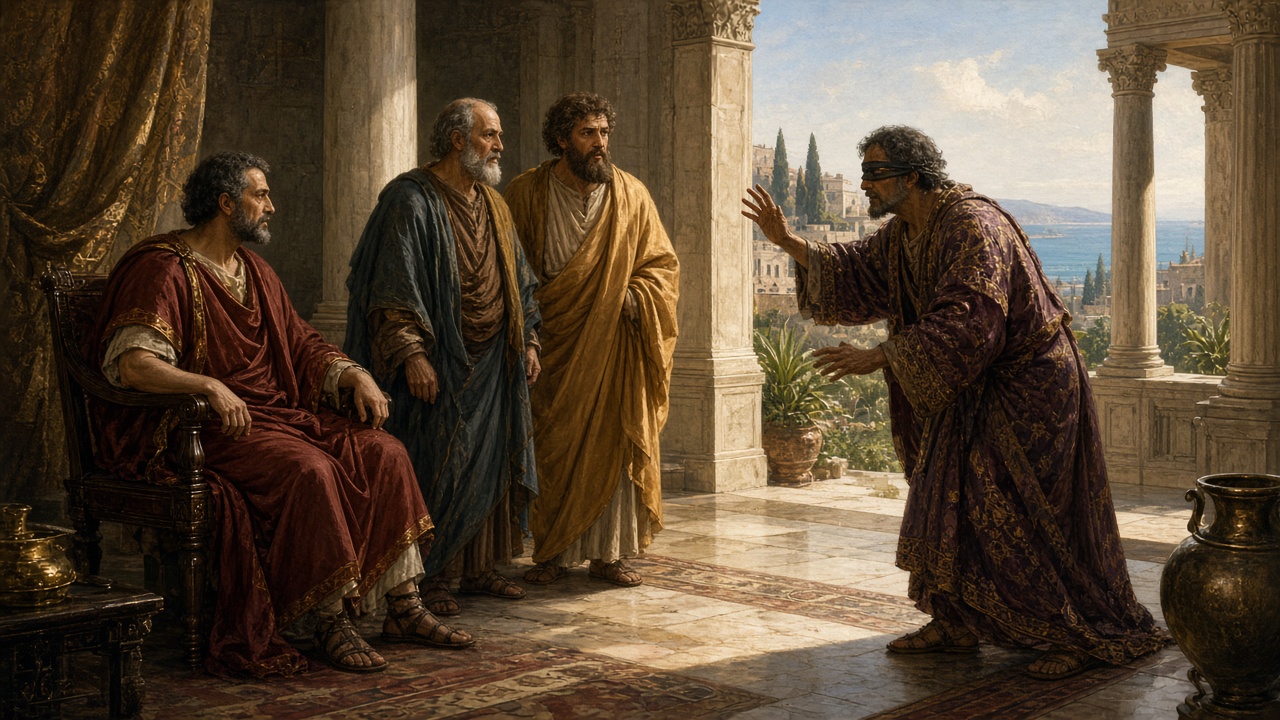
4So Barnabas and Saul, sent out by the Holy Spirit, went down to Seleucia, and from there they sailed to Cyprus. 5When they arrived in Salamis, they began to proclaim the word of God in the Jewish synagogues. (Now they also had John as their assistant.) 6When they had crossed over the whole island as far as Paphos, they found a magician, a Jewish false prophet named Bar-Jesus, 7who was with the proconsul Sergius Paulus, an intelligent man. The proconsul summoned Barnabas and Saul and wanted to hear the word of God. 8But the magician Elymas (for that is the way his name is translated) opposed them, trying to turn the proconsul away from the faith. 9But Saul (also known as Paul), filled with the Holy Spirit, stared straight at him 10and said, “You who are full of all deceit and all wrongdoing, you son of the devil, you enemy of all righteousness – will you not stop making crooked the straight paths of the Lord? 11Now look, the hand of the Lord is against you, and you will be blind, unable to see the sun for a time!” Immediately mistiness and darkness came over him, and he went around seeking people to lead him by the hand. 12Then when the proconsul saw what had happened, he believed, because he was greatly astounded at the teaching about the Lord.
Paul and Barnabas at Pisidian Antioch
13Then Paul and his companions put out to sea from Paphos and came to Perga in Pamphylia, but John left them and returned to Jerusalem. 14Moving on from Perga, they arrived at Pisidian Antioch, and on the Sabbath day they went into the synagogue and sat down. 15After the reading from the law and the prophets, the leaders of the synagogue sent them a message, saying, “Brothers, if you have any message of exhortation for the people, speak it.” 16So Paul stood up, gestured with his hand and said,
“Men of Israel, and you Gentiles who fear God, listen: 17The God of this people Israel chose our ancestors and made the people great during their stay as foreigners in the country of Egypt, and with uplifted arm he led them out of it. 18For a period of about forty years he put up with them in the wilderness. 19After he had destroyed seven nations in the land of Canaan, he gave his people their land as an inheritance. 20All this took about four hundred fifty years. After this he gave them judges until the time of Samuel the prophet. 21Then they asked for a king, and God gave them Saul son of Kish, a man from the tribe of Benjamin, who ruled forty years. 22After removing him, God raised up David their king. He testified about him: ‘ I have found David the son of Jesse to be a man after my heart, who will accomplish everything I want him to do.’ 23From the descendants of this man God brought to Israel a Savior, Jesus, just as he promised. 24Before Jesus arrived, John had proclaimed a baptism for repentance to all the people of Israel. 25But while John was completing his mission, he said repeatedly, ‘What do you think I am? I am not he. But look, one is coming after me. I am not worthy to untie the sandals on his feet!’ 26Brothers, descendants of Abraham’s family, and those Gentiles among you who fear God, the message of this salvation has been sent to us. 27For the people who live in Jerusalem and their rulers did not recognize him, and they fulfilled the sayings of the prophets that are read every Sabbath by condemning him. 28Though they found no basis for a death sentence, they asked Pilate to have him executed. 29When they had accomplished everything that was written about him, they took him down from the cross and placed him in a tomb. 30But God raised him from the dead, 31and for many days he appeared to those who had accompanied him from Galilee to Jerusalem. These are now his witnesses to the people. 32And we proclaim to you the good news about the promise to our ancestors, 33that this promise God has fulfilled to us, their children, by raising Jesus, as also it is written in the second psalm, ‘ You are my Son; today I have fathered you*.’ 34But regarding the fact that he has raised Jesus from the dead, never again to be in a state of decay, God has spoken in this way: ‘ I will give you the holy and trustworthy promises made to David*.’ 35Therefore he also says in another psalm, ‘ You will not permit your Holy One to experience decay*.’ 36For David, after he had served God’s purpose in his own generation, died, was buried with his ancestors, and experienced decay, 37but the one whom God raised up did not experience decay. 38Therefore let it be known to you, brothers, that through this one forgiveness of sins is proclaimed to you, 39and by this one everyone who believes is justified from everything from which the law of Moses could not justify you. 40Watch out, then, that what is spoken about by the prophets does not happen to you:
41‘ Look, you scoffers; be amazed and perish!
For I am doing a work in your days,
a work you would never believe, even if someone tells you.’”
42As Paul and Barnabas were going out, the people were urging them to speak about these things on the next Sabbath. 43When the meeting of the synagogue had broken up, many of the Jews and God-fearing proselytes followed Paul and Barnabas, who were speaking with them and were persuading them to continue in the grace of God.
44On the next Sabbath almost the whole city assembled together to hear the word of the Lord. 45But when the Jews saw the crowds, they were filled with jealousy, and they began to contradict what Paul was saying by reviling him. 46Both Paul and Barnabas replied courageously, “It was necessary to speak the word of God to you first. Since you reject it and do not consider yourselves worthy of eternal life, we are turning to the Gentiles. 47For this is what the Lord has commanded us: ‘ I have appointed you to be a light for the Gentiles, to bring salvation to the ends of the earth.’” 48When the Gentiles heard this, they began to rejoice and praise the word of the Lord, and all who had been appointed for eternal life believed. 49So the word of the Lord was spreading through the entire region. 50But the Jews incited the God-fearing women of high social standing and the prominent men of the city, stirred up persecution against Paul and Barnabas, and threw them out of their region. 51So after they shook the dust off their feet in protest against them, they went to Iconium. 52And the disciples were filled with joy and with the Holy Spirit.
Você sabia?
A missão enviada de Antioquia
- O Dicionário Bíblico de Easton (1897) descreve Antioquia da Síria como a terceira cidade em importância do Império Romano, depois de Roma e Alexandria; foi a igreja dali que separou Barnabé e Saulo. Entre seus profetas e mestres estavam Simeão, chamado Níger, sobrenome que significa negro, talvez pela pele escura, e Lúcio de Cirene, no norte da África.Fontes: Antioch (Syria) · o próprio texto bíblico · Simeon · Lucius
- Em Pafos, capital de Chipre e residência do governador romano, um feiticeiro judeu chamado Barjesus, também conhecido como Elimas, nome árabe que significa mago ou feiticeiro, tentou desviar o procônsul Sérgio Paulo da fé. É aqui que Saulo também é chamado Paulo; o Dicionário Bíblico de Easton (1897) diz que o nome Paulo provavelmente lhe foi dado na infância para uso no mundo gentio, enquanto Saulo era seu nome hebraico de casa.Fontes: Paphos · Elymas · Paul · o próprio texto bíblico
- Enviados de Antioquia, desceram a Selêucia, o porto da cidade perto da foz do Orontes, e navegaram até Chipre; depois desembarcaram em Perge, capital da Panfília, às margens do rio Cestro. Ali João os deixou e voltou para Jerusalém; seu nome romano, Marcos, aos poucos passou a substituir seu nome judaico, e ele era primo de Barnabé.Fontes: Seleucia · Perga · John Mark · o próprio texto bíblico
Notas escritas com auxílio de IA a partir de fontes abertas (Theographic Bible Metadata, CC BY-SA 4.0; Easton’s Bible Dictionary, domínio público) e revisadas antes de publicar.
Lugares deste capítulo
- Antioch · Hoje: Antioch on the Orontes · 36.227, 36.172 · versículo 1
- Cyrene · 32.821, 21.851 · versículo 1
- Cyprus · 35.000, 33.000 · versículo 4
- Seleucia · Hoje: Seleucia Pieria · 36.124, 35.922 · versículo 4
- Salamis · 35.185, 33.902 · versículo 5
- Paphos · Hoje: New Paphos · 34.756, 32.404 · versículos 6, 13
- Jerusalem · 31.777, 35.234 · versículos 13, 27, 31
- Pamphylia · 37.000, 31.000 · versículo 13
- Perga · 36.960, 30.854 · versículos 13, 14
- Antioch · Hoje: Antioch in Pisidia · 38.306, 31.189 · versículo 14
- Pisidia · 38.306, 31.189 · versículo 14
- Egypt · 30.129, 31.308 · versículo 17
- Canaan · 32.767, 35.333 · versículo 19
- Galilee · 32.760, 35.527 · versículo 31
- Iconium · Hoje: Konya · 37.872, 32.492 · versículo 51
Só aparecem lugares com identificação de alta confiança (90% ou mais segundo as fontes acadêmicas reunidas pelo OpenBible). Mapa da época: DARE (Digital Atlas of the Roman Empire), CC BY 4.0; mapa atual: © colaboradores do OpenStreetMap; lugares: OpenBible.info (CC BY 4.0).
Créditos e licença desta tradução
NET Bible
NET Bible®, New English Translation (NET)
copyright © 1996-2016 Biblical Studies Press, L. L. C.
Please see https://netbible.com/copyright/ for full NET Bible copyright and permissions information. You can also read the NET Bible at http://NETBible.org .
Language: English
Dialect (if applicable): American
Language in English: English
Translation by:
Please see https://netbible.com/copyright/ for full NET Bible copyright and permissions information. You can also read the NET Bible at http://NETBible.org .
The NET Bible (New English Translation) is a completely new translation of the Bible with 58,506 translators’ notes ! It was completed by more than 25 scholars – experts in the original biblical languages – who worked directly from the best currently available Hebrew, Aramaic, and Greek texts. Turn the pages and see the breadth of the translators’ notes, documenting their decisions and choices as they worked.
The translators’ notes make the original languages far more accessible, allowing you to look over the translator’s shoulder at the very process of translation. This level of documentation is a first for a Bible translation, making transparent the textual basis and the rationale for key renderings (including major interpretive options and alternative translations).
This unparalleled level of detail helps connect people to the Bible in the original languages in a way never before possible without years of study of Hebrew, Aramaic, and Greek. It unlocks the riches of the Bible’s truth from entirely new perspectives.
A donation is appreciated. Donate at Bible.org/donations_form so we can continue to provide our material for free for our 16,000+ articles on Bible.org and our world class Bible Study tool at lumina.bible.org .
2026-10-02
Fonte: http://ebible.org/engnet/ · eBible.org