Cântico dos Cânticos 2
Updated Brenton English Septuagint · Toque num versículo para ver as referências cruzadas.
The Bride’s Admiration
The Bride
1I am a flower of the plain,
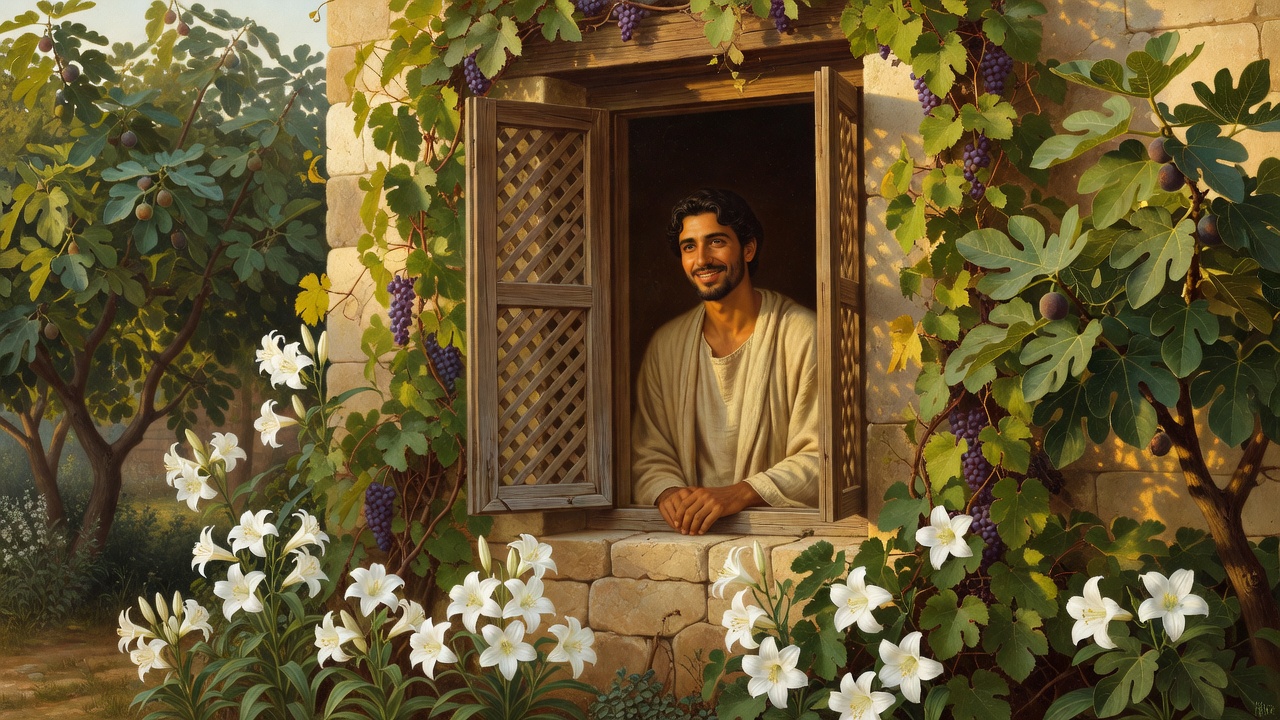
A lily of the valleys.
The Bridegroom
2As a lily among thorns,
So is my companion among the daughters.
The Bride
3As the apple among the trees of the wood,
So is my kinsman among the sons.
I desired his shadow, and sat down,
And his fruit was sweet in my throat.
4Bring me into the wine house;
Set love before me.
5Strengthen me with perfumes,
Stay me with apples: for I am wounded with love.
6His left hand shall be under my head,
And his right hand shall embrace me.
7I have charged you, ye daughters of Jerusalem,
By the powers and by the virtues of the field,
That ye do not rouse or wake my love, until he please.
8The voice of my kinsman! behold, he comes leaping over the mountains, bounding over the hills.
9My kinsman is like a roe
Or a young hart on the mountains of Bethel:
Behold, he is behind our wall,
Looking through the windows,
Peeping through the lattices.
10My kinsman answers, and says to me,
Rise up, come, my companion, my fair one, my dove.
11For, behold, the winter is past,
The rain is gone, it has departed.
12The flowers are seen in the land;
The time of pruning has arrived;
The voice of the turtledove has been heard in our land.
13The fig tree has put forth its young figs,
The vines put forth the tender grape, they yield a smell:
Arise, come, my companion, my fair one, my dove; yea, come.
The Bridegroom
14Thou art my dove, in the shelter of the rock,
Near the wall:
Show me thy face,
And cause me to hear thy voice;
For thy voice is sweet,
And thy countenance is beautiful.
The Friends
15Take us the little foxes that spoil the vines:
For our vines put forth tender grapes.
The Bride
16My kinsman is mine, and I am his:
He feeds his flock among the lilies.
17Until the day dawn, and the shadows depart,
Turn, my kinsman,
Be thou like to a roe or young hart
On the mountains of the ravines.
Você sabia?
A Primavera e o Despertar do Amor
- Sarom era uma planície costeira fértil que se estendia entre o Mar Mediterrâneo e a região montanhosa a oeste de Jerusalém, celebrada por sua beleza e vegetação, inspirando imagens como a rosa de Sarom.Fontes: Saron · o próprio texto bíblico
- O poema retrata a chegada da primavera por meio de mudanças na natureza rural, como o fim das chuvas de inverno, o arrulhar das rolas, o amadurecimento dos figos e as videiras em flor que precisavam de proteção contra raposas.Fontes: o próprio texto bíblico
- A jovem se dirige repetidamente às filhas de Jerusalém, expressando suas advertências sobre o amor com base em animais selvagens dos campos, como gazelas e corças.Fontes: Jerusalem · o próprio texto bíblico
Notas escritas com auxílio de IA a partir de fontes abertas (Theographic Bible Metadata, CC BY-SA 4.0; Easton’s Bible Dictionary, domínio público) e revisadas antes de publicar.
Lugares deste capítulo
Só aparecem lugares com identificação de alta confiança (90% ou mais segundo as fontes acadêmicas reunidas pelo OpenBible). Mapa da época: DARE (Digital Atlas of the Roman Empire), CC BY 4.0; mapa atual: © colaboradores do OpenStreetMap; lugares: OpenBible.info (CC BY 4.0).
Créditos e licença desta tradução
Updated Brenton English Septuagint
Spelling and formatting update of the Brenton English Septuagint with Apocrypha
Public Domain
Language: English
Dialect: Mixed
Translation by: Sir Lancelot C. L. Brenton
Contributor: Adam Boyd
Original work was by Sir Lancelot C. L. Brenton in 1851.
CC0 Public Domain dedication on language updates by Adam Boyd in 2020.
2026-02-18
Títulos de seção adaptados da Berean Standard Bible (domínio público); não fazem parte do texto bíblico desta tradução.
Fonte: http://ebible.org/englxxup/ · eBible.org