Gênesis 4
Updated Brenton English Septuagint · Toque num versículo para ver as referências cruzadas.
Cain and Abel
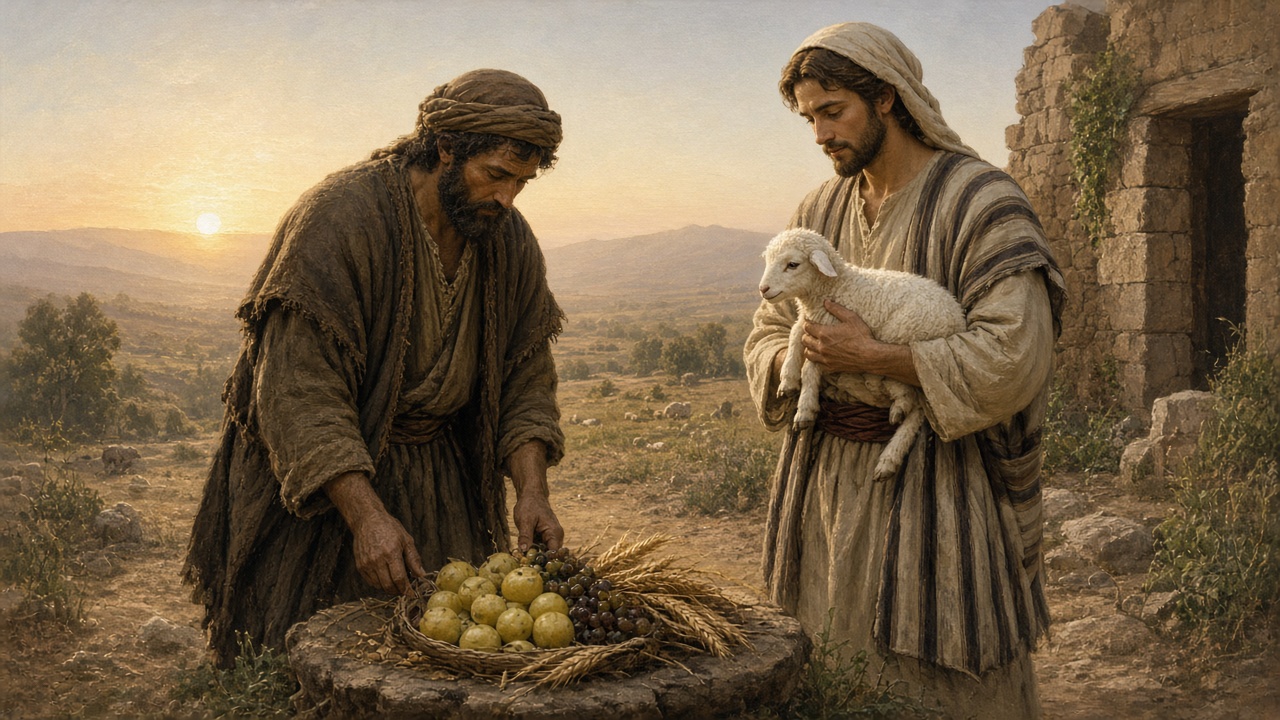
1And Adam knew Eve his wife, and she conceived and brought forth Cain and said, I have gained a man through God. 2And she again bore his brother Abel. And Abel was a keeper of sheep, but Cain was a tiller of the ground. 3And it was so after some time that Cain brought of the fruits of the earth a sacrifice to the Lord. 4And Abel also brought of the firstborn of his sheep and of his fatlings, and God looked upon Abel and his gifts, 5but Cain and his sacrifices he regarded not, and Cain was exceedingly sorrowful and his countenance fell. 6And the Lord God said to Cain, Why art thou become very sorrowful and why is thy countenance fallen? 7Hast thou not sinned if thou hast brought it rightly, but not rightly divided it? be still, to thee shall be his submission, and thou shalt rule over him.
8And Cain said to Abel his brother, Let us go out into the plain; and it came to pass that when they were in the plain Cain rose up against Abel his brother, and slew him. 9And the Lord God said to Cain, Where is Abel thy brother? and he said, I know not, am I my brother’s keeper? 10And the Lord said, What hast thou done? the voice of thy brother’s blood cries to me out of the ground. 11And now thou art cursed from the earth which has opened her mouth to receive thy brother’s blood from thy hand. 12When thou tillest the earth, then it shall not continue to give its strength to thee: thou shalt be groaning and trembling on the earth. 13And Cain said to the Lord God, My crime is too great for me to be forgiven. 14If thou castest me out this day from the face of the earth, and I shall be hidden from thy presence, and I shall be groaning and trembling upon the earth, then it will be that anyone that finds me shall slay me. 15And the Lord God said to him, Not so, anyone that slays Cain shall suffer sevenfold vengeance; and the Lord God set a mark upon Cain that no one that found him might slay him. 16So Cain went forth from the presence of God and dwelt in the land of Nod over against Eden.
The Descendants of Cain
17And Cain knew his wife, and having conceived she bore Enoch; and he built a city; and he named the city after the name of his son, Enoch. 18And to Enoch was born Irad; and Irad begot Mehujael; and Mehujael begot Methushael; and Methushael begot Lamech. 19And Lamech took to himself two wives; the name of the one was Adah, and the name of the second Zillah. 20And Adah bore Jabal; he was the father of those that dwell in tents, feeding cattle. 21And the name of his brother was Jubal; he it was who invented the psaltery and harp. 22And Zillah also bore Tubal; he was a smith, a manufacturer both of brass and iron; and the sister of Tubal was Naamah. 23And Lamech said to his wives,
Adah and Zillah, hear my voice,
Ye wives of Lamech, consider my words,
Because I have slain a man to my sorrow
And a youth to my grief.
24Because vengeance has been exacted seven times on Cain’s behalf,
On Lamech’s it shall be seventy times seven.
Seth and Enosh
25And Adam knew Eve his wife, and she conceived and bore a son, and called his name Seth, saying, For God has raised up to me another seed instead of Abel, whom Cain slew. 26And Seth had a son, and he called his name Enosh: he hoped to call on the name of the Lord God.
Você sabia?
Caim, Abel e a vida a leste do Éden
- O nome hebraico de Abel significa “sopro” ou “vaidade”. Ele cuidava de ovelhas, enquanto seu irmão Caim cultivava o solo: Abel trouxe as melhores porções dos primogênitos do rebanho, e Caim trouxe fruto do solo. O Dicionário Bíblico de Easton (1897) lê a expressão “no decorrer do tempo” (à margem, “ao fim dos dias”) como provável referência ao sábado.Fontes: Abel · Cain · o próprio texto bíblico
- Depois da morte de Abel, Caim foi morar na terra de Node, a leste do Éden, nome que significa exílio, errância ou inquietação. Ali construiu uma cidade e deu-lhe o nome de seu filho Enoque. O Dicionário Bíblico de Easton observa que essa é a primeira cidade mencionada nas Escrituras.Fontes: Nod · Enoch (son of Cain) · o próprio texto bíblico
- Lameque, quinto na descendência de Caim, casou-se com duas mulheres, Ada e Zilá. O Dicionário Bíblico de Easton chama o discurso dele a elas de único exemplo conservado de poesia antediluviana, às vezes conhecido como “cântico da espada de Lameque”. Os filhos deles se ligam a modos de vida antigos: Jabal, às tendas e ao gado; Jubal, à harpa e à flauta; e Tubalcaim, à forja de bronze e ferro.Fontes: Lamech (descendant of Cain) · Adah (wife of Lamech) · Zillah · o próprio texto bíblico
Notas escritas com auxílio de IA a partir de fontes abertas (Theographic Bible Metadata, CC BY-SA 4.0; Easton’s Bible Dictionary, domínio público) e revisadas antes de publicar.
Créditos e licença desta tradução
Updated Brenton English Septuagint
Spelling and formatting update of the Brenton English Septuagint with Apocrypha
Public Domain
Language: English
Dialect: Mixed
Translation by: Sir Lancelot C. L. Brenton
Contributor: Adam Boyd
Original work was by Sir Lancelot C. L. Brenton in 1851.
CC0 Public Domain dedication on language updates by Adam Boyd in 2020.
2026-02-18
Títulos de seção adaptados da Berean Standard Bible (domínio público); não fazem parte do texto bíblico desta tradução.
Fonte: http://ebible.org/englxxup/ · eBible.org