Gênesis 10
Updated Brenton English Septuagint · Toque num versículo para ver as referências cruzadas.
The Table of Nations
1Now these are the generations of the sons of Noah, Shem, Ham, Japheth; and sons were born to them after the flood.
The Japhethites
2The sons of Japheth, Gomer, and Magog, and Madai, and Javan, and Elisa, and Tubal, and Meshech, and Tiras. 3And the sons of Gomer, Ashkenaz, and Riphath, and Togarmah. 4And the sons of Javan, Elishah, and Tarshish, Kittim, Rodanim. 5From these were the islands of the Gentiles divided in their land, each according to his tongue, in their tribes and in their nations.
The Hamites
6And the sons of Ham, Cush, and Mizraim, Put, and Canaan. 7And the sons of Cush, Seba, and Havilah, and Sabtah, and Raamah, and Sabteca. And the sons of Raamah, Sheba, and Dedan. 8And Cush begot Nimrod: he began to be a giant upon the earth. 9He was a giant hunter before the Lord God; therefore they say, As Nimrod the giant hunter before the Lord. 10And the beginning of his kingdom was Babylon, and Erech, and Accad, and Calneh, in the land of Shinar. 11Out of that land came Asshur, and built Nineveh, and the city Rehoboth, and Calah, 12and Resen between Nineveh and Calah: this is the great city. 13And Mizraim begot the Ludim, and the Naphtuhim, and the Anamim, and the Lehabim, 14and the Pathrusim, and the Casluhim (whence came forth Philistines) and the Caphtorim. 15And Canaan begot Sidon his firstborn, and the Hittite, 16and the Jebusite, and the Amorite, and the Girgashite, 17and the Hivite, and the Arkite, and the Sinite, 18and the Arvadite, and the Zemarite, and the Hamathite; and after this the tribes of the Canaanites were dispersed. 19And the boundaries of the Canaanites were from Sidon till one comes to Gerar and Gaza, till one comes to Sodom and Gomorrah, Admah and Zeboiim, as far as Lasha. 20These were the sons of Ham in their tribes according to their tongues, in their countries, and in their nations.
The Semites
21And to Shem himself also were children born, the father of all the sons of Eber, the brother of Japheth the elder. 22Sons of Shem, Elam, and Asshur, and Arpachshad, and Lud, and Aram, and Cainan. 23And sons of Aram, Uz, and Hul, and Gether, and Mash. 24And Arpachshad begot Cainan, and Cainan begot Shelah. And Shelah begot Eber. 25And to Eber were born two sons, the name of the one, Peleg, because in his days the earth was divided, and the name of his brother Joktan. 26And Joktan begot Almodad, and Sheleph, and Hazarmaveth, and Jerah, 27and Hadoram, and Aibel, and Diklah, 28and Obal, and Abimael, and Sheba, 29and Ophir, and Havilah, and Jobab, all these were the sons of Joktan. 30And their dwelling was from Mesha, till one comes to Sephar, a mountain of the east. 31These were the sons of Shem in their tribes, according to their tongues, in their countries, and in their nations. 32These are the tribes of the sons of Noah, according to their generations, according to their nations: of them were the islands of the Gentiles scattered over the earth after the flood.
Você sabia?
As nações depois do dilúvio
- Gênesis 10 segue as famílias dos três filhos de Noé, Sem, Cam e Jafé, e diz que, depois do dilúvio, as nações da terra se espalharam a partir deles, agrupadas por clãs, línguas, terras e nações. A linhagem de Jafé está ligada a povos do leste da Europa e do norte da Ásia: Gômer é geralmente considerado ancestral dos celtas e dos cimérios, que em tempos antigos se estabeleceram ao norte do mar Negro, e Javã tornou-se o nome hebraico que os povos do Oriente usavam para os gregos, sobretudo os da Jônia.Fontes: o próprio texto bíblico · Japheth · Gomer (son of Japheth) · Javan
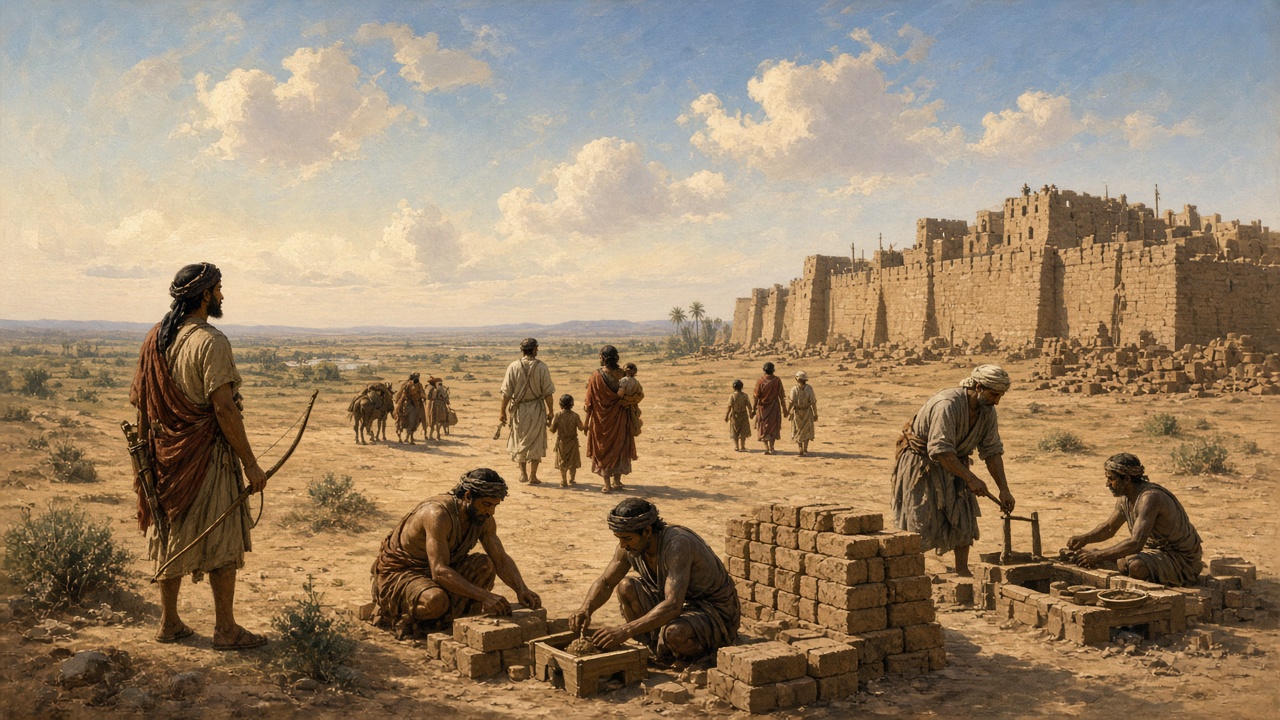
- Cuxe, filho de Cam, foi o pai de Ninrode, lembrado como um poderoso caçador diante do Senhor, cujo reino começou em Babilônia, Ereque, Acade e Calné, na terra de Sinar, provavelmente a Babilônia ou o sul da Mesopotâmia. Daquela terra ele partiu para a Assíria e construiu Nínive, Reobote-Ir, Calá e Resém; o sítio de Calá corresponde provavelmente às ruínas de Nimrud, na margem esquerda do Tigre.Fontes: o próprio texto bíblico · Shinar · Nineveh · Calah
- Mizraim, forma dual de uma palavra hebraica que significa montículo ou fortaleza, pode indicar o Alto e o Baixo Egito e é o nome que os hebreus costumavam dar àquele país; o árabe ainda o chama Muzr. Sem é chamado irmão mais velho de Jafé e antepassado de todos os filhos de Héber, tido como fundador do povo hebreu, enquanto uma tradição árabe lembra Joctã, filho de Héber e Kahtan em árabe, como ancestral de tribos da Arábia central e meridional.Fontes: o próprio texto bíblico · Mizraim · Eber (Heber) · Joktan
Notas escritas com auxílio de IA a partir de fontes abertas (Theographic Bible Metadata, CC BY-SA 4.0; Easton’s Bible Dictionary, domínio público) e revisadas antes de publicar.
Lugares deste capítulo
- Erech · Hoje: Uruk · 31.322, 45.636 · versículo 10
- Shinar · Hoje: Babylonia · 32.543, 44.422 · versículo 10
- Assyria · 36.359, 43.153 · versículo 11
- Calah · Hoje: Nimrud · 36.098, 43.329 · versículos 11, 12
- Nineveh · 36.359, 43.153 · versículos 11, 12
- Canaan · 32.767, 35.333 · versículo 19
- Gaza · Hoje: Tell Harube · 31.504, 34.464 · versículo 19
- Sidon · Hoje: Sandikli archaeological site in Sidon · 33.561, 35.372 · versículo 19
Só aparecem lugares com identificação de alta confiança (90% ou mais segundo as fontes acadêmicas reunidas pelo OpenBible). Mapa da época: DARE (Digital Atlas of the Roman Empire), CC BY 4.0; mapa atual: © colaboradores do OpenStreetMap; lugares: OpenBible.info (CC BY 4.0).
Créditos e licença desta tradução
Updated Brenton English Septuagint
Spelling and formatting update of the Brenton English Septuagint with Apocrypha
Public Domain
Language: English
Dialect: Mixed
Translation by: Sir Lancelot C. L. Brenton
Contributor: Adam Boyd
Original work was by Sir Lancelot C. L. Brenton in 1851.
CC0 Public Domain dedication on language updates by Adam Boyd in 2020.
2026-02-18
Títulos de seção adaptados da Berean Standard Bible (domínio público); não fazem parte do texto bíblico desta tradução.
Fonte: http://ebible.org/englxxup/ · eBible.org