Êxodo 2
Updated Brenton English Septuagint · Toque num versículo para ver as referências cruzadas.
The Birth and Adoption of Moses
1And there was a certain man of the tribe of Levi, who took to wife one of the daughters of Levi. 2And she conceived, and bore a male child; and having seen that he was fair, they hid him three months. 3And when they could no longer hide him, his mother took for him an ark, and besmeared it with bitumen, and cast the child into it, and put it in the ooze by the river. 4And his sister was watching from a distance, to learn what would happen to him.
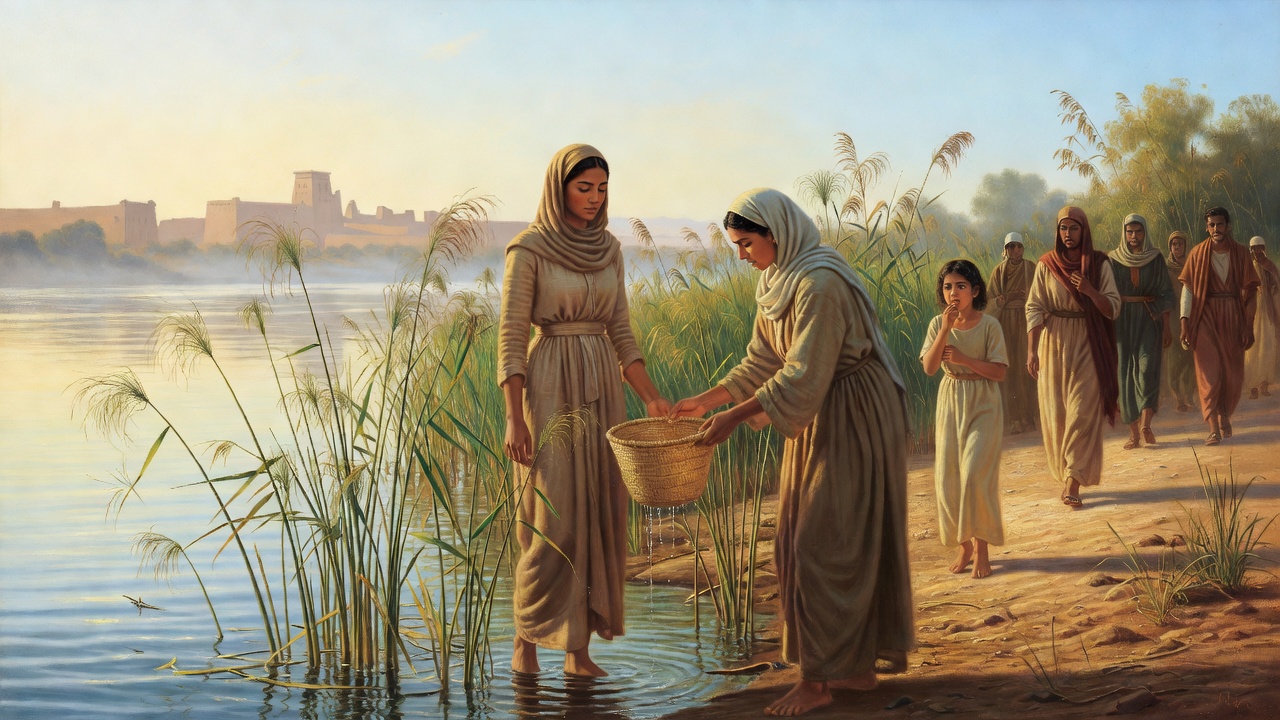
5And the daughter of Pharaoh came down to the river to bathe; and her maids walked by the river’s side, and having seen the ark in the ooze, she sent her maid, and took it up. 6And having opened it, she sees the babe weeping in the ark: and the daughter of Pharaoh had compassion on it, and said, This is one of the Hebrews’ children. 7And his sister said to the daughter of Pharaoh, Wilt thou that I call to thee a nurse of the Hebrews, and shall she suckle the child for thee? 8And the daughter of Pharaoh said, Go: and the young woman went, and called the mother of the child. 9And the daughter of Pharaoh said to her, Take care of this child, and suckle it for me, and I will give thee the wages; and the woman took the child, and suckled it. 10And when the boy was grown, she brought him to the daughter of Pharaoh, and he became her son; and she called his name, Moses, saying, I took him out of the water.
The Rejection and Flight of Moses
11And it came to pass in that length of time, that Moses having grown, went out to his brethren the sons of Israel: and having noticed their distress, he sees an Egyptian smiting a certain Hebrew of his brethren the children of Israel. 12And having looked round this way and that way, he sees no one; and he smote the Egyptian, and hid him in the sand. 13And having gone out the second day he sees two Hebrew men fighting; and he says to the injurer, Wherefore smitest thou thy neighbor? 14And he said, Who made thee a ruler and a judge over us? wilt thou slay me as thou yesterday slewest the Egyptian? Then Moses was alarmed, and said, If it be thus, this matter has become known. 15And Pharaoh heard this matter, and sought to slay Moses; and Moses departed from the presence of Pharaoh, and dwelt in the land of Midian; and having come into the land of Midian, he sat on the well. 16And the priest of Midian had seven daughters, feeding the flock of their father Jethro; and they came and drew water until they filled their pitchers, to water the flock of their father Jethro. 17And the shepherds came, and were driving them away; and Moses rose up and rescued them, and drew water for them, and watered their sheep. 18And they came to Reuel their father; and he said to them, Why have ye come so quickly today? 19And they said, An Egyptian delivered us from the shepherds, and drew water for us and watered our sheep. 20And he said to his daughters, And where is he? and why have ye left the man? call him therefore, that he may eat bread. 21And Moses was established with the man, and he gave Zipporah his daughter to Moses to wife. 22And the woman conceived and bore a son, and Moses called his name Gershom, saying, I am a sojourner in a strange land.
God Hears the Cry of the Israelites
23And in those days after a length of time, the king of Egypt died; and the children of Israel groaned because of their tasks, and cried, and their cry because of their tasks went up to God. 24And God heard their groanings, and God remembered his covenant made with Abraham and Isaac and Jacob. 25And God looked upon the children of Israel, and was made known to them.
Você sabia?
O nascimento e a fuga de Moisés
- A filha do faraó deu ao menino o nome de Moisés e explicou que o havia tirado da água. O Dicionário Bíblico de Easton (1897) liga o nome dele a “tirado”, ou à palavra egípcia mesu, “filho” — o elemento a partir do qual o dicionário também explica Ramsés como “filho real”.Fontes: o próprio texto bíblico · Moses
- Em Êxodo 2, uma filha de Levi esconde o filho por três meses, e a filha do faraó, ao achá-lo entre os juncos do Nilo, reconhece uma criança hebreia. O Dicionário Bíblico de Easton (1897) liga a aflição dos israelitas ao “novo rei que não conhecera a José”, por muito tempo tido como Aahmes I, chamado Amosis por Josefo, embora o dicionário, citando descobertas então recentes, o identifique como Seti. O sofrimento deles, diz a obra, começou depois que os hicsos, senhores do Egito por cerca de cinco séculos, foram expulsos e a antiga dinastia foi restaurada.Fontes: o próprio texto bíblico · Pharaoh
- Depois que o faraó procurou matá-lo, Moisés fugiu para Midiã e sentou-se junto a um poço; mais tarde casou-se com Zípora, uma das sete filhas do sacerdote de Midiã. Os midianitas eram árabes nômades, descendentes de Midiã, o quarto filho de Abraão com Quetura, e pastoreavam seus rebanhos na península do Sinai e no deserto ao norte da península Arábica. Neste capítulo o sacerdote se chama Reuel, a quem o Dicionário Bíblico de Easton (1897) chama Raguel, considerando essa forma seu nome pessoal e Jetro — “excelência” — um título oficial, caso os dois sejam identificados.Fontes: o próprio texto bíblico · Midian · Midian · Jethro
Notas escritas com auxílio de IA a partir de fontes abertas (Theographic Bible Metadata, CC BY-SA 4.0; Easton’s Bible Dictionary, domínio público) e revisadas antes de publicar.
Lugares deste capítulo
- Nile · Hoje: Nile River · 31.465, 30.367 · versículos 3, 5
- Midian · 28.495, 35.012 · versículos 15, 16
- Egypt · 30.129, 31.308 · versículo 23
Só aparecem lugares com identificação de alta confiança (90% ou mais segundo as fontes acadêmicas reunidas pelo OpenBible). Mapa da época: DARE (Digital Atlas of the Roman Empire), CC BY 4.0; mapa atual: © colaboradores do OpenStreetMap; lugares: OpenBible.info (CC BY 4.0).
Créditos e licença desta tradução
Updated Brenton English Septuagint
Spelling and formatting update of the Brenton English Septuagint with Apocrypha
Public Domain
Language: English
Dialect: Mixed
Translation by: Sir Lancelot C. L. Brenton
Contributor: Adam Boyd
Original work was by Sir Lancelot C. L. Brenton in 1851.
CC0 Public Domain dedication on language updates by Adam Boyd in 2020.
2026-02-18
Títulos de seção adaptados da Berean Standard Bible (domínio público); não fazem parte do texto bíblico desta tradução.
Fonte: http://ebible.org/englxxup/ · eBible.org