Levítico 21
Literal Standard Version · Toque num versículo para ver as referências cruzadas.
Holiness Required of Priests
1And YHWH says to Moses, “Speak to the priests, sons of Aaron, and you have said to them: No one defiles himself for a [dead] person among his people, 2except for his relation who [is] near to him: for his mother, and for his father, and for his son, and for his daughter, and for his brother, 3and for his sister, the virgin, who is near to him, who has not been to a man; he is defiled for her. 4A master [priest] does not defile himself among his people—to defile himself; 5they do not make baldness on their head, and they do not shave the corner of their beard, and they do not make a cutting in their flesh; 6they are holy to their God, and they do not defile the Name of their God, for the fire-offerings of YHWH, bread of their God, they are bringing near, and have been holy. 7They do not take a woman of harlotry, or defiled, and they do not take a woman cast out from her husband, for he [is] holy to his God; 8and you have sanctified him, for he is bringing the bread of your God near. He is holy to you, for I, YHWH, sanctifying you, [am] holy. 9And when a daughter of any priest defiles herself by going whoring—she is defiling her father; she is burned with fire. 10And the high priest of his brothers, on whose head the anointing oil is poured, and who has consecrated his hand to put on the garments, does not uncover his head, nor tear his garments, 11nor does he come beside any dead person; he does not defile himself for his father and for his mother; 12nor does he go out from the sanctuary, nor does he defile the sanctuary of his God, for the separation of the anointing oil of his God [is] on him; I [am] YHWH. 13And he takes a wife in her virginity; 14a widow, or cast out, or defiled, [or] a harlot—these he does not take, but he takes a virgin of his own people [for] a wife, 15and he does not defile his seed among his people; for I [am] YHWH, sanctifying him.”
Restrictions against Those with Blemishes
16And YHWH speaks to Moses, saying, 17“Speak to Aaron, saying, No man of your seed throughout their generations in whom there is blemish draws near to bring the bread of his God near, 18for no man in whom [is] a blemish draws near: a man blind, or lame, or disfigured, or deformed, 19or a man in whom there is a breach in the foot, or a breach in the hand, 20or hunchbacked, or a dwarf, or [with] a defect in his eye, or [with] an itch, or [with] a scab, or [with] a broken testicle. 21No man in whom is blemish (of the seed of Aaron the priest) comes near to bring the fire-offerings of YHWH near; blemish [is] in him; he does not come near to bring the bread of his God near. 22Bread of his God—from the most holy things and from the holy things—he eats; 23only, he does not come toward the veil, and he does not draw near to the altar; for blemish [is] in him; and he does not defile My sanctuaries; for I [am] YHWH, sanctifying them.” 24And Moses speaks to Aaron, and to his sons, and to all the sons of Israel.
Você sabia?
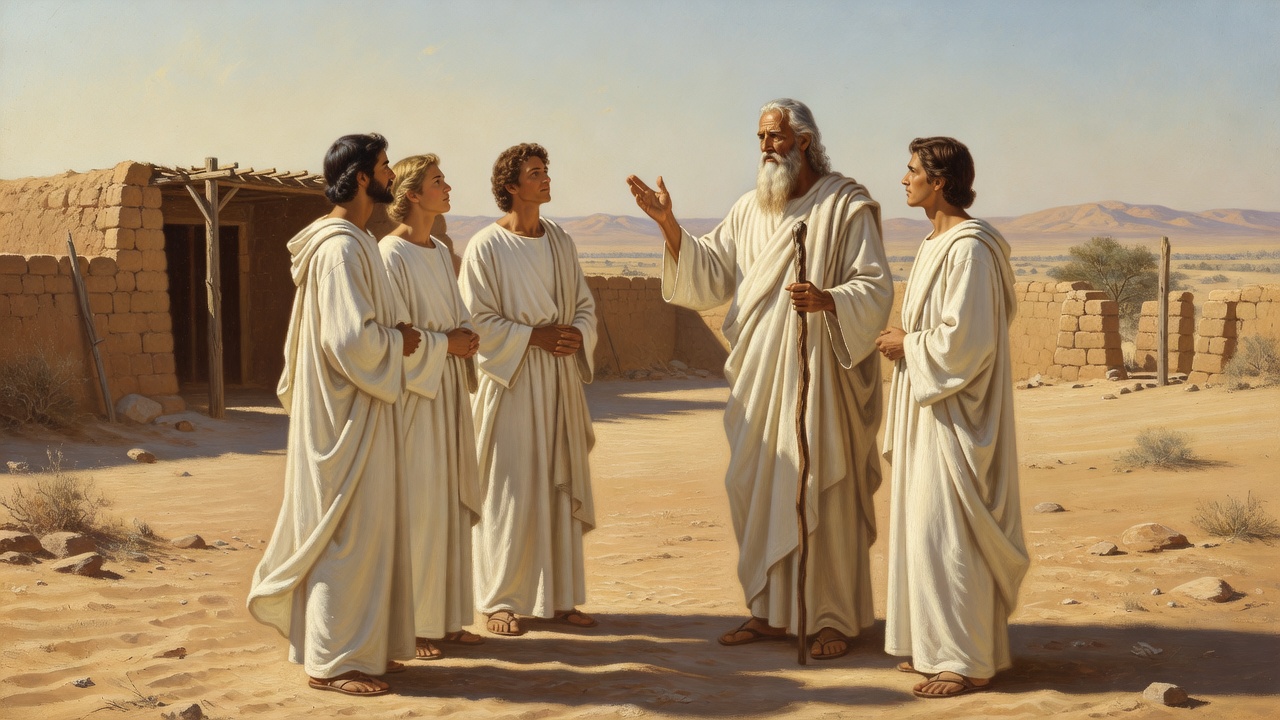
Santidade e Requisitos para o Sacerdócio
- Os sacerdotes comuns só podiam guardar luto por parentes consanguíneos imediatos — pais, filhos e irmãos solteiros —, enquanto o sumo sacerdote era estritamente proibido de se contaminar por qualquer cadáver, incluindo seus próprios pais, e não podia rasgar suas vestes em sinal de luto.Fontes: o próprio texto bíblico
- Enquanto os sacerdotes comuns eram proibidos de se casar com mulheres divorciadas ou prostitutas, o sumo sacerdote tinha uma exigência ainda mais rigorosa: só podia se casar com uma virgem do seu próprio povo.Fontes: o próprio texto bíblico
- Os descendentes de Arão com defeitos físicos ou lesões eram impedidos de apresentar ofertas queimadas no altar, mas ainda tinham permissão plena para comer das porções de alimentos santos e santíssimos.Fontes: o próprio texto bíblico
Notas escritas com auxílio de IA a partir de fontes abertas (Theographic Bible Metadata, CC BY-SA 4.0; Easton’s Bible Dictionary, domínio público) e revisadas antes de publicar.
Créditos e licença desta tradução
Literal Standard Version
The Holy Bible in English, Literal Standard Version
copyright © 2020 Covenant Press
Language: English
Dialect: American
Contributor: Covenant Press
The Literal Standard Version of the Holy Bible is a registered copyright of Covanet Press and the Covenant Christian Coalition (© 2020). Covenant Press is soliciting partnerships with Bible publishers that are interested in the LSV project. For queries about partnering with us, please email the translation team at [email protected]. To learn more, visit lsvbible.com. The purpose behind the LSV is to provide readers with a modern, easy-to-read, literal, and accurate translation of the Bible that is free to read, distribute, and translate from. We pray that God will use the LSV to illuminate the hearts and minds of multitudes with the good news that His Son Jesus Christ came in the flesh, died for our sins as a substitutionary sacrifice, rose bodily from the dead, and is coming back again.
This translation is made available to you under the terms of the
Creative Commons Attribution Share-Alike license 4.0.
You have permission to share and redistribute this Bible translation in any format and to make reasonable revisions and adaptations of this translation, provided that:
You include the above copyright and source information.
If you make any changes to the text, you must indicate that you did so in a way that makes it clear that the original licensor is not necessarily endorsing your changes.
If you redistribute this text, you must distribute your contributions under the same license as the original.
Pictures included with Scriptures and other documents on this site are licensed just for use with those Scriptures and documents.
For other uses, please contact the respective copyright owners.
Note that in addition to the rules above, revising and adapting God's Word involves a great responsibility to be true to God's Word. See Revelation 22:18-19.
2026-10-02
Títulos de seção adaptados da Berean Standard Bible (domínio público); não fazem parte do texto bíblico desta tradução.
Fonte: http://eBible.org/englsv/ · eBible.org