Isaías 64
Isaac Leeser Tanakh · Toque num versículo para ver as referências cruzadas.
A Prayer for God’s Power
1(63:19) Oh that thou mightest rend the heavens, come down: at thy presence would mountains [then] melt away. 2(64:1) As fire is kindled on brushwood, as water is made to bubble up by fire—to make thy name known to thy adversaries, that at thy presence nations might tremble! 3(64:2) [As] when thou didst fearful deeds which we had not looked for, thou camest down, [while] at thy presence mountains melted away; 4(64:3) Yea! what from the beginning of the world men had not heard, not perceived by their hearing; no eye [also] had seen a god beside thee, who could do [the like] for the one that waiteth for him. 5(64:4) Thou acceptest him that rejoiceth and worketh righteousness, those that remember thee in thy ways: behold, thou wast wroth, for we had sinned on them continually; and can we thus be saved? 6(64:5) And we are become like an unclean man all of us, and like a soiled garment, all our righteousness; and we wither like a leaf all of us; and our iniquities, like the wind, will bear us away. 7(64:6) And there is none that calleth upon thy name, that stirreth himself up to lay hold of thee; for thou hast hidden thy face from us, and hast let us melt away, through the force of our iniquities. 8(64:7) But now, O Lord, our father art thou; we are the clay, and thou our fashioner; and the work of thy hand are we all. 9(64:8) Be not wroth, O Lord, so very greatly, and do not for ever remember [our] iniquity: behold, look, we beseech thee, thy people are we all. 10(64:9) Thy holy cities are become a wilderness, Zion is become a wilderness, Jerusalem, a desolate place. 11(64:10) Our holy and beautiful house where our fathers praised thee, is burnt up with fire; and all our costly things are become ruins. 12(64:11) Wilt thou for these things refrain thyself, O Lord? wilt thou be silent, and afflict us so very greatly?
Você sabia?
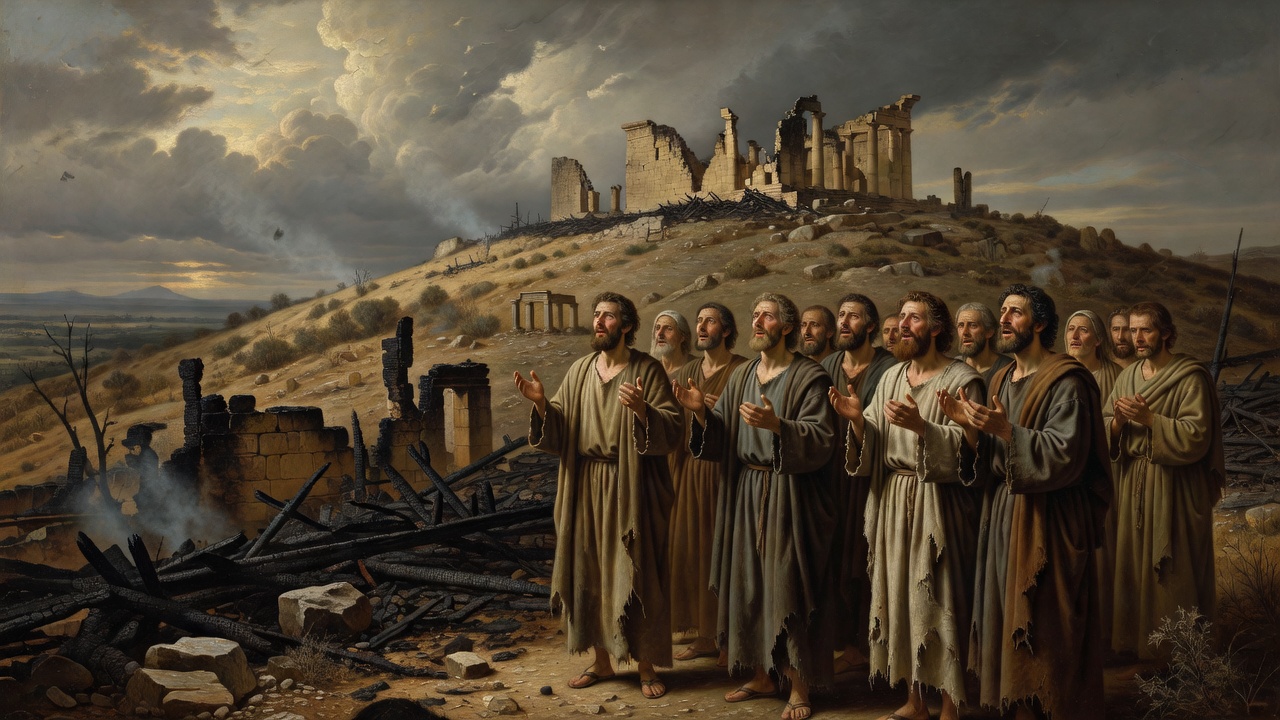
Uma Oração por Misericórdia em Meio às Ruínas
- A passagem começa com uma súplica para que Deus fenda os céus e desça com poder abalador, como fogo que acende a lenha. Contudo, contrasta esse desejo pela presença de Deus com uma confissão da indignidade humana, comparando as pessoas a folhas secas levadas por suas próprias iniquidades.Fontes: o próprio texto bíblico
- Em Isaías 64, a comunidade apela a Deus como Pai e artesão, declarando: "nós somos o barro, e tu és o nosso oleiro". Essa metáfora enfatiza a fragilidade humana e a total dependência de Deus, suplicando por misericórdia divina apesar do reconhecimento de suas culpas.Fontes: o próprio texto bíblico
- O capítulo lamenta a destruição dos espaços sagrados, descrevendo Sião e Jerusalém como desertos e desolações. O texto lamenta especificamente o incêndio e a ruína do templo sagrado onde as gerações passadas haviam prestado louvor.Fontes: o próprio texto bíblico · Zion · Jerusalem
Notas escritas com auxílio de IA a partir de fontes abertas (Theographic Bible Metadata, CC BY-SA 4.0; Easton’s Bible Dictionary, domínio público) e revisadas antes de publicar.
Lugares deste capítulo
Só aparecem lugares com identificação de alta confiança (90% ou mais segundo as fontes acadêmicas reunidas pelo OpenBible). Mapa da época: DARE (Digital Atlas of the Roman Empire), CC BY 4.0; mapa atual: © colaboradores do OpenStreetMap; lugares: OpenBible.info (CC BY 4.0).
Créditos e licença desta tradução
Isaac Leeser Tanakh
The Isaac Leeser Tanakh (Jewish Bible)
Public Domain
Language: English
Dialect: archaic British
Translation by: Isaac Leeser
2020-10-14
Títulos de seção adaptados da Berean Standard Bible (domínio público); não fazem parte do texto bíblico desta tradução.
Fonte: http://ebible.org/englee/ · eBible.org