Gênesis 8
Isaac Leeser Tanakh · Toque num versículo para ver as referências cruzadas.
The Ark Rests on Ararat
1And God remembered Noah, and every living thing, and all the cattle that were with him in the ark: and God caused a wind to pass over the earth, and the waters were assuaged; 2The fountains also of the deep, and the windows of heaven were stopped; and the rain from heaven was restrained. 3And the waters returned from off the earth, gradually returning; and the waters were abated after the end of the hundred and fifty days. 4And the ark rested in the seventh month, on the seventeenth day of the month, upon the mountains of Ararat. 5And the waters decreased continually until the tenth month; in the tenth month, on the first day of the month, were the tops of the mountains seen;
Noah Sends a Raven and a Dove
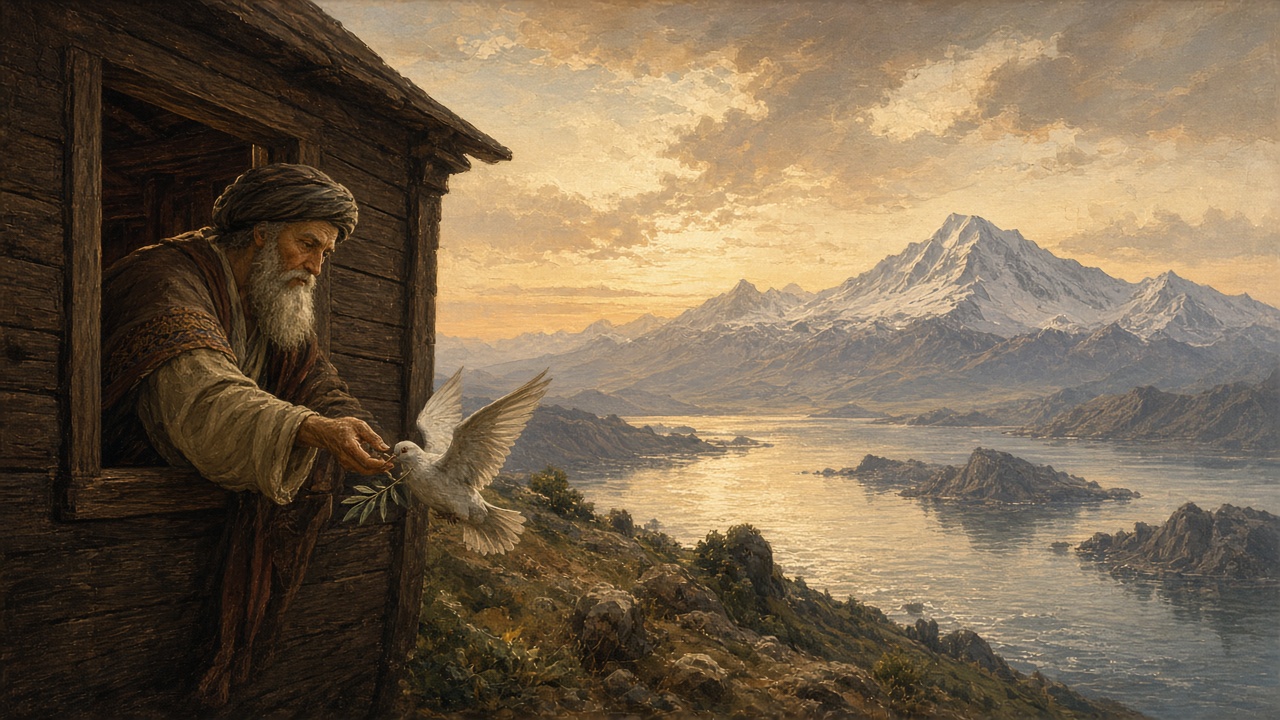
6And it came to pass at the end of forty days, that Noah opened the window of the ark which he had made; 7And he sent forth a raven which went forth to and fro, until the waters were dried up from off the earth. 8He then sent forth a dove from him, to see if the waters were abated from off the face of the ground. 9But the dove found no resting-place for the sole of her foot, and she returned unto him unto the ark; for there was water on the face of the whole earth; then he put forth his hand, and took her, and brought her into the ark. 10And he stayed yet another seven days, and again he sent forth the dove out of the ark. 11And the dove came in to him at the time of the evening; and, lo, an olive-leaf plucked off was in her mouth; so Noah knew that the waters were abated from off the earth. 12And he stayed yet other seven days, and sent forth the dove; but she returned not again unto him any more.
Exiting the Ark
13And it came to pass in the six hundredth and first year, in the first month, on the first day of the month, that the waters were dried up from off the earth; and Noah removed the covering of the ark, and looked, and, behold, the face of the ground was dry. 14And in the second month, on the seven and twentieth day of the month, was the earth perfectly dried up. 15And God spoke unto Noah, saying, 16Go forth from the ark, thou, and thy wife, and thy sons, and thy sons' wives with thee. 17Every living thing that is with thee, of all flesh, both of fowl, and of cattle, and of every creeping thing that creepeth upon the earth, bring forth with thee; that they may breed abundantly on the earth, and be fruitful, and multiply upon the earth. 18And Noah went forth, and his sons, and his wife, and his sons' wives with him. 19Every beast, every creeping thing, and every fowl, whatsoever creepeth upon the earth, after their families, went forth out of the ark.
Noah Builds an Altar
20And Noah built an altar unto the Lord, and he took of every clean cattle, and of every clean fowl, and offered burnt-offerings on the altar. 21And the Lord smelled the sweet savour; and the Lord said in his heart, I will not again curse the ground any more for the sake of man; although the imagination of man's heart is evil from his youth: neither will I again smite any more every thing living, as I have done. 22All the while the earth remaineth, seed-time and harvest, and cold and heat, and summer and winter, and day and night, shall not cease.
Você sabia?
As águas recuam
- A arca pousou sobre os montes de Ararate, nome que significa “terra sagrada” ou “terra alta” e designa um país em cujas montanhas a arca parou depois do dilúvio. O Easton's Bible Dictionary (1897) sugere que esses montes eram, provavelmente, a cordilheira curda do sul da Armênia, embora o nome também seja comumente aplicado a um pico alto e quase inacessível que se ergue da planície do Araxes. Em 2 Reis 19:37 e Isaías 37:38, a Authorized Version traduz o nome por “Armênia” e a Revised Version por “terra de Ararate”, enquanto Jeremias 51:27 o usa para a Armênia central ou meridional.Fontes: Ararat · o próprio texto bíblico
- O nome hebraico de Noé significa “descanso”, e neste capítulo a própria arca encontra descanso enquanto as águas baixam. Ele era filho de Lameque e neto de Matusalém, e pai de Sem, Cam e Jafé. O Easton's Bible Dictionary o descreve como o elo entre o mundo antigo e o novo, e como um segundo grande progenitor da família humana.Fontes: Noah · o próprio texto bíblico
- Notas cronológicas situam o Grande Dilúvio em 2347 a.C., com duração de um ano; o recuo das águas em 2346 a.C., ao longo de 220 dias; e a saída da arca em 2346 a.C., num único dia. No próprio capítulo, as águas já baixaram depois de 150 dias e a arca pousa no décimo sétimo dia do sétimo mês; no primeiro dia do primeiro mês do ano seiscentos e um de Noé as águas secaram, e no vigésimo sétimo dia do segundo mês a terra está completamente seca.Fontes: The Great Flood · The flood subsides · Leaving the Ark · o próprio texto bíblico
Notas escritas com auxílio de IA a partir de fontes abertas (Theographic Bible Metadata, CC BY-SA 4.0; Easton’s Bible Dictionary, domínio público) e revisadas antes de publicar.
Lugares deste capítulo
- Ararat · Hoje: Urartu · 39.703, 44.300 · versículo 4
Só aparecem lugares com identificação de alta confiança (90% ou mais segundo as fontes acadêmicas reunidas pelo OpenBible). Mapa da época: DARE (Digital Atlas of the Roman Empire), CC BY 4.0; mapa atual: © colaboradores do OpenStreetMap; lugares: OpenBible.info (CC BY 4.0).
Créditos e licença desta tradução
Isaac Leeser Tanakh
The Isaac Leeser Tanakh (Jewish Bible)
Public Domain
Language: English
Dialect: archaic British
Translation by: Isaac Leeser
2020-10-14
Títulos de seção adaptados da Berean Standard Bible (domínio público); não fazem parte do texto bíblico desta tradução.
Fonte: http://ebible.org/englee/ · eBible.org