Gênesis 40
Isaac Leeser Tanakh · Toque num versículo para ver as referências cruzadas.
The Cupbearer and the Baker
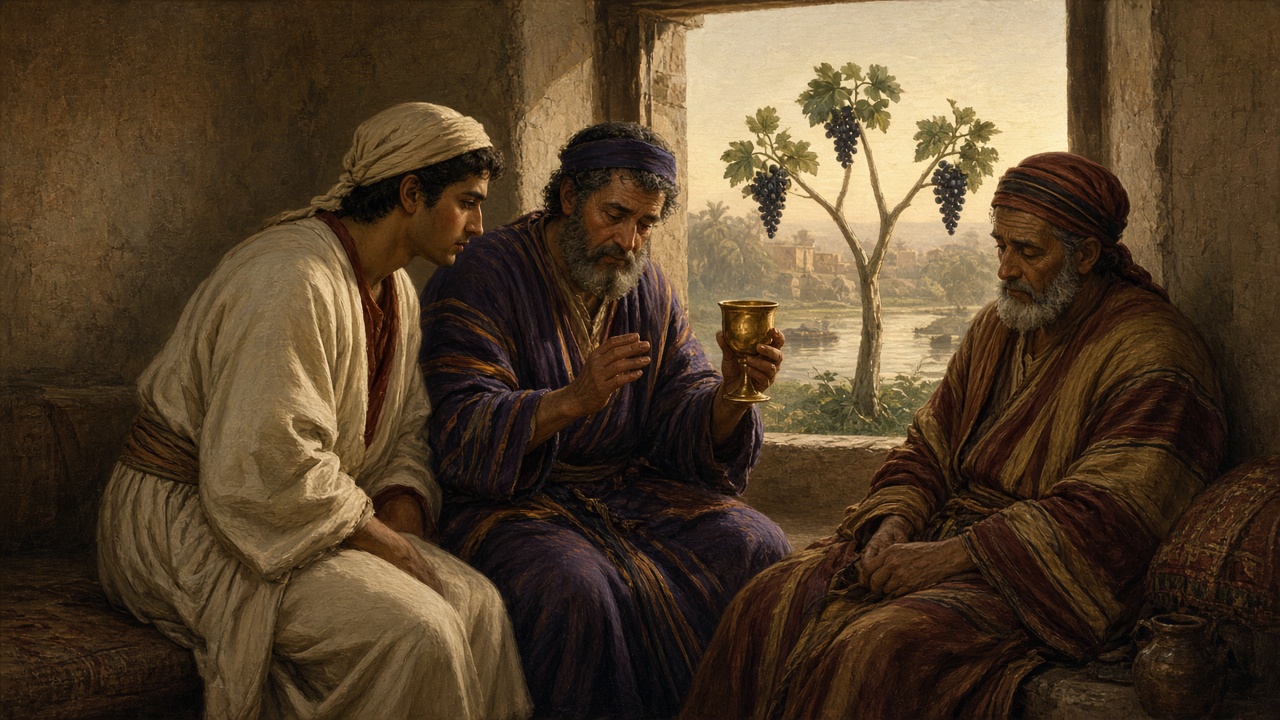
1And it came to pass after these things, that the butler of the king of Egypt and the baker committed an offense, against their lord the king of Egypt. 2And Pharaoh was wroth against his two officers, against the chief of the butlers, and against the chief of the bakers. 3And he put them in ward in the house of the captain of the guards, into the prison, the place where Joseph was confined. 4And the captain of the guards charged Joseph with them, and he served them; and they continued a season in ward. 5And they dreamed a dream, both of them, each his dream in one night, each in accordance with the interpretation of his dream, the butler and the baker of the king of Egypt, who were confined in the prison. 6And Joseph came in unto them in the morning, and looked at them, and, behold, they were sad. 7And he asked the officers of Pharaoh that were with him in ward in his lord's house, saying, Wherefore look ye so sadly today? 8And they said unto him, We have dreamed a dream, and there is none to interpret it. And Joseph said unto them, Do not interpretations belong to God? tell it to me, I pray you. 9The chief of the butlers then told his dream to Joseph, and said to him, In my dream, behold, a vine was before me; 10And on the vine were three branches; and it was as though it budded, shot forth its blossoms, and on its clusters the grapes became ripe: 11And Pharaoh's cup was in my hand; and I took the grapes, and pressed them out into Pharaoh's cup, and I placed the cup into Pharaoh's hand. 12And Joseph said unto him, This is its interpretation: The three branches are three days; 13Within yet three days will Pharaoh lift up thy head, and restore thee unto thy office; and thou shalt place Pharaoh's cup into his hand, after the former manner when thou wast his butler. 14Therefore if thou thinkest on me when it shall be well with thee, then show kindness, I pray thee, unto me, and make mention of me unto Pharaoh, and bring me out of this house; 15For indeed I was stolen away out of the land of the Hebrews; and here also have I not done the least that they should put me into the dungeon. 16And when the chief of the bakers saw that he had well interpreted, he said unto Joseph, I also [saw] in my dream, and, behold, I had three baskets with fine bread on my head: 17And in the uppermost basket there was of all manner of bakemeats, used as food for Pharaoh; and the birds did eat them out of the basket from my head. 18And Joseph answered and said, This is the interpretation: The three baskets are three days; 19Within yet three days will Pharaoh lift up thy head from off thee, and will hang thee on a tree; and the birds shall eat thy flesh from off thee. 20And it came to pass on the third day, which was Pharaoh's birthday, that he made a feast unto all his servants: and he lifted up the head of the chief of the butlers and the head of the chief of the bakers among his servants. 21And he restored the chief of the butlers unto his butlership; and he placed the cup in Pharaoh's hand; 22But the chief of the bakers he hanged, as Joseph had interpreted to them. 23Yet the chief of the butlers did not remember Joseph, and forgot him.
Você sabia?
Sonhos na prisão de Faraó
- Faraó ficou irado com dois oficiais, o chefe dos copeiros e o chefe dos padeiros, e os colocou na casa do capitão da guarda, a mesma prisão em que José estava preso. O capitão os confiou a José, que se tornou o atendente pessoal deles.Fontes: o próprio texto bíblico
- Na mesma noite, o copeiro e o padeiro sonharam, cada qual com o próprio sonho, e José disse que as interpretações pertencem a Deus. Ele tomou os três ramos e os três cestos como três dias: Faraó ergueria a cabeça do copeiro e o restauraria, mas tiraria a cabeça do padeiro e o enforcaria numa árvore. No terceiro dia, aniversário de Faraó, o rei ofereceu um banquete aos seus oficiais, restaurou o copeiro e enforcou o padeiro.Fontes: o próprio texto bíblico
- José pediu ao copeiro que, depois de restaurado, se lembrasse dele e o mencionasse a Faraó. Disse que tinha sido sequestrado da terra dos hebreus e que nada havia feito para ser lançado no calabouço. O Easton's Bible Dictionary (1897) identifica o Faraó da época de José provavelmente como Apopi, ou Apopis, o último dos reis hicsos; alguns argumentam, porém, que José chegou ao Egito mais tarde, no reinado de Thothmes III.Fontes: o próprio texto bíblico · Pharaoh (of Joseph)
Notas escritas com auxílio de IA a partir de fontes abertas (Theographic Bible Metadata, CC BY-SA 4.0; Easton’s Bible Dictionary, domínio público) e revisadas antes de publicar.
Lugares deste capítulo
Só aparecem lugares com identificação de alta confiança (90% ou mais segundo as fontes acadêmicas reunidas pelo OpenBible). Mapa da época: DARE (Digital Atlas of the Roman Empire), CC BY 4.0; mapa atual: © colaboradores do OpenStreetMap; lugares: OpenBible.info (CC BY 4.0).
Créditos e licença desta tradução
Isaac Leeser Tanakh
The Isaac Leeser Tanakh (Jewish Bible)
Public Domain
Language: English
Dialect: archaic British
Translation by: Isaac Leeser
2020-10-14
Títulos de seção adaptados da Berean Standard Bible (domínio público); não fazem parte do texto bíblico desta tradução.
Fonte: http://ebible.org/englee/ · eBible.org