Êxodo 14
Isaac Leeser Tanakh · Toque num versículo para ver as referências cruzadas.
Pharaoh Pursues the Israelites
1And the Lord spoke unto Moses, saying, 2Speak unto the children of Israel, that they turn back and encamp before Pi-hachiroth, between Migdol and the sea; in front of Baal-zephon; opposite to this shall ye encamp by the sea. 3And Pharaoh will say of the children of Israel, They are entangled in the land, the wilderness hath shut them in. 4And I will harden the heart of Pharaoh, that he shall follow after them; and I will get myself honor on Pharaoh, and on all his host; and the Egyptians shall know that I am the Lord; and they did so. 5And it was told to the king of Egypt that the people had fled; and the heart of Pharaoh and of his servants was changed with respect to the people, and they said, What is this which we have done, that we have let Israel go from serving us? 6And he made ready his chariot, and took his people with him. 7And he took six hundred chosen chariots, and all the chariots of Egypt, and captains over every one of them. 8And the Lord hardened the heart of Pharaoh, the king of Egypt, and he pursued after the children of Israel; and the children of Israel went out with a high hand. 9And the Egyptians pursued after them, and they overtook them encamping by the sea, all the horses and chariots of Pharaoh, and his horsemen, and his army, beside Pi-hachiroth, before Baal-zephon. 10And when Pharaoh drew nigh, the children of Israel lifted up their eyes, and, behold, the Egyptians were marching after them, and they were greatly afraid; and the children of Israel cried out unto the Lord. 11And they said unto Moses, Is it because there were no graves in Egypt, that thou hast taken us away to die in the wilderness? what is this which thou hast done to us, to bring us forth out of Egypt? 12Is not this the word that we spoke unto thee in Egypt, saying, Let us alone, that we may serve the Egyptians? for it is better for us to serve the Egyptians than that we should die in the wilderness. 13And Moses said unto the people, Fear ye not, stand still and see the salvation of the Lord, which he will do for you today; for as ye have seen the Egyptians today, ye shall not see them again any more for ever. 14The Lord will fight for you, and ye shall hold your peace.
Parting the Red Sea
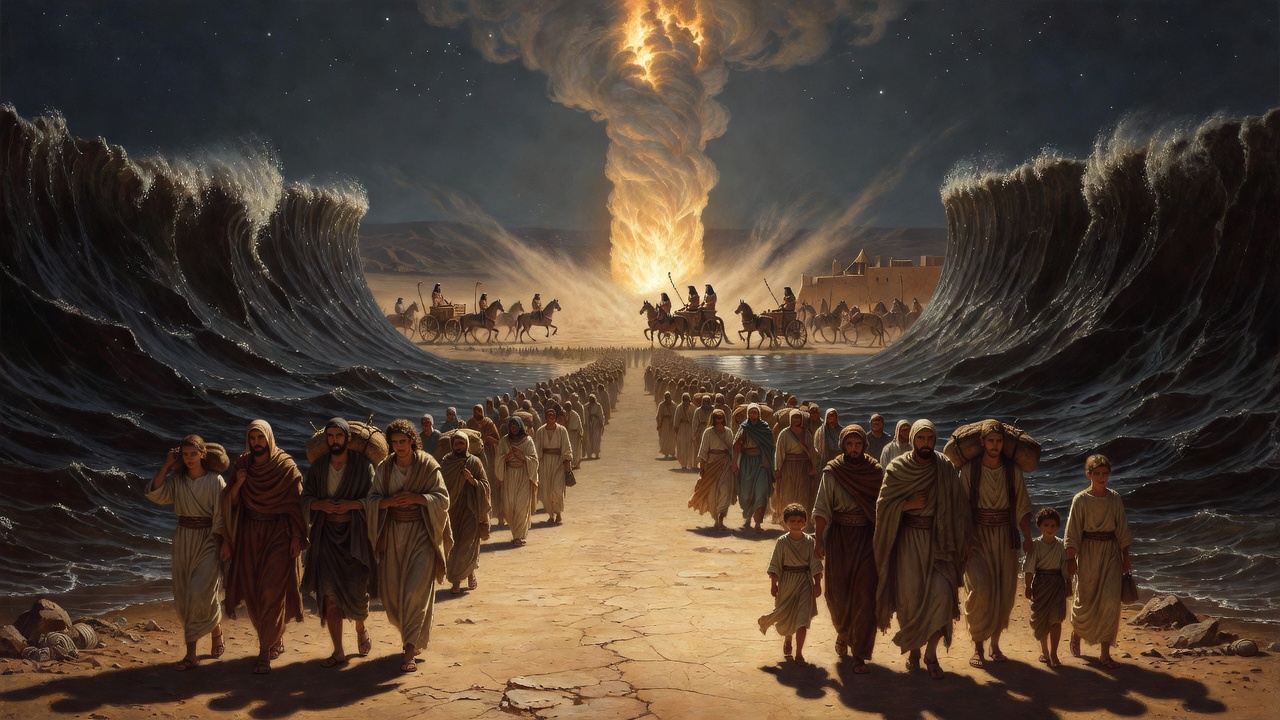
15And the Lord said unto Moses, Wherefore criest thou unto me? speak unto the children of Israel, that they go forward; 16But do thou lift up thy staff, and stretch out thy hand over the sea, and divide it; and the children of Israel shall go through the midst of the sea on dry ground. 17And I, behold, I will harden the heart of the Egyptians, and they shall follow them: and I will get myself honor on Pharaoh, and on all his host, on his chariots, and on his horsemen. 18And the Egyptians shall know that I am the Lord, when I have got myself honor on Pharaoh, on his chariots, and on his horsemen. 19And the angel of God, that went before the camp of Israel, removed and went behind them; and the pillar of cloud removed from before them, and stood behind them; 20And it came between the camp of the Egyptians and the camp of Israel; and it was a cloud and darkness [to the first], but it gave light by night [to these]: and the one came not near unto the other all the night. 21And Moses stretched out his hand over the sea; and the Lord drove back the sea with a strong east wind all that night, and made the sea dry land, and the waters were divided. 22And the children of Israel went into the midst of the sea upon the dry ground: and the waters were a wall unto them, on their right hand, and on their left. 23And the Egyptians pursued, and went in after them, all Pharaoh's horses, his chariots, and his horsemen, to the midst of the sea. 24And it came to pass in the morning watch, that the Lord looked unto the camp of the Egyptians with the pillar of fire and of the cloud, and brought into confusion the camp of the Egyptians; 25And he took off the wheels of their chariots, and caused them to move onward with difficulty; and the Egyptians said, Let us flee from the face of Israel; for the Lord fighteth for them against the Egyptians. 26And the Lord said unto Moses, Stretch out thy hand over the sea, and the waters shall return over the Egyptians, over their chariots, and over their horsemen. 27And Moses stretched forth his hand over the sea, and the sea returned, when the morning appeared, to its strength; while the Egyptians were fleeing against it; and the Lord overthrew the Egyptians in the midst of the sea. 28And the waters returned, and covered the chariots, and the horsemen with all the host of Pharaoh that came after them into the sea: there remained of them not even one. 29But the children of Israel walked upon dry ground in the midst of the sea; and the waters were unto them a wall on their right hand, and on their left. 30Thus the Lord saved Israel on that day out of the land of the Egyptians; and Israel saw the Egyptians dead upon the shore of the sea. 31And Israel saw that great power which the Lord had shown on the Egyptians: and the people feared the Lord, and then believed in the Lord, and in Moses his servant.
Você sabia?
Israel encurralado entre o faraó e o mar
- Israel recebeu ordem de voltar atrás e acampar diante de Pi-Hairote, entre Migdol e o mar, bem em frente a Baal-Zefom, para que o faraó pensasse que o deserto os havia encurralado. Pi-Hairote significa lugar onde crescem os juncos, embora a Septuaginta e o copta leiam fazenda, e Baal-Zefom significa Baal do norte.Fontes: o próprio texto bíblico · Pi-hahiroth · Baal-zephon
- O dicionário bíblico de Easton (1897) descreve Baal-Zefom como uma cidade egípcia à beira do golfo de Suez, provavelmente o atual Jebel Deraj ou Kulalah, na margem ocidental, e observa que Baal-zapuna, dos egípcios, era um lugar de culto. Alguns identificaram Pi-Hairote com Ajrud, uma fortaleza entre Etã e Suez. O verbete de Pi-Hairote acrescenta que a condição do istmo de Suez na época do Êxodo não é conhecida com exatidão, de modo que Pi-Hairote e os outros acampamentos de Israel no Egito não podem ser localizados com certeza; o istmo foi formado por depósitos do Nilo.Fontes: Baal-zephon · Pi-hahiroth
- O dicionário bíblico de Easton (1897) diz que o faraó do Êxodo foi provavelmente Menephtah I, o décimo quarto e mais velho filho sobrevivente de Ramsés II, e que ele residia em Zoã, onde ocorreram as entrevistas com Moisés e Arão registradas em Êxodo. O mesmo verbete ainda trata como questão aberta se esse rei foi Seti II ou seu pai Menephtah, e observa que alguns julgam que o peso das evidências favorece Seti II.Fontes: Pharaoh (of the Exodus)
Notas escritas com auxílio de IA a partir de fontes abertas (Theographic Bible Metadata, CC BY-SA 4.0; Easton’s Bible Dictionary, domínio público) e revisadas antes de publicar.
Lugares deste capítulo
Só aparecem lugares com identificação de alta confiança (90% ou mais segundo as fontes acadêmicas reunidas pelo OpenBible). Mapa da época: DARE (Digital Atlas of the Roman Empire), CC BY 4.0; mapa atual: © colaboradores do OpenStreetMap; lugares: OpenBible.info (CC BY 4.0).
Créditos e licença desta tradução
Isaac Leeser Tanakh
The Isaac Leeser Tanakh (Jewish Bible)
Public Domain
Language: English
Dialect: archaic British
Translation by: Isaac Leeser
2020-10-14
Títulos de seção adaptados da Berean Standard Bible (domínio público); não fazem parte do texto bíblico desta tradução.
Fonte: http://ebible.org/englee/ · eBible.org