Números 21
JPS TaNaKH 1917 · Toque num versículo para ver as referências cruzadas.
The Defeat of Arad
1And the Canaanite, the king of Arad, who dwelt in the South, heard tell that Israel came by the way of Atharim; and he fought against Israel, and took some of them captive. 2And Israel vowed a vow unto the LORD, and said: 'If Thou wilt indeed deliver this people into my hand, then I will utterly destroy their cities.' 3And the LORD hearkened to the voice of Israel, and delivered up the Canaanites; and they utterly destroyed them and their cities; and the name of the place was called Hormah.
The Bronze Serpent
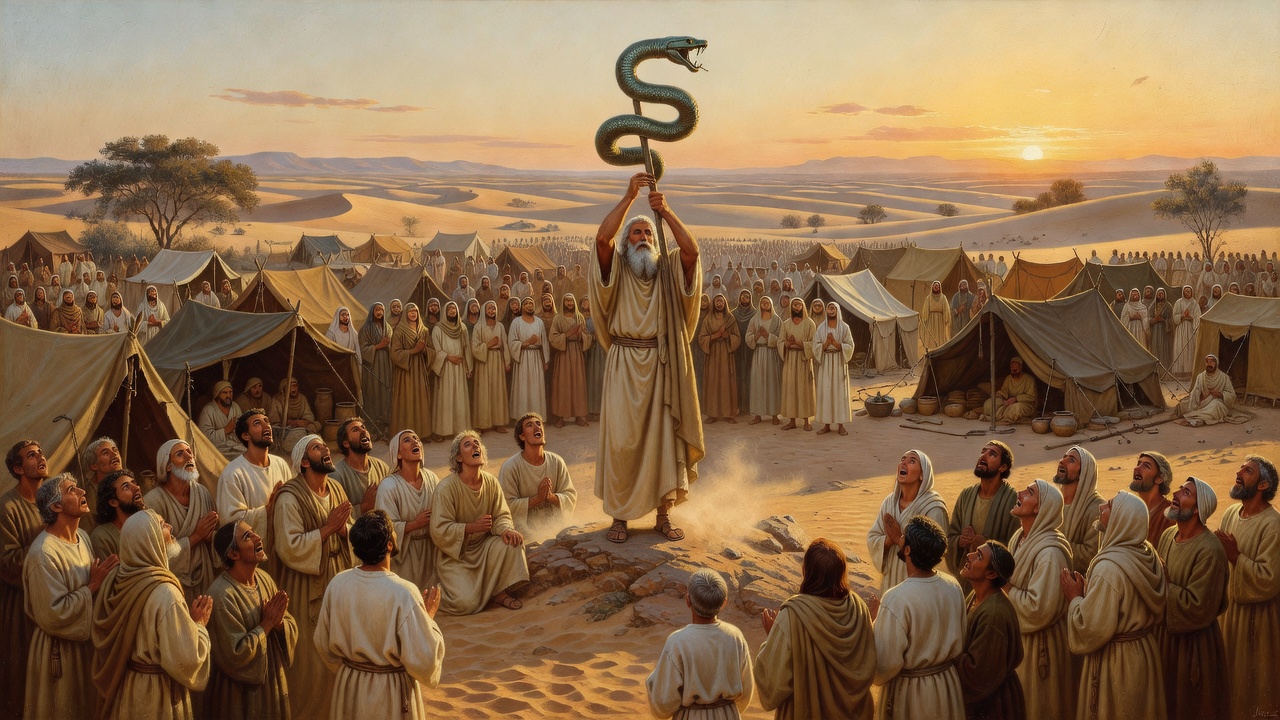
4And they journeyed from mount Hor by the way to the Red Sea, to compass the land of Edom; and the soul of the people became impatient because of the way. 5And the people spoke against God, and against Moses: 'Wherefore have ye brought us up out of Egypt to die in the wilderness? for there is no bread, and there is no water; and our soul loatheth this light bread.' 6And the LORD sent fiery serpents among the people, and they bit the people; and much people of Israel died. 7And the people came to Moses, and said: 'We have sinned, because we have spoken against the LORD, and against thee; pray unto the LORD, that He take away the serpents from us.' And Moses prayed for the people. 8And the LORD said unto Moses: 'Make thee a fiery serpent, and set it upon a pole; and it shall come to pass, that every one that is bitten, when he seeth it, shall live.' 9And Moses made a serpent of brass, and set it upon the pole; and it came to pass, that if a serpent had bitten any man, when he looked unto the serpent of brass, he lived.
The Journey to Moab
10And the children of Israel journeyed, and pitched in Oboth. 11And they journeyed from Oboth, and pitched at Ije-abarim, in the wilderness which is in front of Moab, toward the sun-rising. 12From thence they journeyed, and pitched in the valley of Zered. 13From thence they journeyed, and pitched on the other side of the Arnon, which is in the wilderness, that cometh out of the border of the Amorites. — For Arnon is the border of Moab, between Moab and the Amorites; 14wherefore it is said in the book of the Wars of the LORD: Vaheb in Suphah, and the valleys of Arnon, 15And the slope of the valleys that inclineth toward the seat of Ar, and leaneth upon the border of Moab. — 16And from thence to Beer; that is the well whereof the LORD said unto Moses: 'Gather the people together, and I will give them water.' 17Then sang Israel this song: Spring up, O well — sing ye unto it — 18The well, which the princes digged, which the nobles of the people delved, with the sceptre, and with their staves. And from the wilderness to Mattanah; 19and from Mattanah to Nahaliel; and from Nahaliel to Bamoth; 20and from Bamoth to the valley that is in the field of Moab, by the top of Pisgah, which looketh down upon the desert.
The Defeat of Sihon
21And Israel sent messengers unto Sihon king of the Amorites, saying: 22'Let me pass through thy land; we will not turn aside into field, or into vineyard; we will not drink of the water of the wells; we will go by the king's highway, until we have passed thy border.' 23And Sihon would not suffer Israel to pass through his border; but Sihon gathered all his people together, and went out against Israel into the wilderness, and came to Jahaz; and he fought against Israel. 24And Israel smote him with the edge of the sword, and possessed his land from the Arnon unto the Jabbok, even unto the children of Ammon; for the border of the children of Ammon was strong. 25And Israel took all these cities; and Israel dwelt in all the cities of the Amorites, in Heshbon, and in all the towns thereof. 26For Heshbon was the city of Sihon the king of the Amorites, who had fought against the former king of Moab, and taken all his land out of his hand, even unto the Arnon. 27Wherefore they that speak in parables say: Come ye to Heshbon! let the city of Sihon be built and established! 28For a fire is gone out of Heshbon, a flame from the city of Sihon; it hath devoured Ar of Moab, the lords of the high places of Arnon. 29Woe to thee, Moab! thou art undone, O people of Chemosh; he hath given his sons as fugitives, and his daughters into captivity, unto Sihon king of the Amorites. 30We have shot at them — Heshbon is perished — even unto Dibon, and we have laid waste even unto Nophah, which reacheth unto Medeba.
The Defeat of Og
31Thus Israel dwelt in the land of the Amorites. 32And Moses sent to spy out Jazer, and they took the towns thereof, and drove out the Amorites that were there. 33And they turned and went up by the way of Bashan; and Og the king of Bashan went out against them, he and all his people, to battle at Edrei. 34And the LORD said unto Moses: 'Fear him not; for I have delivered him into thy hand, and all his people, and his land; and thou shalt do to him as thou didst unto Sihon king of the Amorites, who dwelt at Heshbon.' 35So they smote him, and his sons, and all his people, until there was none left him remaining; and they possessed his land.
Você sabia?
A serpente de bronze e a marcha além do Arnom
- Quando os israelitas ficaram impacientes durante a jornada ao redor de Edom e se queixaram da falta de comida e água, serpentes venenosas surgiram no acampamento. Moisés recebeu instruções para fazer uma serpente de bronze e colocá-la sobre uma haste para que qualquer pessoa mordida pudesse olhar para ela e viver.Fontes: o próprio texto bíblico
- Este capítulo cita um antigo texto hebraico hoje desconhecido, chamado Livro das Guerras do SENHOR, para delimitar a fronteira ao longo do rio Arnom, que separava os moabitas dos amorreus.Fontes: o próprio texto bíblico · Arnon
- A passagem inclui um poema antigo que menciona Camos, a divindade adorada pelos moabitas. O poema relata como Seom, rei dos amorreus, havia conquistado anteriormente terras moabitas desde Hesbom até o Arnom antes de Israel derrotá-lo em batalha.Fontes: o próprio texto bíblico · Chemosh · Sihon · Heshbon
Notas escritas com auxílio de IA a partir de fontes abertas (Theographic Bible Metadata, CC BY-SA 4.0; Easton’s Bible Dictionary, domínio público) e revisadas antes de publicar.
Lugares deste capítulo
- Negeb · 31.245, 34.841 · versículo 1
- Edom · 30.746, 35.604 · versículo 4
- Way of the Red Sea · Hoje: road between the Dead Sea and the Gulf of Aqaba · 29.727, 34.998 · versículo 4
- Egypt · 30.129, 31.308 · versículo 5
- Moab · Hoje: Moab 1 · 31.181, 35.701 · versículos 11, 13, 15, 20, 26, 28, 29
- Valley of Zered · Hoje: Wadi al Hasa · 31.027, 35.485 · versículo 12
- Arnon · Hoje: Wadi Mujib · 31.466, 35.573 · versículos 13, 14, 24, 26, 28
- Waheb · Hoje: within 50 km of Sufeh · 31.666, 35.817 · versículo 14
- Jeshimon · 31.470, 35.223 · versículo 20
- King’s Highway · 31.955, 35.934 · versículo 22
- Ammon · 31.955, 35.934 · versículo 24
- Jabbok · Hoje: Zarqa River · 32.115, 35.543 · versículo 24
- Dibon · Hoje: Tall Dhiban · 31.502, 35.777 · versículo 30
- Medeba · Hoje: Madaba · 31.716, 35.795 · versículo 30
- Bashan · 32.781, 35.935 · versículo 33
Só aparecem lugares com identificação de alta confiança (90% ou mais segundo as fontes acadêmicas reunidas pelo OpenBible). Mapa da época: DARE (Digital Atlas of the Roman Empire), CC BY 4.0; mapa atual: © colaboradores do OpenStreetMap; lugares: OpenBible.info (CC BY 4.0).
Créditos e licença desta tradução
JPS TaNaKH 1917
The Jewish Bible (Old Testament) in English, published by the Jewish Publication Society in 1917
Public Domain
Language: English
Dialect: American
Translation by: Jewish Publication Society
This copy of the Old JPS TaNaKH by the Jewish Publication Society is brought to you courtesy of eBible.org . For the new JPS TaNaKH (1972, 1978, 1980), please see jps.org .
2023-09-19
Títulos de seção adaptados da Berean Standard Bible (domínio público); não fazem parte do texto bíblico desta tradução.
Fonte: http://ebible.org/engjps/ · eBible.org