Isaías 64
JPS TaNaKH 1917 · Toque num versículo para ver as referências cruzadas.
A Prayer for God’s Power
1(63-19) Oh, that Thou wouldest rend the heavens, that Thou wouldest come down, that the mountains might quake at Thy presence, 2(64-1) As when fire kindleth the brush-wood, and the fire causeth the waters to boil; to make Thy name known to Thine adversaries, that the nations might tremble at Thy presence, 3(64-2) When Thou didst tremendous things which we looked not for — Oh that Thou wouldest come down, that the mountains might quake at Thy presence! — 4(64-3) And whereof from of old men have not heard, nor perceived by the ear, neither hath the eye seen a God beside Thee, who worketh for him that waiteth for Him. 5(64-4) Thou didst take away him that joyfully worked righteousness, those that remembered Thee in Thy ways — behold, Thou wast wroth, and we sinned — upon them have we stayed of old, that we might be saved. 6(64-5) And we are all become as one that is unclean, and all our righteousnesses are as a polluted garment; and we all do fade as a leaf, and our iniquities, like the wind, take us away. 7(64-6) And there is none that calleth upon Thy name, that stirreth up himself to take hold of Thee; for Thou hast hid Thy face from us, and hast consumed us by means of our iniquities. 8(64-7) But now, O LORD, Thou art our Father; we are the clay, and Thou our potter, and we all are the work of Thy hand. 9(64-8) Be not wroth very sore, O LORD, neither remember iniquity for ever; behold, look, we beseech Thee, we are all Thy people. 10(64-9) Thy holy cities are become a wilderness, Zion is become a wilderness, Jerusalem a desolation. 11(64-10) Our holy and our beautiful house, where our fathers praised Thee, is burned with fire; and all our pleasant things are laid waste. 12(64-11) Wilt Thou refrain Thyself for these things, O LORD? Wilt Thou hold Thy peace, and afflict us very sore?
Você sabia?
Uma Oração por Misericórdia em Meio às Ruínas
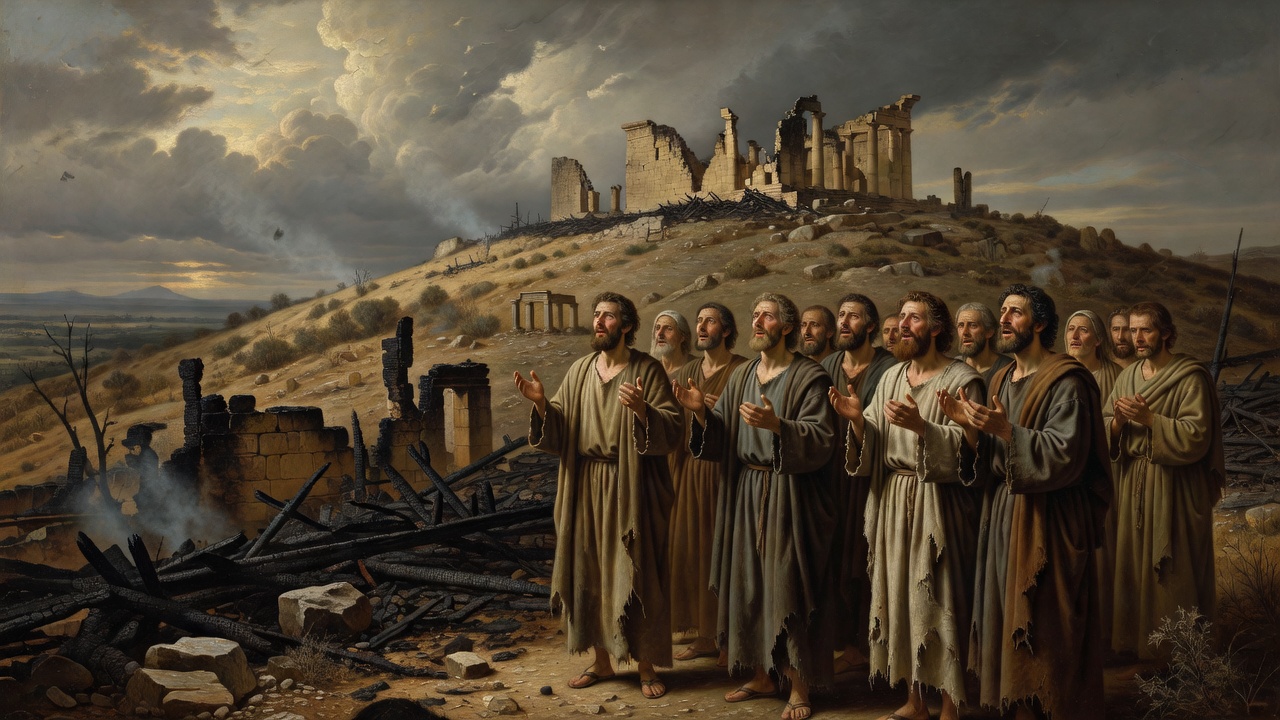
- A passagem começa com uma súplica para que Deus fenda os céus e desça com poder abalador, como fogo que acende a lenha. Contudo, contrasta esse desejo pela presença de Deus com uma confissão da indignidade humana, comparando as pessoas a folhas secas levadas por suas próprias iniquidades.Fontes: o próprio texto bíblico
- Em Isaías 64, a comunidade apela a Deus como Pai e artesão, declarando: "nós somos o barro, e tu és o nosso oleiro". Essa metáfora enfatiza a fragilidade humana e a total dependência de Deus, suplicando por misericórdia divina apesar do reconhecimento de suas culpas.Fontes: o próprio texto bíblico
- O capítulo lamenta a destruição dos espaços sagrados, descrevendo Sião e Jerusalém como desertos e desolações. O texto lamenta especificamente o incêndio e a ruína do templo sagrado onde as gerações passadas haviam prestado louvor.Fontes: o próprio texto bíblico · Zion · Jerusalem
Notas escritas com auxílio de IA a partir de fontes abertas (Theographic Bible Metadata, CC BY-SA 4.0; Easton’s Bible Dictionary, domínio público) e revisadas antes de publicar.
Lugares deste capítulo
Só aparecem lugares com identificação de alta confiança (90% ou mais segundo as fontes acadêmicas reunidas pelo OpenBible). Mapa da época: DARE (Digital Atlas of the Roman Empire), CC BY 4.0; mapa atual: © colaboradores do OpenStreetMap; lugares: OpenBible.info (CC BY 4.0).
Créditos e licença desta tradução
JPS TaNaKH 1917
The Jewish Bible (Old Testament) in English, published by the Jewish Publication Society in 1917
Public Domain
Language: English
Dialect: American
Translation by: Jewish Publication Society
This copy of the Old JPS TaNaKH by the Jewish Publication Society is brought to you courtesy of eBible.org . For the new JPS TaNaKH (1972, 1978, 1980), please see jps.org .
2023-09-19
Títulos de seção adaptados da Berean Standard Bible (domínio público); não fazem parte do texto bíblico desta tradução.
Fonte: http://ebible.org/engjps/ · eBible.org