Números 11
Free Bible Version · Toque num versículo para ver as referências cruzadas.
The Complaints of the People
1It wasn't long before the people started to complain about how much they were suffering. When the Lord heard what they were saying, he became angry. Fire from the Lord burned them, destroying some on the edge of the camp. 2The people cried to Moses for help. He prayed to the Lord and the fire subsided. 3So that place was named Taberah, because the fire from the Lord burned them.
4A group of troublemakers among them had such intense food cravings they affected the Israelites who started crying again, asking “Who's going to get us some meat to eat? 5We think back to all the fish we ate in Egypt that didn't cost us anything, as well as the cucumbers, melons, leeks, onions, and garlic. 6We're fading away here! The only thing we ever see is this manna!”
7Manna looked like coriander seeds, light in color like gum resin. 8The people would go out and collect it, grind it up in a mill or crush it in a mortar. Then they would boil it in a pot and make it into flatbread. It tasted like pastries made with the best olive oil. 9When the dew came down on the camp at night the manna would come down with it.
The Complaint of Moses
10Moses heard all the families crying at the entrance to their tents. The Lord became very angry, and Moses was also upset. 11He asked the Lord, “Why have you made things so tough for me, your servant? Why are you so unhappy with me that you have placed on me the heavy responsibility for all these people? 12Are they my children? Did I give birth to them, so you could tell me, ‘Hold them close to your chest like a nurse carrying a baby’ and take them to the land you promised to give to their forefathers? 13Where am I supposed to get meat for all of them? They keep on complaining to me, ‘Get us some meat to eat!’ 14I can't go on carrying all these people by myself—it's just too much. 15If this is the way you're going to treat me, then please just kill me now so I don't have to face how depressed I've become. Please grant me this one request.”
Seventy Elders Anointed
16The Lord told Moses, “Bring before me seventy Israelite elders who you know are respected as leaders by the people. Take them to the Tent of Meeting. They will stand there with you. 17I will come down and talk with you there. I will take some of the Spirit you have and give it to them. They will take some of the responsibility for the people so you won't have to bear it alone.
18Tell the people: Purify yourselves, for tomorrow you'll have meat to eat, because you were complaining and the Lord heard you saying, ‘Who's going to get us some meat to eat? We were better off in Egypt!’ So the Lord is going to provide you with meat to eat. 19You're going to eat it, not for just a day or two, and not for five or ten or twenty days. 20You're going to eat it for a whole month until it makes you vomit and it comes out through your nostrils, because you have rejected the Lord who is right here with you, complaining to him by saying, ‘Why on earth did we ever leave Egypt?’”
21But Moses replied, “Here I am with 600,000 people and you're telling me, ‘I'm going to give them meat and they'll eat it for a month’? 22Even if all our flocks and herds were slaughtered, would that be enough for them? Even if all the fish in the sea were caught, would that be enough for them?”
23“Doesn't the Lord have the power to do that?” the Lord responded. “Now you're going to find out whether what I've said will happen or not!”
24Moses went and shared with the people what the Lord said. He summoned seventy elders of the people and had them stand around the tent. 25Then the Lord came down and talked to him. The Lord took some of the Spirit Moses had and gave it to them. They prophesied, but this didn't ever happen again.
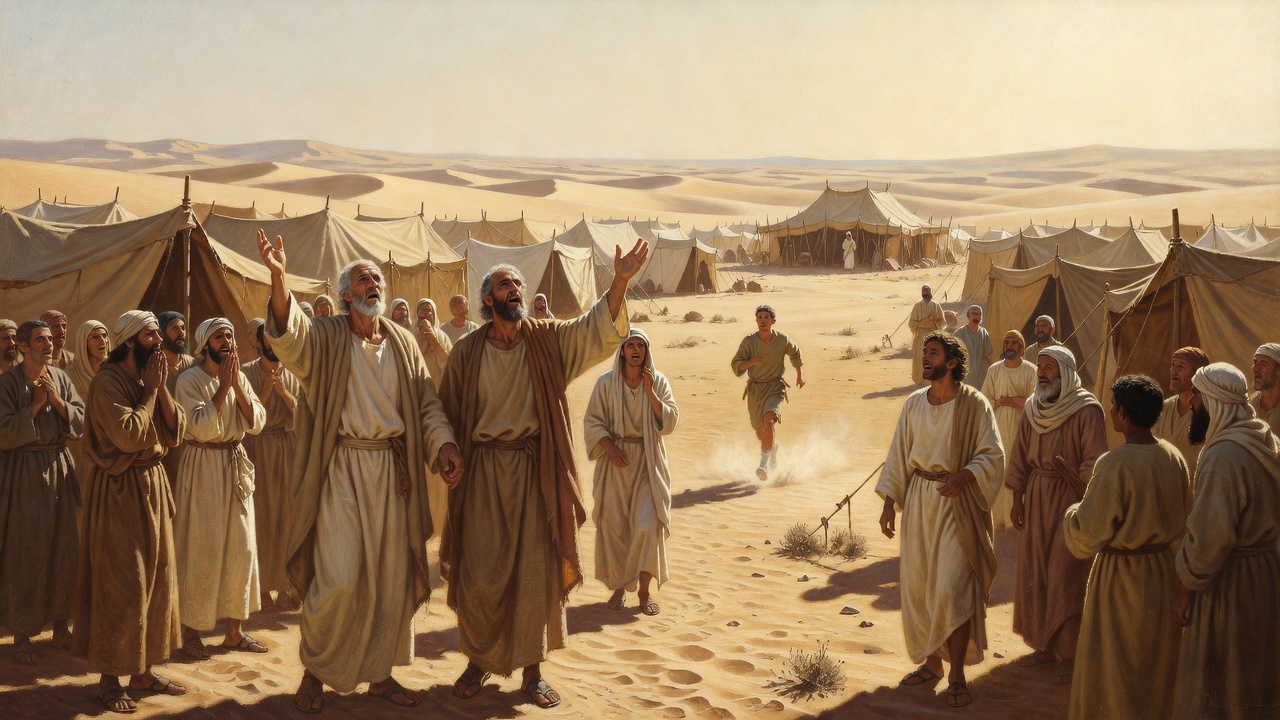
26However, two men named Eldad and Medad had stayed behind in the camp. The Spirit came on them too. (They had been put on the list of the seventy elders, but they hadn't gone to the tent. But they prophesied where they were in the camp anyway.) 27A young lad ran and told Moses, “Eldad and Medad are prophesying in the camp.”
28Joshua, son of Nun, who had been Moses' assistant since he was young, reacted, saying, “Moses, my lord, you have to stop them!”
29“Are you jealous for my reputation?” Moses replied. “I wish that every one of the Lord's people were prophets and that the Lord would give his Spirit to all of them!” 30Then Moses went back to the camp with the elders of Israel.
The Quail and the Plague
31The Lord sent a wind that blew quail in from the sea and deposited them near the camp. They covered the ground to a depth of about two cubits and extended for a day's journey in every direction from the camp. 32All through that day and night, and all through the next day, the people went on collecting the quail. Everyone collected at least ten homers, and they spread them out to dry all around the camp.
33But while the people were still biting into the meat, before they even chewed it down, the Lord showed his burning anger against them, killing some of them with a severe disease. 34They named that place Kibroth-hattaavah, because that was where they buried the people who had these intense food cravings.
35Then they moved on from Kibroth-hattaavah to Hazeroth, where they stayed for some time.
Você sabia?
Queixas, codornizes e o Espírito no acampamento
- Os locais mencionados neste capítulo receberam nomes derivados de acontecimentos da viagem: Taberá significa "queimada", nomeada após o fogo consumir a extremidade do acampamento, enquanto Quibrote-Hataavá significa "sepulturas da cobiça" ou do desejo, onde foram enterrados os que desejaram carne.Fontes: Taberah · Kibroth-hattaavah · o próprio texto bíblico
- Embora setenta anciãos tenham sido escolhidos para ajudar Moisés na liderança, Eldade e Medade permaneceram no acampamento em vez de ir à Tenda do Encontro, mas o Espírito repousou sobre eles e profetizaram. Quando Josué pediu a Moisés que os impedisse, Moisés respondeu desejando que todo o povo do Senhor fosse profeta.Fontes: Eldad · Joshua · o próprio texto bíblico
- O texto descreve o maná como semelhante a sementes de coentro e resina, o qual os israelitas recolhiam, moíam em moinhos manuais ou pilavam em almofarizes, coziam em panelas ou assavam em bolos com sabor de massa preparada com azeite.Fontes: o próprio texto bíblico
Notas escritas com auxílio de IA a partir de fontes abertas (Theographic Bible Metadata, CC BY-SA 4.0; Easton’s Bible Dictionary, domínio público) e revisadas antes de publicar.
Lugares deste capítulo
Só aparecem lugares com identificação de alta confiança (90% ou mais segundo as fontes acadêmicas reunidas pelo OpenBible). Mapa da época: DARE (Digital Atlas of the Roman Empire), CC BY 4.0; mapa atual: © colaboradores do OpenStreetMap; lugares: OpenBible.info (CC BY 4.0).
Créditos e licença desta tradução
Free Bible Version
The New Testament and Psalms in the Free Bible Version translation in American English
Copyright © 2018 Dr. Jonathan Gallagher
Language: English
Dialect: American
Translation by: Dr. Jonathan Gallagher
This translation is made available to you under the terms of the
Creative Commons Attribution Share-Alike license 4.0.
You have permission to share and redistribute this Bible translation in any format and to make reasonable revisions and adaptations of this translation, provided that:
You include the above copyright and source information.
If you make any changes to the text, you must indicate that you did so in a way that makes it clear that the original licensor is not necessarily endorsing your changes.
If you redistribute this text, you must distribute your contributions under the same license as the original.
Pictures included with Scriptures and other documents on this site are licensed just for use with those Scriptures and documents.
For other uses, please contact the respective copyright owners.
Note that in addition to the rules above, revising and adapting God's Word involves a great responsibility to be true to God's Word. See Revelation 22:18-19.
2026-10-02
Títulos de seção adaptados da Berean Standard Bible (domínio público); não fazem parte do texto bíblico desta tradução.
Fonte: http://ebible.org/engfbv/ · eBible.org