Mateus 15
Berean Standard Bible · Toque num versículo para ver as referências cruzadas.
The Tradition of the Elders
1Then some Pharisees and scribes came to Jesus from Jerusalem and asked, 2“Why do Your disciples break the tradition of the elders? They do not wash their hands before they eat.”
3Jesus replied, “And why do you break the command of God for the sake of your tradition? 4For God said, ‘Honor your father and mother’ and ‘Anyone who curses his father or mother must be put to death.’ 5But you say that if anyone says to his father or mother, ‘Whatever you would have received from me is a gift devoted to God,’ 6he need not honor his father or mother with it. Thus you nullify the word of God for the sake of your tradition. 7You hypocrites! Isaiah prophesied correctly about you:
8‘These people honor Me with their lips,
but their hearts are far from Me.
9They worship Me in vain;
they teach as doctrine the precepts of men.’”
What Defiles a Man
10Jesus called the crowd to Him and said, “Listen and understand. 11A man is not defiled by what enters his mouth, but by what comes out of it.”
12Then the disciples came to Him and said, “Are You aware that the Pharisees were offended when they heard this?”
13But Jesus replied, “Every plant that My heavenly Father has not planted will be pulled up by its roots. 14Disregard them! They are blind guides. If a blind man leads a blind man, both will fall into a pit.”
15Peter said to Him, “Explain this parable to us.”
16“Do you still not understand?” Jesus asked. 17“Do you not yet realize that whatever enters the mouth goes into the stomach and then is eliminated? 18But the things that come out of the mouth come from the heart, and these things defile a man. 19For out of the heart come evil thoughts, murder, adultery, sexual immorality, theft, false testimony, and slander. 20These are what defile a man, but eating with unwashed hands does not defile him.”
The Faith of the Canaanite Woman
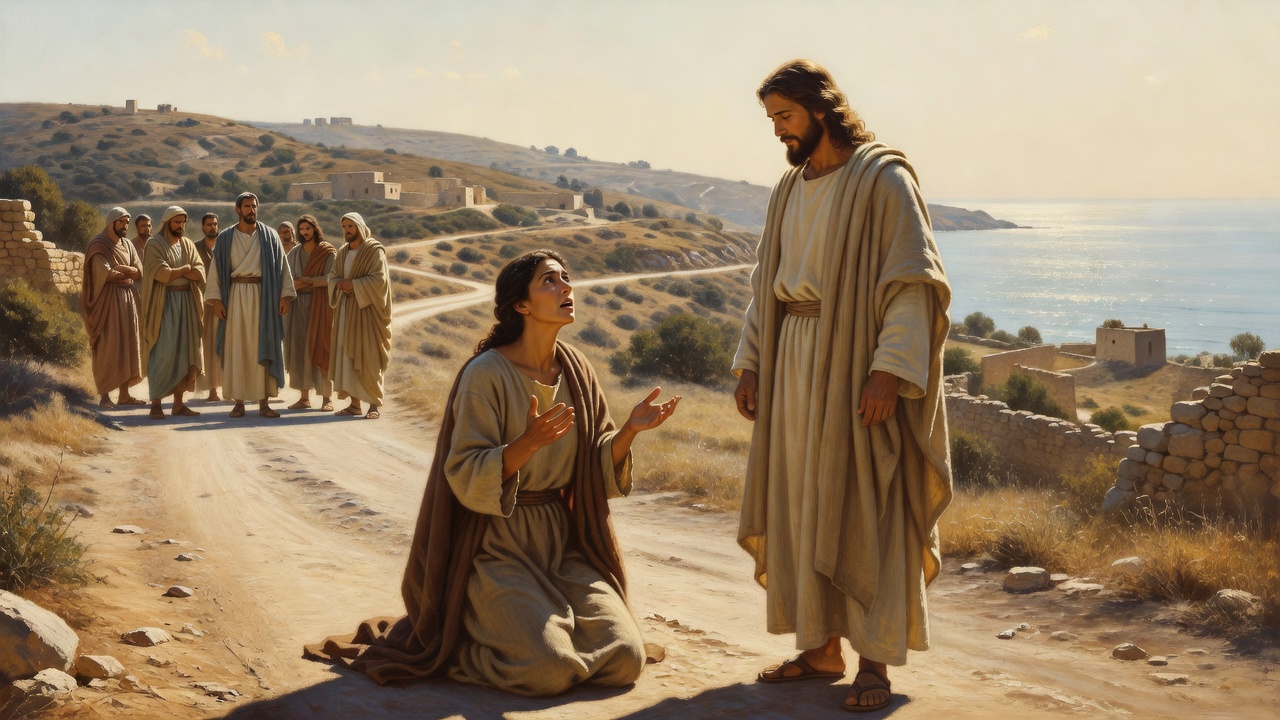
21Leaving that place, Jesus withdrew to the district of Tyre and Sidon. 22And a Canaanite woman from that region came to Him, crying out, “Lord, Son of David, have mercy on me! My daughter is miserably possessed by a demon.”
23But Jesus did not answer a word. So His disciples came and urged Him, “Send her away, for she keeps crying out after us.”
24He answered, “I was sent only to the lost sheep of the house of Israel.”
25The woman came and knelt before Him. “Lord, help me!” she said.
26But Jesus replied, “It is not right to take the children’s bread and toss it to the dogs.”
27“Yes, Lord,” she said, “even the dogs eat the crumbs that fall from their master’s table.”
28“O woman,” Jesus answered, “your faith is great! Let it be done for you as you desire.” And her daughter was healed from that very hour.
The Feeding of the Four Thousand
29Moving on from there, Jesus went along the Sea of Galilee. Then He went up on a mountain and sat down. 30Large crowds came to Him, bringing the lame, the blind, the crippled, the mute, and many others, and laid them at His feet, and He healed them. 31The crowd was amazed when they saw the mute speaking, the crippled restored, the lame walking, and the blind seeing. And they glorified the God of Israel.
32Then Jesus called His disciples to Him and said, “I have compassion for this crowd, because they have already been with Me three days and have nothing to eat. I do not want to send them away hungry, or they may faint along the way.”
33The disciples replied, “Where in this desolate place could we find enough bread to feed such a large crowd?”
34“How many loaves do you have?” Jesus asked.
“Seven,” they replied, “and a few small fish.”
35And He instructed the crowd to sit down on the ground. 36Taking the seven loaves and the fish, He gave thanks and broke them. Then He gave them to the disciples, and the disciples gave them to the people.
37They all ate and were satisfied, and the disciples picked up seven basketfuls of broken pieces that were left over. 38A total of four thousand men were fed, in addition to women and children.
39After Jesus had dismissed the crowds, He got into the boat and went to the region of Magadan.
Você sabia?
Tradição, a costa de Tiro e pão à beira do lago
- Fariseus e escribas vieram de Jerusalém e perguntaram por que os discípulos de Jesus comiam sem lavar as mãos, tratando isso como uma quebra da tradição dos anciãos. Ele respondeu citando Isaías, que o Easton's Bible Dictionary (1897) identifica como filho de Amoz e situa nos reinados de Uzias, Jotão, Acaz e Ezequias, sobre gente que honra a Deus com os lábios enquanto o coração está longe.Fontes: o próprio texto bíblico · Isaiah
- Jesus retirou-se então para a região de Tiro e Sidom, onde uma mulher cananeia pediu que ele curasse a filha e o chamou de Filho de Davi. Sidom, na costa do Mediterrâneo ao norte de Tiro, tomou o nome de Zidão, o filho mais velho de Canaã e antepassado dos sidônios e dos fenícios. Era a mais antiga cidade fenícia e a cidade-mãe de Tiro; ficava no território de Aser, mas nunca foi subjugada.Fontes: o próprio texto bíblico · Sidon · Tyre · Canaan
- Depois, Jesus seguiu ao longo do mar da Galileia, sentou-se num monte e curou as pessoas postas a seus pés, antes de alimentar quatro mil homens, além de mulheres e crianças, com sete pães e alguns peixinhos. O Easton's Bible Dictionary (1897) observa que João chama esse lago de mar de Tiberíades e situa sua superfície a 682 pés abaixo do Mediterrâneo. O mesmo dicionário diz que a travessia de barco terminou em Magadã, nome que aparece só neste capítulo e que Marcos chama de Dalmanuta, na margem oeste do lago.Fontes: o próprio texto bíblico · Sea of Galilee · Magadan
Notas escritas com auxílio de IA a partir de fontes abertas (Theographic Bible Metadata, CC BY-SA 4.0; Easton’s Bible Dictionary, domínio público) e revisadas antes de publicar.
Lugares deste capítulo
- Jerusalem · 31.777, 35.234 · versículo 1
- Galilee · 32.760, 35.527 · versículo 21
- Sidon · Hoje: Sandikli archaeological site in Sidon · 33.561, 35.372 · versículo 21
- Tyre · 33.271, 35.196 · versículo 21
- Canaan · 32.767, 35.333 · versículo 22
- Sea of Galilee · 32.819, 35.590 · versículo 29
Só aparecem lugares com identificação de alta confiança (90% ou mais segundo as fontes acadêmicas reunidas pelo OpenBible). Mapa da época: DARE (Digital Atlas of the Roman Empire), CC BY 4.0; mapa atual: © colaboradores do OpenStreetMap; lugares: OpenBible.info (CC BY 4.0).
Créditos e licença desta tradução
Berean Standard Bible
The Holy Bible in English: Berean Standard Bible
Public Domain
Language: English
Contributor: BSB Publishing, LLC
2026-10-02
Fonte: http://ebible.org/engbsb/ · eBible.org