João 1
Berean Standard Bible · Toque num versículo para ver as referências cruzadas.
Sobre este livro
Sobre João
- O Dicionário Bíblico de Easton (1897) atribui o Evangelho de João ao apóstolo João e afirma que ele provavelmente foi escrito em Éfeso por volta de 90 d.C. Observa que, depois da destruição de Jerusalém em 70 d.C., Éfeso se tornou um centro da vida e da atividade cristãs no Oriente, e que, a partir de cerca de 1820, houve muitas tentativas de negar que João fosse o autor.Fontes: Easton: John, Gospel of
- A narrativa se passa no tempo de Pôncio Pilatos, o sexto procurador romano da Judeia, de 26 a 36 d.C., com sede em Cesareia e que subia com frequência a Jerusalém. A Judeia era então a mais meridional das três divisões da Palestina, distinta da Galileia e da Samaria, e fazia parte da província romana da Síria; o Evangelho também situa um casamento em Caná, cidade da Galileia perto de Cafarnaum.Fontes: Pontius Pilate · Judea · Cana
- Depois do prólogo (1:1-5), Easton diz que a narrativa histórica começa no versículo 6 e se divide em duas partes. A primeira (1:6 até o capítulo 12) acompanha o ministério público desde a apresentação de Jesus por João Batista até o fim desse ministério. A segunda (capítulos 13 a 21) o apresenta na vida privada com seus seguidores imediatos (13-17) e depois relata seus sofrimentos e as aparições aos discípulos após a ressurreição (18-21).Fontes: Easton: John, Gospel of
- Easton enumera quatro traços distintivos: a relação do Filho com o Pai, a relação de Cristo com os que creem, o anúncio do Espírito Santo como Consolador e o destaque dado ao amor no caráter cristão. O dicionário afirma que o Evangelho se dirigia principalmente aos cristãos.Fontes: Easton: John, Gospel of
- Easton observa que outrora se supôs que João escreveu para suprir omissões dos três primeiros evangelhos, mas diz que não há evidência disso. Citando Reuss, descreve o livro antes como uma apresentação histórica da fé cristã centrada na pessoa de Cristo, que retrata a oposição do mundo à verdade nele revelada e a bem-aventurança espiritual dos poucos que se entregam a ele como a Luz da vida.Fontes: Easton: John, Gospel of
Notas escritas com auxílio de IA a partir de fontes abertas (Theographic Bible Metadata, CC BY-SA 4.0; Easton’s Bible Dictionary, domínio público) e revisadas antes de publicar.
The Beginning
1In the beginning was the Word, and the Word was with God, and the Word was God. 2He was with God in the beginning. 3Through Him all things were made, and without Him nothing was made that has been made. 4In Him was life, and that life was the light of men. 5The Light shines in the darkness, and the darkness has not overcome it.
The Witness of John
6There came a man who was sent from God. His name was John. 7He came as a witness to testify about the Light, so that through him everyone might believe. 8He himself was not the Light, but he came to testify about the Light.
9The true Light who gives light to every man was coming into the world. 10He was in the world, and though the world was made through Him, the world did not recognize Him. 11He came to His own, and His own did not receive Him. 12But to all who did receive Him, to those who believed in His name, He gave the right to become children of God— 13children born not of blood, nor of the desire or will of man, but born of God.
The Word Became Flesh
14The Word became flesh and made His dwelling among us. We have seen His glory, the glory of the one and only Son from the Father, full of grace and truth.
15John testified concerning Him. He cried out, saying, “This is He of whom I said, ‘He who comes after me has surpassed me because He was before me.’”
16From His fullness we have all received grace upon grace. 17For the law was given through Moses; grace and truth came through Jesus Christ. 18No one has ever seen God, but the one and only Son, who is Himself God and is at the Father’s side, has made Him known.
The Mission of John the Baptist
19And this was John’s testimony when the Jews of Jerusalem sent priests and Levites to ask him, “Who are you?” 20He did not refuse to confess, but openly declared, “I am not the Christ.”
21“Then who are you?” they inquired. “Are you Elijah?”
He said, “I am not.”
“Are you the Prophet?”
He answered, “No.”
22So they said to him, “Who are you? We need an answer for those who sent us. What do you say about yourself?”
23John replied in the words of Isaiah the prophet:
“I am a voice of one calling in the wilderness,
‘Make straight the way for the Lord.’”
24Then the Pharisees who had been sent 25asked him, “Why then do you baptize, if you are not the Christ, nor Elijah, nor the Prophet?”
26“I baptize with water,” John replied, “but among you stands One you do not know. 27He is the One who comes after me, the straps of whose sandals I am not worthy to untie.”
28All this happened at Bethany beyond the Jordan, where John was baptizing.
Jesus the Lamb of God
29The next day John saw Jesus coming toward him and said, “Look, the Lamb of God, who takes away the sin of the world! 30This is He of whom I said, ‘A man who comes after me has surpassed me because He was before me.’ 31I myself did not know Him, but the reason I came baptizing with water was that He might be revealed to Israel.”
32Then John testified, “I saw the Spirit descending from heaven like a dove and resting on Him. 33I myself did not know Him, but the One who sent me to baptize with water told me, ‘The man on whom you see the Spirit descend and rest is He who will baptize with the Holy Spirit.’ 34I have seen and testified that this is the Son of God.”
The First Disciples
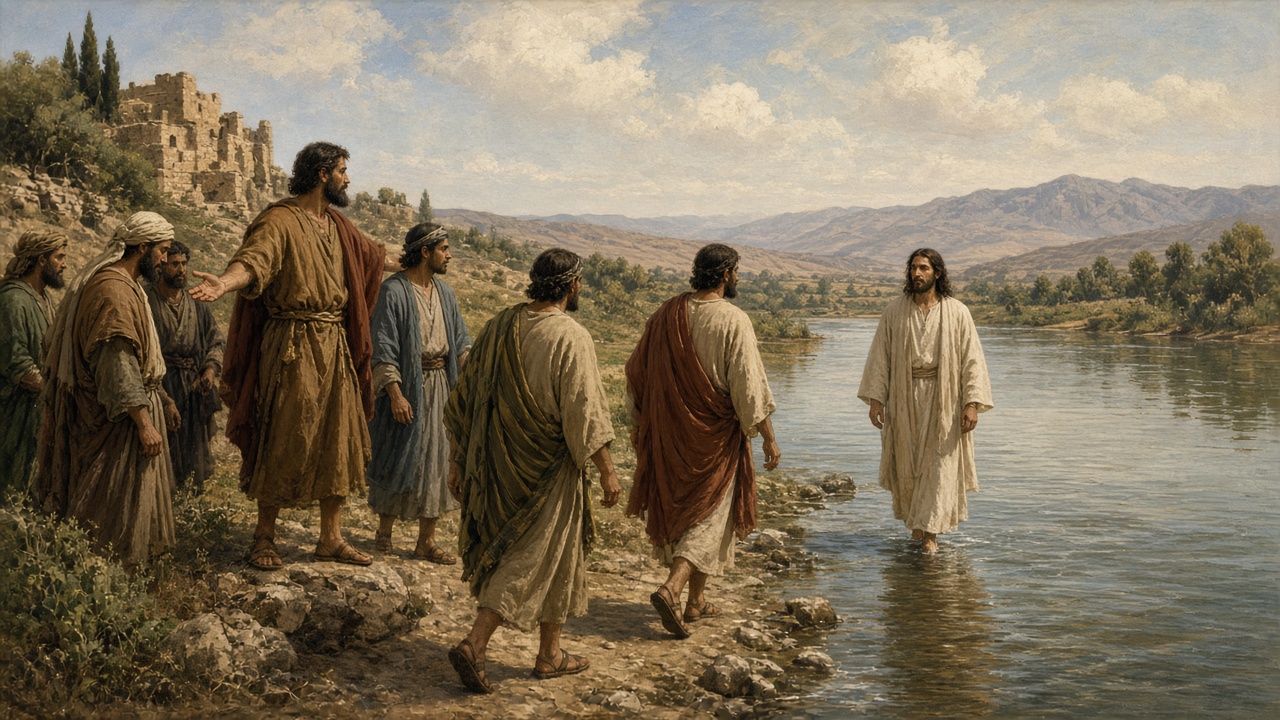
35The next day John was there again with two of his disciples. 36When he saw Jesus walking by, he said, “Look, the Lamb of God!” 37And when the two disciples heard him say this, they followed Jesus.
38Jesus turned and saw them following. “What do you want?” He asked.
They said to Him, “Rabbi” (which means Teacher), “where are You staying?”
39“Come and see,” He replied. So they went and saw where He was staying, and spent that day with Him. It was about the tenth hour.
40Andrew, Simon Peter’s brother, was one of the two who heard John’s testimony and followed Jesus. 41He first found his brother Simon and told him, “We have found the Messiah” (which is translated as Christ).
42Andrew brought him to Jesus, who looked at him and said, “You are Simon son of John. You will be called Cephas” (which is translated as Peter).
Jesus Calls Philip and Nathanael
43The next day Jesus decided to set out for Galilee. Finding Philip, He told him, “Follow Me.” 44Now Philip was from Bethsaida, the same town as Andrew and Peter.
45Philip found Nathanael and told him, “We have found the One Moses wrote about in the Law, the One the prophets foretold—Jesus of Nazareth, the son of Joseph.”
46“Can anything good come from Nazareth?” Nathanael asked.
“Come and see,” said Philip.
47When Jesus saw Nathanael approaching, He said of him, “Here is a true Israelite, in whom there is no deceit.”
48“How do You know me?” Nathanael asked.
Jesus replied, “Before Philip called you, I saw you under the fig tree.”
49“Rabbi,” Nathanael answered, “You are the Son of God! You are the King of Israel!”
50Jesus said to him, “Do you believe just because I told you I saw you under the fig tree? You will see greater things than these.” 51Then He declared, “Truly, truly, I tell you, you will all see heaven open and the angels of God ascending and descending on the Son of Man.”
Você sabia?
O Verbo, o testemunho de João e os primeiros discípulos
- Quando os judeus de Jerusalém enviaram sacerdotes e levitas para perguntar quem ele era, João negou ser o Cristo, Elias ou o Profeta, e se descreveu, com palavras de Isaías, como uma voz que clama no deserto. Ele era de descendência sacerdotal: seu pai, Zacarias, pertencia à turma de Abias, e sua mãe, Isabel, era das filhas de Arão. Uma nota sobre o acontecimento situa esse testemunho no ano 27 d.C.Fontes: o próprio texto bíblico · John the Baptist · John's Witness
- Tudo isso aconteceu em Betânia, além do Jordão, onde João estava batizando. Uma nota sobre o lugar registra que a Revised Version traz aqui Betânia em vez de Betabara, com a autoridade dos manuscritos mais antigos, e que o nome parece ter sido o de um lugar a leste do Jordão.Fontes: o próprio texto bíblico · Bethany
- André, então discípulo de João e natural de Betsaida, ouviu João chamar Jesus de Cordeiro de Deus, passou a segui-lo e é descrito como o primeiro dos discípulos de Jesus; em seguida, levou seu irmão Simão. Filipe encontrou Natanael e falou-lhe de Jesus de Nazaré, e Natanael perguntou se dali poderia vir alguma coisa boa, uma cidade não mencionada no Antigo Testamento. Natanael, de Caná da Galileia, é chamado um israelita em quem não há engano e, como este Evangelho nunca nomeia Bartolomeu, tem sido identificado com ele.Fontes: o próprio texto bíblico · Andrew · Nathanael · Nazareth
Notas escritas com auxílio de IA a partir de fontes abertas (Theographic Bible Metadata, CC BY-SA 4.0; Easton’s Bible Dictionary, domínio público) e revisadas antes de publicar.
Lugares deste capítulo
- Jerusalem · 31.777, 35.234 · versículo 19
- Jordan · Hoje: Jordan River · 31.761, 35.558 · versículo 28
- Galilee · 32.760, 35.527 · versículo 43
- Nazareth · 32.702, 35.298 · versículos 45, 46
Só aparecem lugares com identificação de alta confiança (90% ou mais segundo as fontes acadêmicas reunidas pelo OpenBible). Mapa da época: DARE (Digital Atlas of the Roman Empire), CC BY 4.0; mapa atual: © colaboradores do OpenStreetMap; lugares: OpenBible.info (CC BY 4.0).
Créditos e licença desta tradução
Berean Standard Bible
The Holy Bible in English: Berean Standard Bible
Public Domain
Language: English
Contributor: BSB Publishing, LLC
2026-10-02
Fonte: http://ebible.org/engbsb/ · eBible.org