Êxodo 5
Berean Standard Bible · Toque num versículo para ver as referências cruzadas.
Pharaoh’s First Refusal
1After that, Moses and Aaron went to Pharaoh and said, “This is what the LORD, the God of Israel, says: ‘Let My people go, so that they may hold a feast to Me in the wilderness.’”
2But Pharaoh replied, “Who is the LORD that I should obey His voice and let Israel go? I do not know the LORD, and I will not let Israel go.”
3“The God of the Hebrews has met with us,” they answered. “Please let us go on a three-day journey into the wilderness to sacrifice to the LORD our God, or He may strike us with plagues or with the sword.”
4But the king of Egypt said to them, “Moses and Aaron, why do you draw the people away from their work? Get back to your labor!” 5Pharaoh also said, “Look, the people of the land are now numerous, and you would be stopping them from their labor.”
Bricks and Straw
6That same day Pharaoh commanded the taskmasters of the people and their foremen: 7“You shall no longer supply the people with straw for making bricks. They must go and gather their own straw. 8But require of them the same quota of bricks as before; do not reduce it. For they are lazy; that is why they are crying out, ‘Let us go and sacrifice to our God.’ 9Make the work harder on the men so they will be occupied and pay no attention to these lies.”
10So the taskmasters and foremen of the people went out and said to them, “This is what Pharaoh says: ‘I am no longer giving you straw. 11Go and get your own straw wherever you can find it; but your workload will in no way be reduced.’”
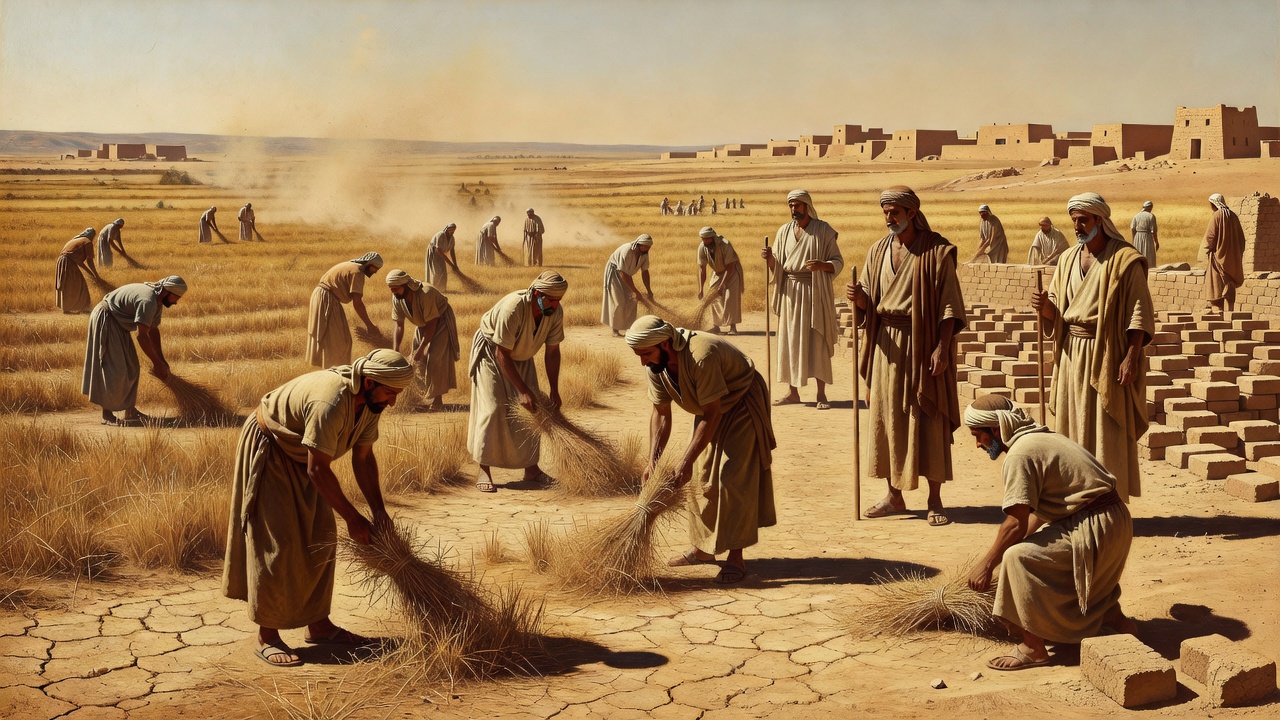
12So the people scattered all over the land of Egypt to gather stubble for straw. 13The taskmasters kept pressing them, saying, “Fulfill your quota each day, just as you did when straw was provided.”
14Then the Israelite foremen, whom Pharaoh’s taskmasters had set over the people, were beaten and asked, “Why have you not fulfilled your quota of bricks yesterday or today, as you did before?”
The Cry of the Israelites
15So the Israelite foremen went and appealed to Pharaoh: “Why are you treating your servants this way? 16No straw has been given to your servants, yet we are told, ‘Make bricks!’ Look, your servants are being beaten, but the fault is with your own people.”
17“You are slackers!” Pharaoh replied. “Slackers! That is why you keep saying, ‘Let us go and sacrifice to the LORD.’ 18Now get to work. You will be given no straw, yet you must deliver the full quota of bricks.”
19The Israelite foremen realized they were in trouble when they were told, “You must not reduce your daily quota of bricks.” 20When they left Pharaoh, they confronted Moses and Aaron, who stood waiting to meet them.
21“May the LORD look upon you and judge you,” the foremen said, “for you have made us a stench before Pharaoh and his officials; you have placed in their hand a sword to kill us!”
22So Moses returned to the LORD and asked, “Lord, why have You brought trouble upon this people? Is this why You sent me? 23Ever since I went to Pharaoh to speak in Your name, he has brought trouble on this people, and You have not delivered Your people in any way.”
Você sabia?
Trabalho mais duro depois da recusa do faraó
- O Easton's Bible Dictionary (1897) diz que o faraó do Êxodo foi provavelmente Menephtah I, o décimo quarto e mais velho filho sobrevivente de Ramsés II, mas trata a identificação como uma questão ainda em aberto: alguns estudiosos, observa a obra, preferem Seti II, cujo reinado ela descreve como iniciado em paz e terminado num desastre repentino. O verbete diz que ele residia em Zoã, onde recebeu Moisés e Arão nas audiências registradas em Êxodo.Fontes: Pharaoh (of the Exodus) · o próprio texto bíblico
- O Easton's Bible Dictionary (1897) situa a chegada de Jacó ao Egito provavelmente cerca de 350 anos antes do nascimento de Moisés. Diz que um rei hicso, de um povo semita pastoril da Ásia e chamado rei pastor, recebeu a família com favor e lhes destinou Gósen, a melhor terra; neste capítulo o faraó trata o povo de Israel, já numeroso, como trabalhadores que não pretende deixar partir.Fontes: Moses · o próprio texto bíblico
- O faraó responde ao pedido de celebrar uma festa no deserto deixando de fornecer a palha para os tijolos, mas ainda exigindo a mesma cota diária. O povo se espalha por toda a terra do Egito para recolher restolho, e os oficiais israelitas que os capatazes do faraó haviam posto sobre eles são espancados quando essa cota não é cumprida.Fontes: o próprio texto bíblico
Notas escritas com auxílio de IA a partir de fontes abertas (Theographic Bible Metadata, CC BY-SA 4.0; Easton’s Bible Dictionary, domínio público) e revisadas antes de publicar.
Lugares deste capítulo
Só aparecem lugares com identificação de alta confiança (90% ou mais segundo as fontes acadêmicas reunidas pelo OpenBible). Mapa da época: DARE (Digital Atlas of the Roman Empire), CC BY 4.0; mapa atual: © colaboradores do OpenStreetMap; lugares: OpenBible.info (CC BY 4.0).
Créditos e licença desta tradução
Berean Standard Bible
The Holy Bible in English: Berean Standard Bible
Public Domain
Language: English
Contributor: BSB Publishing, LLC
2026-10-02
Fonte: http://ebible.org/engbsb/ · eBible.org