Deuteronômio 24
Berean Standard Bible · Toque num versículo para ver as referências cruzadas.
Marriage and Divorce Laws
1If a man marries a woman, but she becomes displeasing to him because he finds some indecency in her, he may write her a certificate of divorce, hand it to her, and send her away from his house.
2If, after leaving his house, she goes and becomes another man’s wife, 3and the second man hates her, writes her a certificate of divorce, hands it to her, and sends her away from his house, or if he dies, 4then the husband who divorced her first may not remarry her after she has been defiled, for that is an abomination to the LORD. You must not bring sin upon the land that the LORD your God is giving you as an inheritance.
5If a man is newly married, he must not be sent to war or be pressed into any duty. For one year he is free to stay at home and bring joy to the wife he has married.
Additional Laws
6Do not take a pair of millstones or even an upper millstone as security for a debt, because that would be taking one’s livelihood as security.
7If a man is caught kidnapping one of his Israelite brothers, whether he treats him as a slave or sells him, the kidnapper must die. So you must purge the evil from among you.
8In cases of infectious skin diseases, be careful to diligently follow everything the Levitical priests instruct you. Be careful to do as I have commanded them. 9Remember what the LORD your God did to Miriam on the journey after you came out of Egypt.
10When you lend anything to your neighbor, do not enter his house to collect security. 11You are to stand outside while the man to whom you are lending brings the security out to you. 12If he is a poor man, you must not go to sleep with the security in your possession; 13be sure to return it to him by sunset, so that he may sleep in his own cloak and bless you, and this will be credited to you as righteousness before the LORD your God.
14Do not oppress a hired hand who is poor and needy, whether he is a brother or a foreigner residing in one of your towns. 15You are to pay his wages each day before sunset, because he is poor and depends on them. Otherwise he may cry out to the LORD against you, and you will be guilty of sin.
16Fathers shall not be put to death for their children, nor children for their fathers; each is to die for his own sin.
17Do not deny justice to the foreigner or the fatherless, and do not take a widow’s cloak as security. 18Remember that you were slaves in Egypt, and the LORD your God redeemed you from that place. Therefore I am commanding you to do this.
19If you are harvesting in your field and forget a sheaf there, do not go back to get it. It is to be left for the foreigner, the fatherless, and the widow, so that the LORD your God may bless you in all the work of your hands.
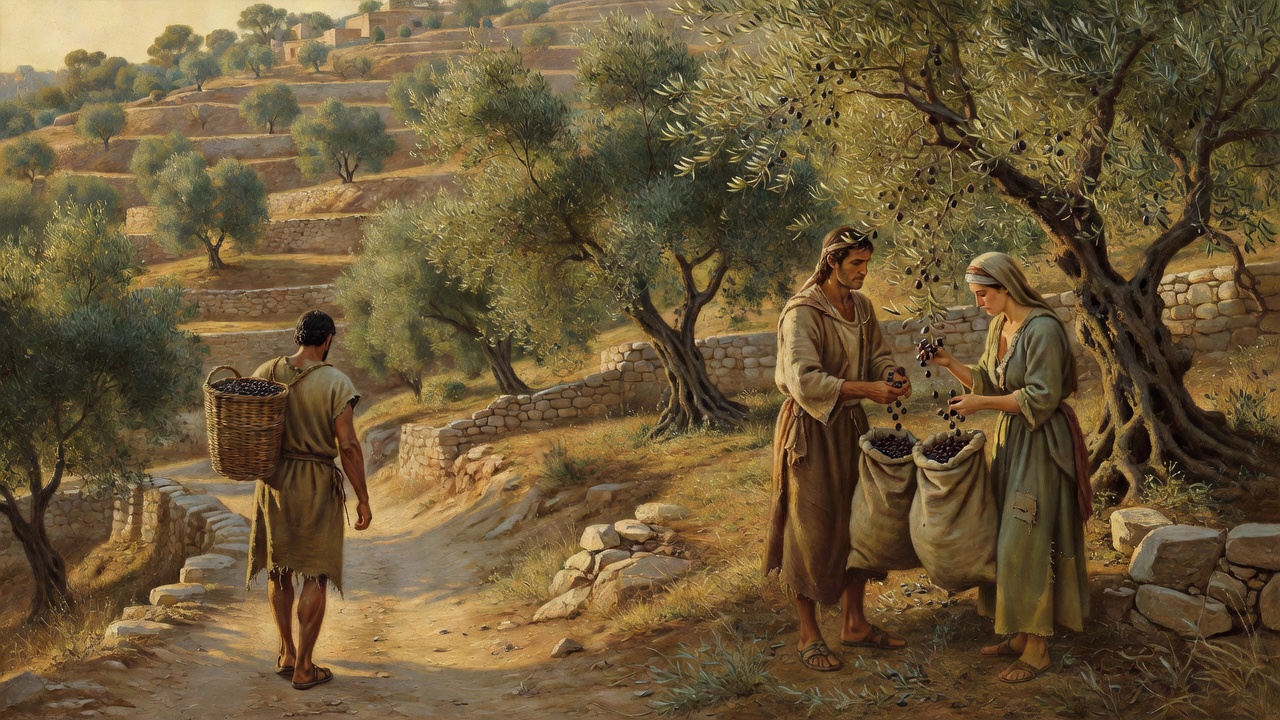
20When you beat the olives from your trees, you must not go over the branches again. What remains will be for the foreigner, the fatherless, and the widow.
21When you gather the grapes of your vineyard, you must not go over the vines again. What remains will be for the foreigner, the fatherless, and the widow. 22Remember that you were slaves in the land of Egypt. Therefore I am commanding you to do this.
Você sabia?
Leis de Compaixão, Justiça e Proteção Social
- As leis de colheita israelitas exigiam que os proprietários deixassem feixes esquecidos de cereais, azeitonas restantes e respigos de uvas para os grupos vulneráveis: o estrangeiro residente, o órfão e a viúva. Esse sistema de assistência apoiava-se na memória coletiva de que os israelitas haviam sido escravos no Egito.Fontes: o próprio texto bíblico · Egypt
- Devedores e trabalhadores assalariados contavam com limites legais explícitos. Os credores eram proibidos de entrar na casa de um devedor para tomar penhores, de reter mós indispensáveis ao sustento diário ou de guardar a capa de dormir de uma pessoa pobre após o pôr do sol, além de deverem pagar os diaristas antes do anoitecer.Fontes: o próprio texto bíblico
- Ao dar instruções sobre doenças infecciosas da pele e as orientações dos sacerdotes levíticos, o texto relembra a aflição que atingiu Miriã, irmã de Moisés e Arão, durante a caminhada pelo deserto após a saída do Egito.Fontes: o próprio texto bíblico · Miriam · Egypt
Notas escritas com auxílio de IA a partir de fontes abertas (Theographic Bible Metadata, CC BY-SA 4.0; Easton’s Bible Dictionary, domínio público) e revisadas antes de publicar.
Lugares deste capítulo
Só aparecem lugares com identificação de alta confiança (90% ou mais segundo as fontes acadêmicas reunidas pelo OpenBible). Mapa da época: DARE (Digital Atlas of the Roman Empire), CC BY 4.0; mapa atual: © colaboradores do OpenStreetMap; lugares: OpenBible.info (CC BY 4.0).
Créditos e licença desta tradução
Berean Standard Bible
The Holy Bible in English: Berean Standard Bible
Public Domain
Language: English
Contributor: BSB Publishing, LLC
2026-10-02
Fonte: http://ebible.org/engbsb/ · eBible.org