Atos 17
Berean Standard Bible · Toque num versículo para ver as referências cruzadas.
The Uproar in Thessalonica
1When they had passed through Amphipolis and Apollonia, they came to Thessalonica, where there was a Jewish synagogue. 2As was his custom, Paul went into the synagogue, and on three Sabbaths he reasoned with them from the Scriptures, 3explaining and proving that the Christ had to suffer and rise from the dead. “This Jesus I am proclaiming to you is the Christ,” he declared. 4Some of the Jews were persuaded and joined Paul and Silas, along with a large number of God-fearing Greeks and quite a few leading women.
5The Jews, however, became jealous. So they brought in some troublemakers from the marketplace, formed a mob, and sent the city into an uproar. They raided Jason’s house in search of Paul and Silas, hoping to bring them out to the people. 6But when they could not find them, they dragged Jason and some other brothers before the city officials, shouting, “These men who have turned the world upside down have now come here, 7and Jason has welcomed them into his home. They are all defying Caesar’s decrees, saying that there is another king, named Jesus!”
8On hearing this, the crowd and city officials were greatly disturbed. 9And they collected bond from Jason and the others, and then released them.
The Character of the Bereans
10As soon as night had fallen, the brothers sent Paul and Silas away to Berea. On arriving there, they went into the Jewish synagogue. 11Now the Bereans were more noble-minded than the Thessalonians, for they received the message with great eagerness and examined the Scriptures every day to see if these teachings were true. 12As a result, many of them believed, along with quite a few prominent Greek women and men.
13But when the Jews from Thessalonica learned that Paul was also proclaiming the word of God in Berea, they went there themselves to incite and agitate the crowds. 14The brothers immediately sent Paul to the coast, but Silas and Timothy remained in Berea. 15Those who escorted Paul brought him to Athens and then returned with instructions for Silas and Timothy to join him as soon as possible.
Paul in Athens
16While Paul was waiting for them in Athens, he was deeply disturbed in his spirit to see that the city was full of idols. 17So he reasoned in the synagogue with the Jews and God-fearing Gentiles, and in the marketplace with those he met each day.
18Some Epicurean and Stoic philosophers also began to debate with him. Some of them asked, “What is this babbler trying to say?” Others said, “He seems to be advocating foreign gods.” They said this because Paul was proclaiming the good news of Jesus and the resurrection.
19So they took Paul and brought him to the Areopagus, where they asked him, “May we know what this new teaching is that you are presenting? 20For you are bringing some strange notions to our ears, and we want to know what they mean.”
21Now all the Athenians and foreigners who lived there spent their time doing nothing more than hearing and articulating new ideas.
Paul’s Address in the Areopagus
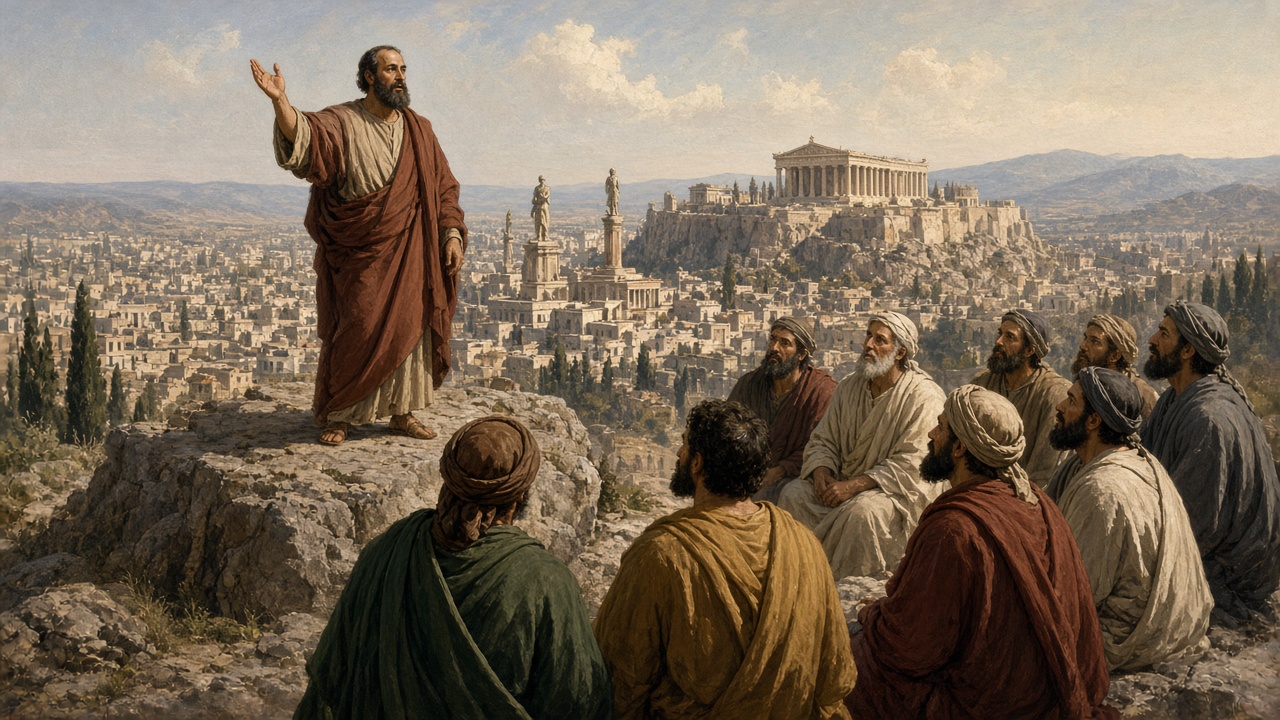
22Then Paul stood up in the meeting of the Areopagus and said, “Men of Athens, I see that in every way you are very religious. 23For as I walked around and examined your objects of worship, I even found an altar with this inscription:
TO AN UNKNOWN GOD.
Therefore what you worship as something unknown, I now proclaim to you.
24The God who made the world and everything in it is the Lord of heaven and earth and does not live in temples made by human hands. 25Nor is He served by human hands, as if He needed anything, because He Himself gives everyone life and breath and everything else. 26From one man He made every nation of men, that they should inhabit the whole earth; and He determined their appointed times and the boundaries of their lands.
27God intended that they would seek Him and perhaps reach out for Him and find Him, though He is not far from each one of us. 28‘For in Him we live and move and have our being.’ As some of your own poets have said, ‘We are His offspring.’ 29Therefore, being offspring of God, we should not think that the Divine Being is like gold or silver or stone, an image formed by man’s skill and imagination.
30Although God overlooked the ignorance of earlier times, He now commands all people everywhere to repent. 31For He has set a day when He will judge the world with justice by the Man He has appointed. He has given proof of this to everyone by raising Him from the dead.”
32When they heard about the resurrection of the dead, some began to mock him, but others said, “We want to hear you again on this topic.” 33At that, Paul left the Areopagus. 34But some joined him and believed, including Dionysius the Areopagite, a woman named Damaris, and others who were with them.
Você sabia?
Da sinagoga ao Areópago
- Tessalônica era uma cidade grande e populosa à beira do golfo Termaico, capital de um dos quatro distritos romanos da Macedônia, governada por um pretor. Jasom hospedou Paulo e Silas ali; uma multidão invadiu sua casa e, como os dois não foram encontrados, Jasom e alguns outros irmãos foram arrastados perante as autoridades da cidade. Foram acusados de acolher homens que desrespeitavam os decretos de César e falavam de outro rei, Jesus, e as autoridades só os soltaram depois de receber fiança.Fontes: Thessalonica · Jason · o próprio texto bíblico
- Atenas, capital da Ática, era celebrada como sede da literatura e da arte gregas, e seus habitantes gostavam de novidades e se destacavam pelo zelo no culto aos deuses. Um satírico romano dizia que era mais fácil encontrar um deus em Atenas do que um homem. O Areópago, colina rochosa a noroeste da Acrópole, era o lugar onde funcionavam o tribunal supremo ateniense e o tribunal dos costumes, e Paulo proferiu o discurso deste capítulo de algum ponto dessa colina.Fontes: Athens · Areopagus · o próprio texto bíblico
- Paulo e Silas chegaram a Tessalônica só depois de passar por Anfípolis, cidade macedônia e grande estação militar romana, a trinta e três milhas romanas de Filipos, e por Apolônia, a cerca de trinta e seis milhas de Tessalônica. Quando a agitação os seguiu até Bereia, outra cidade da Macedônia, os irmãos enviaram Paulo ao litoral, e os que o escoltaram o levaram até Atenas. Silas e Timóteo ficaram em Bereia, com a instrução de se juntar a Paulo assim que pudessem.Fontes: Amphipolis · Apollonia · Berea · o próprio texto bíblico
Notas escritas com auxílio de IA a partir de fontes abertas (Theographic Bible Metadata, CC BY-SA 4.0; Easton’s Bible Dictionary, domínio público) e revisadas antes de publicar.
Lugares deste capítulo
- Amphipolis · 40.820, 23.847 · versículo 1
- Apollonia · 40.624, 23.470 · versículo 1
- Thessalonica · Hoje: Thessaloniki · 40.638, 22.946 · versículos 1, 11, 13
- Berea · Hoje: Veria · 40.518, 22.200 · versículos 10, 11, 13, 14, 15
- Athens · 37.972, 23.727 · versículos 15, 16, 21, 22
- Areopagus · 37.972, 23.724 · versículos 19, 22, 33
Só aparecem lugares com identificação de alta confiança (90% ou mais segundo as fontes acadêmicas reunidas pelo OpenBible). Mapa da época: DARE (Digital Atlas of the Roman Empire), CC BY 4.0; mapa atual: © colaboradores do OpenStreetMap; lugares: OpenBible.info (CC BY 4.0).
Créditos e licença desta tradução
Berean Standard Bible
The Holy Bible in English: Berean Standard Bible
Public Domain
Language: English
Contributor: BSB Publishing, LLC
2026-10-02
Fonte: http://ebible.org/engbsb/ · eBible.org