Jó 3
American Standard Version Byzantine Text · Toque num versículo para ver as referências cruzadas.
Job Laments His Birth
1After this opened Job his mouth, and cursed his day.
2And Job answered and said:
3Let the day perish wherein I was born,
And the night which said, There is a man-child conceived.
4Let that day be darkness;
Let not God from above seek for it,
Neither let the light shine upon it.
5Let darkness and the shadow of death claim it for their own;
Let a cloud dwell upon it;
Let all that maketh black the day terrify it.
6As for that night, let thick darkness seize upon it:
Let it not rejoice among the days of the year;
Let it not come into the number of the months.
7Lo, let that night be barren;
Let no joyful voice come therein.
8Let them curse it that curse the day,
Who are ready to rouse up leviathan.
9Let the stars of the twilight thereof be dark:
Let it look for light, but have none;
Neither let it behold the eyelids of the morning:
10Because it shut not up the doors of my mother’s womb,
Nor hid trouble from mine eyes.
11Why died I not from the womb?
Why did I not give up the ghost when my mother bare me?
12Why did the knees receive me?
Or why the breasts, that I should suck?
13For now should I have lain down and been quiet;
I should have slept; then had I been at rest,
14With kings and counselors of the earth,
Who built up waste places for themselves;
15Or with princes that had gold,
Who filled their houses with silver:
16Or as a hidden untimely birth I had not been,
As infants that never saw light.
17There the wicked cease from troubling;
And there the weary are at rest.
18There the prisoners are at ease together;
They hear not the voice of the taskmaster.
19The small and the great are there:
And the servant is free from his master.
20Wherefore is light given to him that is in misery,
And life unto the bitter in soul;
21Who long for death, but it cometh not,
And dig for it more than for hidden treasures;
22Who rejoice exceedingly,
And are glad, when they can find the grave?
23Why is light given to a man whose way is hidden,
And whom God hath hedged in?
24For my sighing cometh before I eat,
And my groanings are poured out like water.
25For the thing which I fear cometh upon me,
And that which I am afraid of cometh unto me.
26I am not at ease, neither am I quiet, neither have I rest;
But trouble cometh.
Você sabia?
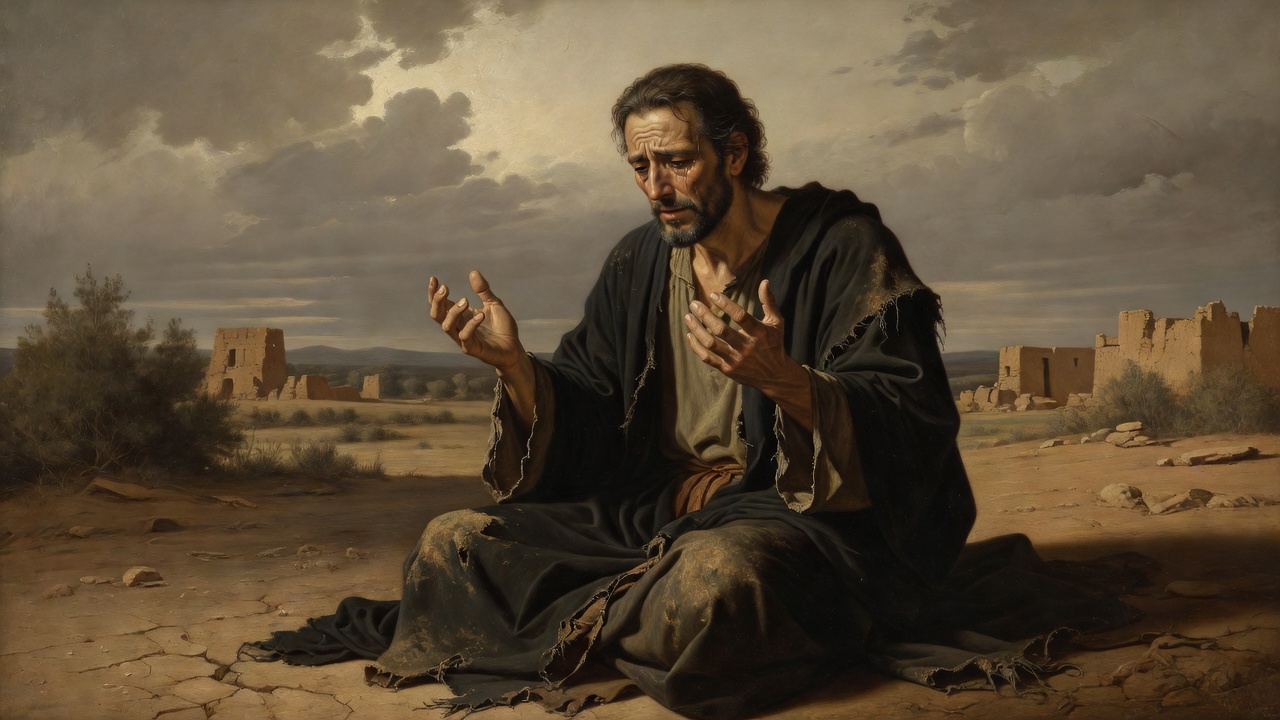
Jó Amaldiçoa o Dia do Seu Nascimento
- Após suportar um sofrimento intenso, Jó quebra o silêncio não para amaldiçoar a Deus, mas para amaldiçoar o dia de seu nascimento e a noite de sua concepção, desejando que aquele dia tivesse sido tragado pela escuridão absoluta.Fontes: o próprio texto bíblico · Job
- Em seu lamento poético, Jó invoca aqueles que amaldiçoam o dia e estão preparados para despertar o Leviatã, empregando uma linguagem poética de caos cósmico para enfatizar seu desejo de apagar a própria existência.Fontes: o próprio texto bíblico
- Jó descreve a sepultura como um lugar de igualdade onde reis, conselheiros, escravos e prisioneiros descansam juntos, livres do esgotamento, da opressão e da angústia que afligem os vivos.Fontes: o próprio texto bíblico
Notas escritas com auxílio de IA a partir de fontes abertas (Theographic Bible Metadata, CC BY-SA 4.0; Easton’s Bible Dictionary, domínio público) e revisadas antes de publicar.
Créditos e licença desta tradução
American Standard Version Byzantine Text
The Holy Bible with Apocrypha, American Standard Version conformed to the Byzantine Text New Testament
Public Domain
Language: English
Dialect: Archaic American
Changes to the ASV dedicated to the Public Domain by Adam Boyd in 2021. The ASV itself is in the Public Domain due to copyright expiration.
2026-10-02
Títulos de seção adaptados da Berean Standard Bible (domínio público); não fazem parte do texto bíblico desta tradução.
Fonte: http://ebible.org/engasvbt/ · eBible.org