Atos 17
American Standard Version Byzantine Text · Toque num versículo para ver as referências cruzadas.
The Uproar in Thessalonica
1Now when they had passed through Amphipolis and Apollonia, they came to Thessalonica, where was a synagogue of the Jews: 2and Paul, as his custom was, went in unto them, and for three sabbath days reasoned with them from the scriptures, 3opening and alleging that it behooved the Christ to suffer, and to rise again from the dead; and that this Jesus, whom, said he, I proclaim unto you, is the Christ. 4And some of them were persuaded, and consorted with Paul and Silas; and of the devout Greeks a great multitude, and of the chief women not a few. 5But the Jews that were disobedient took unto them certain vile fellows of the rabble, and gathering a crowd, set the city on an uproar; and assaulting the house of Jason, they sought to bring them to the people. 6And when they found them not, they dragged Jason and certain brethren before the rulers of the city, crying, These that have turned the world upside down are come hither also; 7whom Jason hath received: and these all act contrary to the decrees of Caesar, saying that there is another king, one Jesus. 8And they troubled the multitude and the rulers of the city, when they heard these things. 9And when they had taken security from Jason and the rest, they let them go.
The Character of the Bereans
10And the brethren immediately sent away Paul and Silas by night unto Berea: who when they were come thither went into the synagogue of the Jews. 11Now these were more noble than those in Thessalonica, in that they received the word with all readiness of mind, examining the scriptures daily, whether these things were so. 12Many of them therefore believed; also of the Greek women of honorable estate, and of men, not a few. 13But when the Jews of Thessalonica had knowledge that the word of God was proclaimed of Paul at Berea also, they came thither likewise, stirring up the multitudes. 14And then immediately the brethren sent forth Paul to go as it were to the sea: but both Silas and Timothy abode there still. 15But they that conducted Paul brought him as far as Athens: and receiving a commandment unto Silas and Timothy that they should come to him with all speed, they departed.
Paul in Athens
16Now while Paul waited for them at Athens, his spirit was provoked within him as he beheld the city full of idols. 17So he reasoned in the synagogue with the Jews and the devout persons, and in the marketplace every day with them that met him. 18And certain also of the Epicurean and the Stoic philosophers encountered him. And some said, What would this babbler say? others, He seemeth to be a setter forth of strange gods: because he preached Jesus and the resurrection. 19And they took hold of him, and brought him unto the Areopagus, saying, May we know what this new teaching is, which is spoken by thee? 20For thou bringest certain strange things to our ears: we would know therefore what these things might mean. 21(Now all the Athenians and the strangers sojourning there spent their time in nothing else, but to tell and to hear something new.)
Paul’s Address in the Areopagus
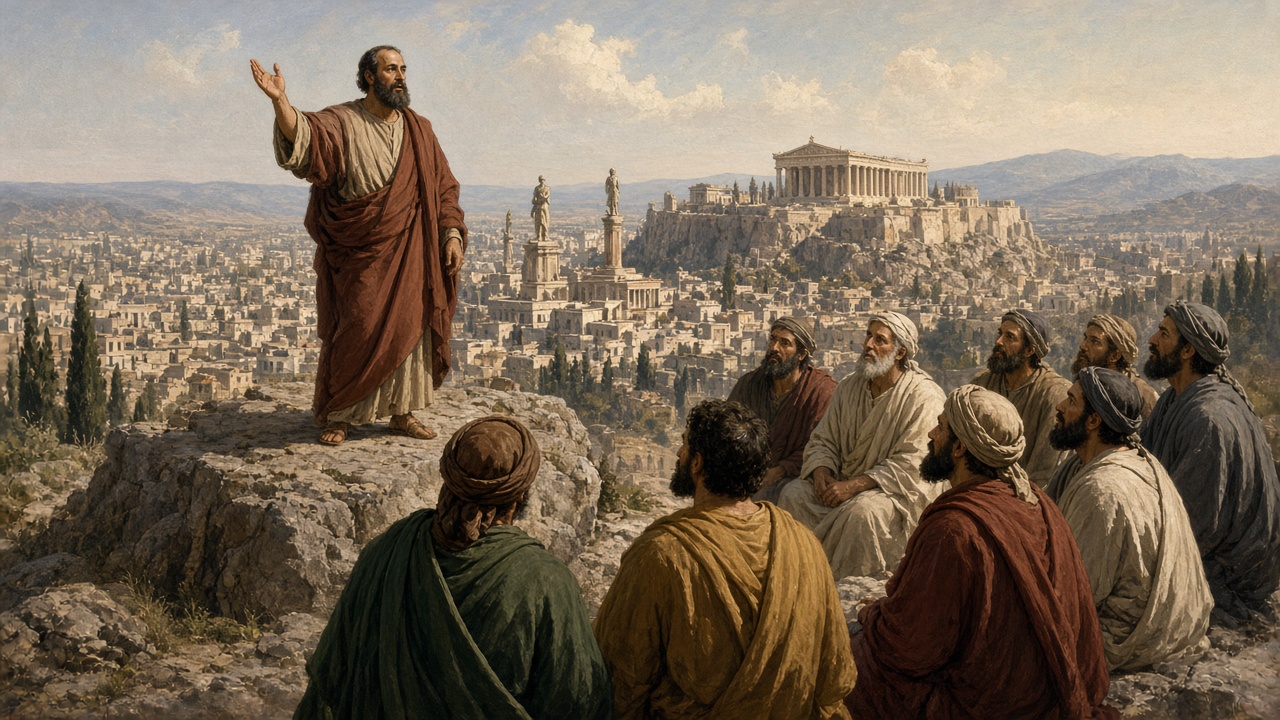
22And Paul stood in the midst of the Areopagus, and said,
Ye men of Athens, in all things I perceive that ye are very religious. 23For as I passed along, and observed the objects of your worship, I found also an altar with this inscription, TO AN UNKNOWN GOD. Whom therefore ye worship in ignorance, him I set forth unto you. 24The God that made the world and all things therein, he, being Lord of heaven and earth, dwelleth not in temples made with hands; 25neither is he served by men’s hands, as though he needed anything, seeing he himself giveth to all life and breath in all things; 26and he made of one blood every nation of men to dwell on all the face of the earth, having determined their appointed seasons, and the bounds of their habitation; 27that they should seek the Lord, if haply they might feel after him and find him, though he is not far from each one of us: 28for in him we live, and move, and have our being; as certain even of your own poets have said,
For we are also his offspring.
29Being then the offspring of God, we ought not to think that the Godhead is like unto gold, or silver, or stone, graven by art and device of man. 30The times of ignorance therefore God overlooked; but now he commandeth all men everywhere to repent: 31because he hath appointed a day in which he will judge the world in righteousness by the man whom he hath ordained; whereof he hath given assurance unto all men, in that he hath raised him from the dead.
32Now when they heard of the resurrection of the dead, some mocked; but others said, We will hear thee again concerning this. 33And so Paul went out from among them. 34But certain men clave unto him, and believed: among whom also was Dionysius the Areopagite, and a woman named Damaris, and others with them.
Você sabia?
Da sinagoga ao Areópago
- Tessalônica era uma cidade grande e populosa à beira do golfo Termaico, capital de um dos quatro distritos romanos da Macedônia, governada por um pretor. Jasom hospedou Paulo e Silas ali; uma multidão invadiu sua casa e, como os dois não foram encontrados, Jasom e alguns outros irmãos foram arrastados perante as autoridades da cidade. Foram acusados de acolher homens que desrespeitavam os decretos de César e falavam de outro rei, Jesus, e as autoridades só os soltaram depois de receber fiança.Fontes: Thessalonica · Jason · o próprio texto bíblico
- Atenas, capital da Ática, era celebrada como sede da literatura e da arte gregas, e seus habitantes gostavam de novidades e se destacavam pelo zelo no culto aos deuses. Um satírico romano dizia que era mais fácil encontrar um deus em Atenas do que um homem. O Areópago, colina rochosa a noroeste da Acrópole, era o lugar onde funcionavam o tribunal supremo ateniense e o tribunal dos costumes, e Paulo proferiu o discurso deste capítulo de algum ponto dessa colina.Fontes: Athens · Areopagus · o próprio texto bíblico
- Paulo e Silas chegaram a Tessalônica só depois de passar por Anfípolis, cidade macedônia e grande estação militar romana, a trinta e três milhas romanas de Filipos, e por Apolônia, a cerca de trinta e seis milhas de Tessalônica. Quando a agitação os seguiu até Bereia, outra cidade da Macedônia, os irmãos enviaram Paulo ao litoral, e os que o escoltaram o levaram até Atenas. Silas e Timóteo ficaram em Bereia, com a instrução de se juntar a Paulo assim que pudessem.Fontes: Amphipolis · Apollonia · Berea · o próprio texto bíblico
Notas escritas com auxílio de IA a partir de fontes abertas (Theographic Bible Metadata, CC BY-SA 4.0; Easton’s Bible Dictionary, domínio público) e revisadas antes de publicar.
Lugares deste capítulo
- Amphipolis · 40.820, 23.847 · versículo 1
- Apollonia · 40.624, 23.470 · versículo 1
- Thessalonica · Hoje: Thessaloniki · 40.638, 22.946 · versículos 1, 11, 13
- Berea · Hoje: Veria · 40.518, 22.200 · versículos 10, 11, 13, 14, 15
- Athens · 37.972, 23.727 · versículos 15, 16, 21, 22
- Areopagus · 37.972, 23.724 · versículos 19, 22, 33
Só aparecem lugares com identificação de alta confiança (90% ou mais segundo as fontes acadêmicas reunidas pelo OpenBible). Mapa da época: DARE (Digital Atlas of the Roman Empire), CC BY 4.0; mapa atual: © colaboradores do OpenStreetMap; lugares: OpenBible.info (CC BY 4.0).
Créditos e licença desta tradução
American Standard Version Byzantine Text
The Holy Bible with Apocrypha, American Standard Version conformed to the Byzantine Text New Testament
Public Domain
Language: English
Dialect: Archaic American
Changes to the ASV dedicated to the Public Domain by Adam Boyd in 2021. The ASV itself is in the Public Domain due to copyright expiration.
2026-10-02
Títulos de seção adaptados da Berean Standard Bible (domínio público); não fazem parte do texto bíblico desta tradução.
Fonte: http://ebible.org/engasvbt/ · eBible.org