Gênesis 50
Wycliffe Bible · Toque num versículo para ver as referências cruzadas.
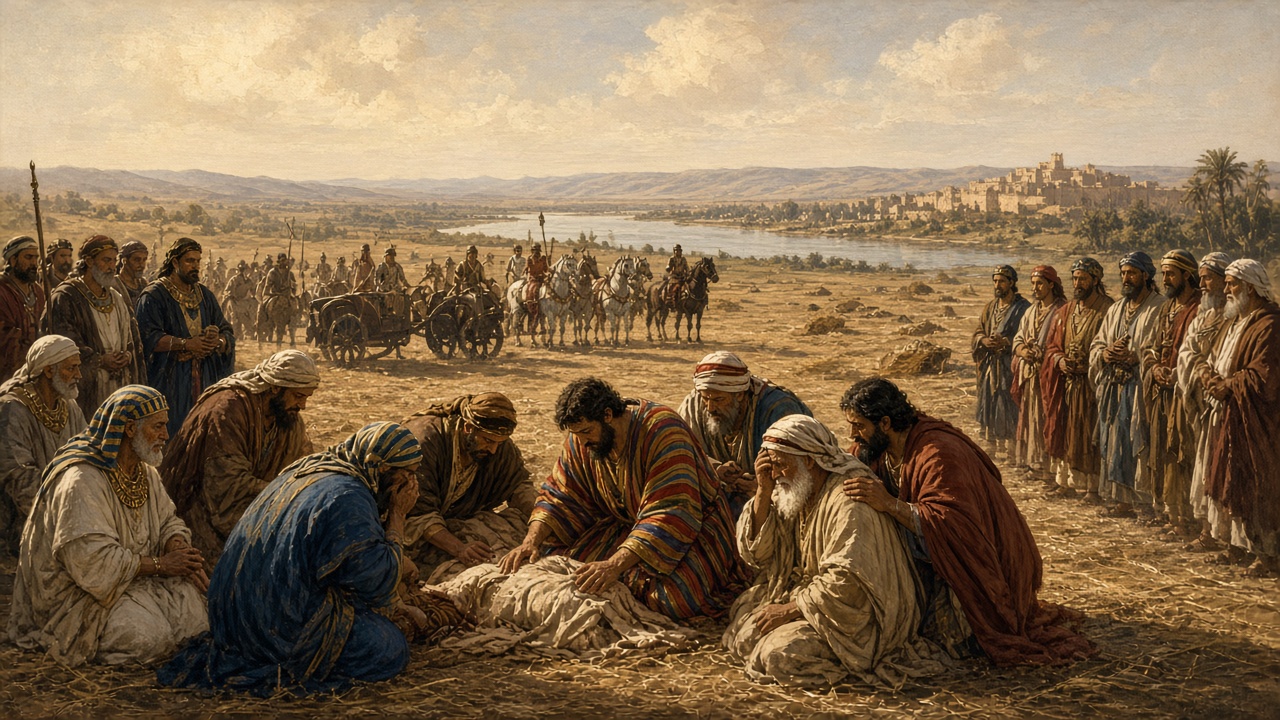
Mourning and Burial for Jacob
1Which thing Joseph seiy, and felde on `the face of the fader, and wepte, and kiste hym; 2and he comaundide hise seruauntis, lechis, that thei schulden anoynte the fadir with swete smellynge spiceries. 3While thei `filliden the comaundementis, fourti daies passiden, for this was the custom of deed bodies anoyntid; and Egipt biwepte hym seuenti daies. 4And whanne the tyme of weiling was fillid, Joseph spak to the meyne of Farao, If Y haue founde grace in youre siyt, speke ye in the eeris of Farao; for my fadir chargide me, 5and seide, Lo! Y die, thou schalt birie me in my sepulcre which Y diggide to me in the lond of Canaan; therfor Y schal stie that Y birie my fadir, and Y schal turne ayen. 6And Farao seide to hym, Stie, and birie thi fader, as thou art chargid. 7And whanne `he stiede, alle the elde men of `the hous of Farao yeden with him, and alle the grettere men in birthe of the lond of Egipt; the hous of Joseph with her britheren, 8without litle children, and flockis, and grete beestis, whiche thei leften in the lond of Gessen, yeden with him. 9And he hadde charis, and horsmen, and felouschip, and cumpany was maad not litil. 10And thei camen to the cornfloor of Adad, which is set ouer Jordan, where thei maden the seruice of the deed bodi, with greet weilyng and strong, and fillide seuen daies. 11And whanne the dwellers of the lond of Canaan hadden seyn this, thei seiden, This is a greet weiling to Egipcians; and therfor thei clepiden the name of that place the weilyng of Egipt. 12Therfor the sones of Jacob diden, as he hadde comaundid to hem; 13and thei baren hym in to the lond of Canaan, and thei birieden hym in the double denne, which denne with the feeld Abraham hadde bouyt of Effron Ethei, ayens the face of Mambre, into possessioun of sepulcre. 14And Joseph turnede ayen in to Egipt with hise britheren and al the felouschipe, whanne the fadir was biried.
Joseph Comforts His Brothers
15And whanne the fadir was deed, the britheren of Joseph dredden, and spaken togidere, lest perauenture he be myndeful of the wrong which he suffride, and yelde to vs al the yuel, that we diden. 16And thei senten to hym, and seiden, Thi fadir comaundide to vs, 17bifore that he diede, that we schulden seie to thee these thingis bi hise wordis; Y beseche, that thou foryete the wickidnesse of thi britheren, and the synne, and malice which thei hauntiden ayens thee; also we preien, that thou foryyue this wickidnesse to thi fadir, the seruaunt of God. Whanne these thingis weren herd, Joseph wepte. 18And hise britheren camen to hym, and worschipiden lowe to erthe, and seiden, We ben thi seruauntis. 19To whiche he answeride, Nyle ye drede; whether we moun ayenstonde Goddis wille? 20Ye thouyten yuel of me, and God turnede it in to good, that he schulde enhaunse me, as ye seen in present tyme, and that he schulde make saaf many puplis; 21nyle ye drede, Y schal fede you and youre litle children. And he coumfortide hem, and spak swetli, and liytly;
The Death of Joseph
22and he dwellide in Egipt, with al the hows of his fadir. And he lyuyde an hundrid yeer, and he seiy the sones of Effraym til to the thridde generacioun; also the sones of Machir, son of Manasses, weren borun in the knees of Joseph. 23Whanne these thingis weren don, Joseph spak to hise brithren, Aftir my deeth God schal visite you, and he schal make to stie fro this lond to the loond which he swoor to Abraham, Ysaac, and Jacob. 24And whanne he hadde chargid hem, and hadde seid, God schal visite you, bere ye out with you my boonus fro this place, 25he diede, whanne an hundrid and ten yeeris of his lijf weren fillid; and he was anoyntid with swete smellynge spiceries, and was kept in a beere in Egipt.
Você sabia?
O sepultamento de Jacó e a morte de José
- A eira de Atade, onde a comitiva pranteou em alta voz durante sete dias do outro lado do Jordão, recebe o nome de uma palavra que significa espinheiro-cerval. Os cananeus que viram o luto chamaram o lugar de Abel-Mizraim, 'prado do Egito' ou 'luto do Egito'. O Dicionário Bíblico de Easton situa Abel-Mizraim a oeste do Jordão e diz que o sítio é desconhecido, ao passo que descreve Atade como provavelmente perto de Hebrom.Fontes: o próprio texto bíblico
- Os filhos de Jacó o sepultaram na caverna de Macpela, no campo perto de Manre, o lugar de sepultura que Abraão tinha comprado de Efrom, o hitita. O Dicionário Bíblico de Easton identifica Efrom como filho de Zoar e registra o preço de quatrocentos siclos de prata.Fontes: o próprio texto bíblico
- José permaneceu no Egito e viveu até os cento e dez anos, o bastante para ver os filhos de Efraim até a terceira geração. Os filhos de Maquir, filho de Manassés, foram criados sobre os joelhos de José — expressão que a Revised Version inglesa traduz por 'nascidos sobre os joelhos de José' e que o Dicionário Bíblico de Easton explica como adoção desde o nascimento. Ele disse a seus irmãos que Deus os faria subir à terra prometida a Abraão, Isaque e Jacó, e fez os filhos de Israel jurarem que levariam os seus ossos do Egito; quando morreu, embalsamaram-no e o colocaram num caixão ali.Fontes: o próprio texto bíblico
Notas escritas com auxílio de IA a partir de fontes abertas (Theographic Bible Metadata, CC BY-SA 4.0; Easton’s Bible Dictionary, domínio público) e revisadas antes de publicar.
Lugares deste capítulo
- Canaan · 32.767, 35.333 · versículos 5, 13
- Egypt · 30.129, 31.308 · versículos 7, 14, 22, 24, 26
- Goshen · Hoje: Goshen 1 · 30.799, 31.834 · versículo 8
- Atad · Hoje: near the mouth of the Jordan River · 31.915, 35.530 · versículos 10, 11
- Jordan · Hoje: Jordan River · 31.761, 35.558 · versículos 10, 11
- Machpelah · Hoje: Cave of the Patriarchs · 31.525, 35.111 · versículo 13
Só aparecem lugares com identificação de alta confiança (90% ou mais segundo as fontes acadêmicas reunidas pelo OpenBible). Mapa da época: DARE (Digital Atlas of the Roman Empire), CC BY 4.0; mapa atual: © colaboradores do OpenStreetMap; lugares: OpenBible.info (CC BY 4.0).
Créditos e licença desta tradução
Wycliffe Bible
This is the Pentateuch and Gospels from The Holy Bible, containing the Old and New Testaments, with the apocryphal books, in the earliest English version made from the latin Vulgate by John Wycliffe and his followers. c.1395
Public Domain
Language: Middle English (English)
Dialect: Middle
Translation by: John Wycliffe
2016-11-08
Títulos de seção adaptados da Berean Standard Bible (domínio público); não fazem parte do texto bíblico desta tradução.
Fonte: http://ebible.org/engWycliffe/ · eBible.org