Gênesis 11
Wycliffe Bible · Toque num versículo para ver as referências cruzadas.
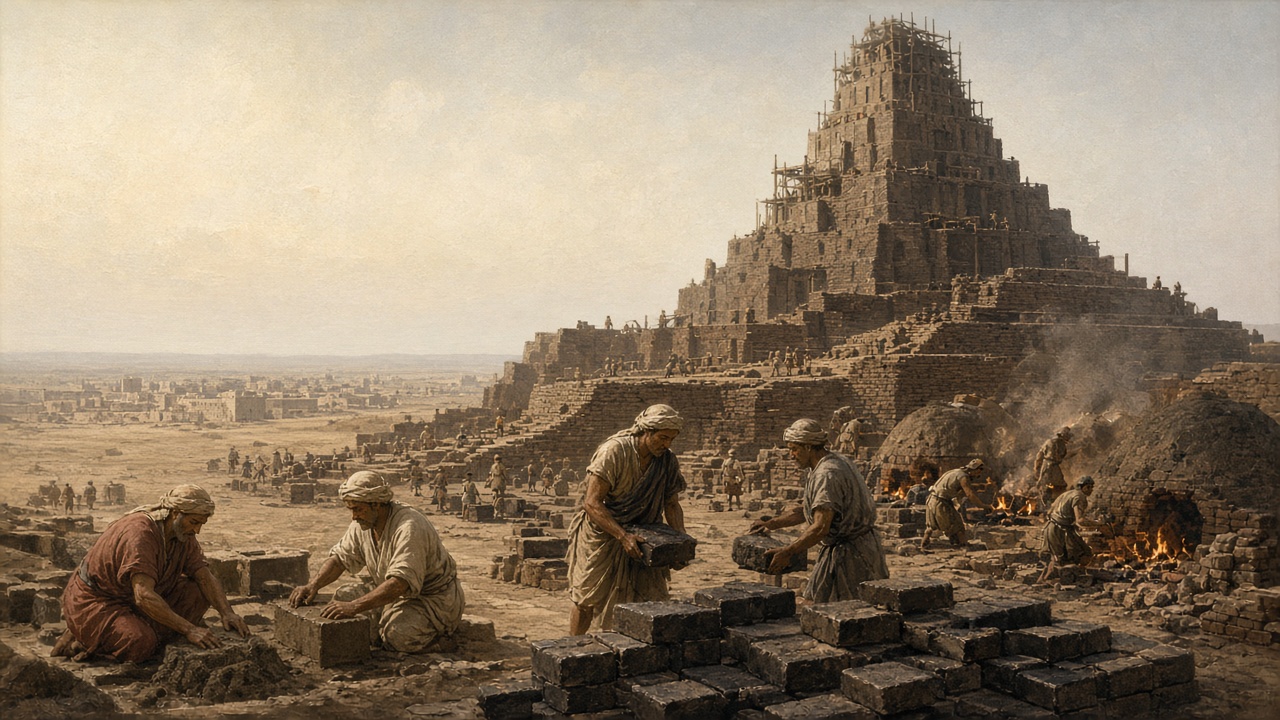
The Tower of Babel
1Forsothe the lond was of o langage, and of the same speche. 2And whanne thei yeden forth fro the eest, thei fonden a feeld in the lond of Sennaar, and dwelliden ther ynne. 3And oon seide to his neiybore, Come ye, and make we tiel stonys, and bake we tho with fier; and thei hadden tiel for stonus, and pitche for morter; 4and seiden, Come ye, and make we to vs a citee and tour, whos hiynesse stretche `til to heuene; and make we solempne oure name bifor that we be departid in to alle londis. 5Forsothe the Lord cam down to se the citee and tour, which the sones of Adam bildiden. 6And he seide, Lo! the puple is oon, and o langage is to alle, and thei han bigunne to make this, nethir thei schulen ceesse of her thouytis, til thei fillen tho in werk; therfor come ye, go we doun, 7and scheende we there the tunge of hem, that ech man here not the voys of his neiybore. 8And so the Lord departide hem fro that place in to alle londis; and thei cessiden to bielde a cytee. 9And therfor the name therof was clepid Babel, for the langage of al erthe was confoundide there; and fro thennus the Lord scaterede hem on the face of alle cuntrees.
Genealogy from Shem to Abram
10These ben the generaciouns of Sem. Sem was of an hundrid yeer whanne he gendride Arfaxath, twey yeer aftir the greet flood. 11And Sem lyuede aftir that he gendride Arfaxath fyue hundrid yeer, and gendride sones and douytris. 12Forsothe Arfaxath lyuede fyue and thretti yeer, and gendride Sale; 13and Arfaxath lyuede aftir that he gendride Sale thre hundride and thre yeer, and gendride sones and douytris. 14Also Sale lyuede thretti yeer, and gendride Heber; 15and Sale lyuede after that he gendride Heber foure hundrid and thre yeer, and gendride sones and douytris. 16Sotheli Heber lyuede foure and thretti yeer, and gendride Falech; 17and Heber lyuede aftir that he gendride Falech foure hundrid and thretti yeer, and gendride sones and douytris. 18Also Falech lyuede thretti yeer, and gendride Reu; 19and Falech lyuede aftir that he gendride Reu two hundrid and nyne yeer, and gendride sones and douytris. 20And Reu lyuede two and thretti yeer, and gendride Saruch; 21and Reu lyuede aftir that he gendride Saruch two hundrid and seuene yeer, and gendride sones and douytris. 22Sotheli Saruch lyuede thretti yeer, and gendride Nachor; 23and Saruch lyuede aftir that he gendride Nacor two hundrid yeer, and gendride sones and douytris. 24Forsothe Nachor lyuede nyne and twenti yeer, and gendride Thare; 25and Nachor lyuede after that he gendride Thare an hundrid and nynetene yeer, and gendride sones and douytris. 26And Thare lyuede seuenti yeer, and gendride Abram, and Nachor, and Aran.
Terah’s Descendants
27Sotheli these ben the generaciouns of Thare. Thare gendride Abram, Nachor, and Aran. Forsothe Aran gendride Loth; 28and Aran diede bifore Thare, his fadir, in the lond of his natiuite, in Vr of Caldeis. 29Forsothe Abram and Nachor weddiden wyues; the name of the wijf of Abram was Saray, and the name of the wiif of Nachor was Melcha, the douyter of Aran, fadir of Melcha and fadir of Jescha. 30Sotheli Saray was bareyn, and hadde no children. 31And so Thare took Abram, his sone, and Loth, the sone of Aran his sone, and Saray, his douyter in lawe, the wijf of Abram, his sone, and ledde hem out of Vr of Caldeis, that thei schulen go in to the lond of Chanaan; and thei camen `til to Aran, and dwelliden there. 32And the daies of Thare weren maad two hundrid yeer and fyue, and he was deed in Aran.
Você sabia?
Babel e o caminho desde Ur
- Viajantes, neste capítulo, se estabelecem numa planície em Sinar e constroem com tijolo cozido e betume, em vez de pedra e argamassa. Um dicionário trata Sinar como, provavelmente, a Babilônia ou o sul da Mesopotâmia, estendendo-se quase até o golfo Pérsico, diz que a torre de Babel foi construída ali e descreve os primeiros habitantes da terra como gente que fabricava tijolos e edificava cidades.Fontes: o próprio texto bíblico · Shinar
- A cidade inacabada recebe o nome de Babel porque, segundo a narrativa, ali o Senhor confundiu a língua do mundo inteiro e dispersou o povo. Um dicionário explica o nome como 'confusão' e sugere que a torre foi, provavelmente, pensada como um ponto de reunião na vasta planície de Sinar, depois de uma migração desde as terras altas da Armênia, para que os construtores não se dispersassem.Fontes: o próprio texto bíblico · Babel
- O capítulo termina com Terá saindo de Ur dos caldeus rumo a Canaã, com Abrão, Sarai e seu neto Ló, e estabelecendo-se depois em Harã, onde morre aos 205 anos; seu filho Harã já havia morrido em Ur. Um dicionário chama Ur de terra natal desse filho, a maior cidade de Sinar ou da Caldeia do norte, e um centro de comércio e poder político, e situa Harã, hoje Harran e chamada Charrã no Antigo Testamento grego e em Atos, junto ao Belik, afluente do Eufrates na Alta Mesopotâmia, onde Abrão permaneceu até a morte de Terá.Fontes: o próprio texto bíblico · Terah · Ur of the Chaldees · Haran
Notas escritas com auxílio de IA a partir de fontes abertas (Theographic Bible Metadata, CC BY-SA 4.0; Easton’s Bible Dictionary, domínio público) e revisadas antes de publicar.
Lugares deste capítulo
- Shinar · Hoje: Babylonia · 32.543, 44.422 · versículo 2
- Chaldea · 30.962, 46.104 · versículos 28, 31
- Canaan · 32.767, 35.333 · versículo 31
- Haran · Hoje: Harran · 36.864, 39.033 · versículos 31, 32
Só aparecem lugares com identificação de alta confiança (90% ou mais segundo as fontes acadêmicas reunidas pelo OpenBible). Mapa da época: DARE (Digital Atlas of the Roman Empire), CC BY 4.0; mapa atual: © colaboradores do OpenStreetMap; lugares: OpenBible.info (CC BY 4.0).
Créditos e licença desta tradução
Wycliffe Bible
This is the Pentateuch and Gospels from The Holy Bible, containing the Old and New Testaments, with the apocryphal books, in the earliest English version made from the latin Vulgate by John Wycliffe and his followers. c.1395
Public Domain
Language: Middle English (English)
Dialect: Middle
Translation by: John Wycliffe
2016-11-08
Títulos de seção adaptados da Berean Standard Bible (domínio público); não fazem parte do texto bíblico desta tradução.
Fonte: http://ebible.org/engWycliffe/ · eBible.org