Deuteronômio 16
Unlocked Literal Bible · Toque num versículo para ver as referências cruzadas.
Passover and the Feast of Unleavened Bread
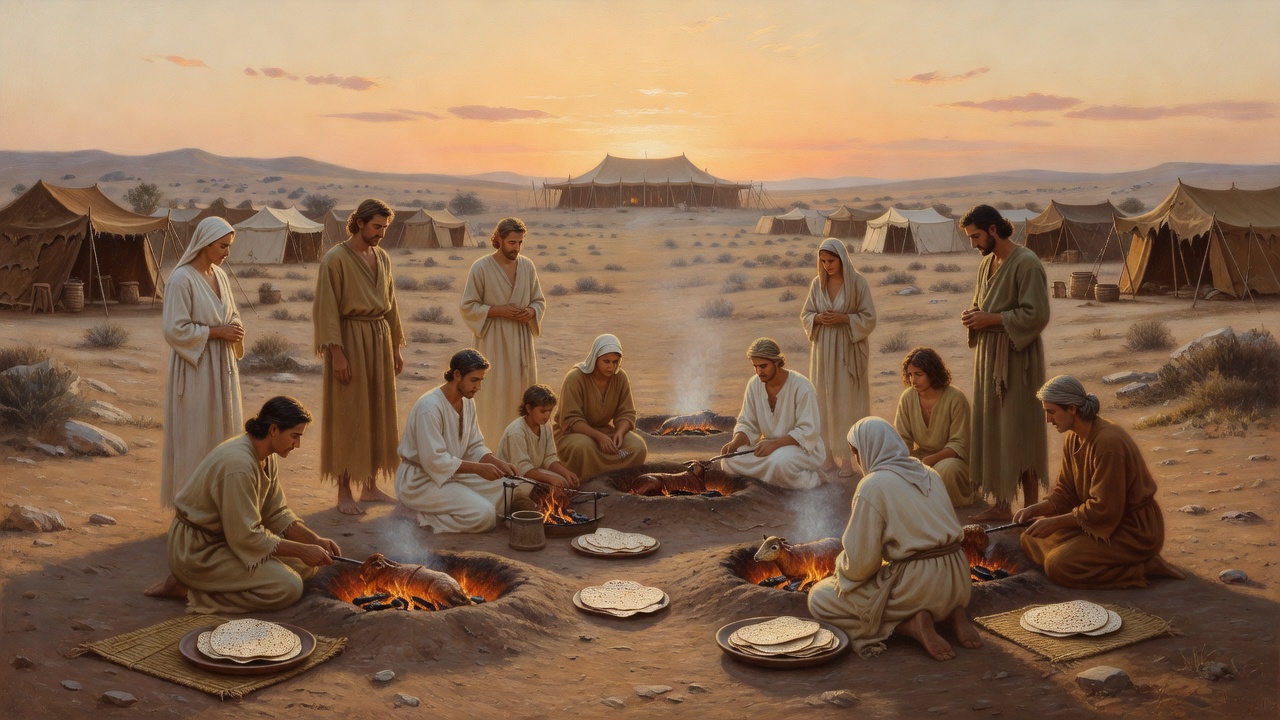
1Observe the month of Abib, and keep the Passover to Yahweh your God, for in the month of Aviv Yahweh your God brought you out of Egypt by night. 2You will sacrifice the Passover to Yahweh your God with some of the flock and the herd in the place that Yahweh will choose as his sanctuary. 3You will eat no leavened bread with it; seven days will you eat unleavened bread with it, the bread of affliction; for you came out of the land of Egypt in haste. Do this all the days of your life so that you may call to mind the day when you came out of the land of Egypt. 4No yeast must be seen among you within all your borders during seven days; nor must any of the meat that you sacrifice in the evening on the first day remain until the morning. 5You may not sacrifice the Passover within any of your city gates that Yahweh your God is giving you. 6Instead, sacrifice at the place that Yahweh your God will choose as his sanctuary. There you will perform the sacrifice of the Passover in the evening at the going down of the sun, at the time of year that you came out of Egypt. 7You must roast it and eat it at the place that Yahweh your God will choose; in the morning you will turn and go to your tents. 8For six days you will eat unleavened bread; on the seventh day there will be a solemn assembly for Yahweh your God; on that day you must do no work.
The Feast of Weeks
9You will count seven weeks for yourselves; from the time you begin to put the sickle to the standing grain you must start counting seven weeks. 10You must keep the Festival of Weeks for Yahweh your God with the contribution of a freewill offering from your hand that you will give, according as Yahweh your God has blessed you. 11You will rejoice before Yahweh your God—you, your son, your daughter, your male servant, your female servant, the Levite who is within your city gates, and the foreigner, the fatherless, and the widow who are among you, at the place that Yahweh your God will choose for his sanctuary. 12You will call to mind that you were a slave in Egypt; you must observe and do these statutes.
The Feast of Tabernacles
13You must keep the Festival of Shelters for seven days after you have gathered in the harvest from your threshing floor and from your winepress. 14You will rejoice during your festival—you, your son, your daughter, your male servant, your female servant, the Levite, and the foreigner, and the fatherless and the widow who are within your gates. 15For seven days you must observe the festival for Yahweh your God at the place that Yahweh will choose, because Yahweh your God will bless you in all your harvest and all the work of your hands, and you must be completely joyful. 16Three times in a year all your males must appear before Yahweh your God at the place that he will choose: at the Festival of Unleavened Bread, at the Festival of Weeks, and at the Festival of Shelters. No one will appear before Yahweh empty-handed; 17instead, every man will give as he is able, that you might know the blessing that Yahweh your God has given to you.
Judges and Justice
18You must make judges and officers within all your city gates that Yahweh your God is giving you; they will be taken from each of your tribes, and they must judge the people with righteous judgment. 19You must not take justice away by force; you must not show partiality nor take a bribe, for a bribe blinds the eyes of the wise and perverts the words of the righteous. 20You must follow after justice, after justice alone, so that you may live and inherit the land that Yahweh your God is giving you.
Forbidden Forms of Worship
21You must not set up for yourselves an Asherah, any sort of pole, beside the altar of Yahweh your God that you will make for yourself. 22Neither must you set up for yourself any sacred stone pillar, which Yahweh your God hates.
Você sabia?
Festas Fixas e Justiça Reta
- Deuteronômio estabelece três festas anuais de peregrinação: a Festa dos Pães Asmos (Páscoa), a Festa das Semanas e a Festa dos Tabernáculos. Nessas ocasiões, os homens de Israel deviam comparecer diante de Deus não em suas próprias cidades, mas no lugar central escolhido como habitação para o Seu Nome.Fontes: o próprio texto bíblico
- As celebrações da Festa das Semanas e da Festa dos Tabernáculos incluíam expressamente grupos vulneráveis da sociedade, como servos, levitas, estrangeiros, órfãos e viúvas. Essa alegria comunitária estava diretamente ligada à lembrança da libertação da escravidão no Egito.Fontes: o próprio texto bíblico
- Além das assembleias religiosas, o texto ordena a nomeação de juízes e oficiais em todas as cidades. Eles eram proibidos de aceitar suborno ou demonstrar parcialidade, estabelecendo a ordem de seguir estritamente a justiça em toda a terra.Fontes: o próprio texto bíblico
Notas escritas com auxílio de IA a partir de fontes abertas (Theographic Bible Metadata, CC BY-SA 4.0; Easton’s Bible Dictionary, domínio público) e revisadas antes de publicar.
Lugares deste capítulo
Só aparecem lugares com identificação de alta confiança (90% ou mais segundo as fontes acadêmicas reunidas pelo OpenBible). Mapa da época: DARE (Digital Atlas of the Roman Empire), CC BY 4.0; mapa atual: © colaboradores do OpenStreetMap; lugares: OpenBible.info (CC BY 4.0).
Créditos e licença desta tradução
Unlocked Literal Bible
The Holy Bible in English, Unlocked Literal Bible translation
copyright © 2017 Door43 World Missions Community
Language: English
Translation by: Door43 World Missions Community
Contributor: 'Alrick G. Headley, M.Div., Th.M.', 'Adam W. Nagelvoort, M.Div. Academic
Ministries, Columbia International University', 'Dave Statezni, BA Orig langs.,
M.Div. Fuller Theological Seminary', 'Bram van den Heuvel, M.A.', 'C. Harry
Harriss, M.Div.', 'David Trombold, M. Div.', 'Elizabeth Oakes, BA in Religious
Studies, Linguistics', 'George "Drew" Curley, M.Div., PhD, Professor of Biblical
Languages', Hendrik "Henry" de Vries, 'Henry Whitney, BA Linguistics', 'Jesse
Griffin, BA Biblical Studies, MA Biblical Languages', 'James N. Pohlig, M.Div.,
MA in Linguistics, D. Litt. in Biblical Languages', 'Larry T Brooks, M.Div.,
Assemblies of God Theological Seminary', 'Larry Sallee, D.Min.', 'Paul M Fahnestock,
M.Div. Reformed Theological Seminary, D. Min. Pittsburgh Theological Seminary',
'Perry Oakes, PhD in Old Testament, MA in Linguistics', 'Peter Smircich, BA Philosophy',
'Susan Quigley, MA in Linguistics', 'Thomas Warren, M.Div., Trinity Evangelical
Divinity School, D.Min, Reformed Theological Seminary', 'Timothy Neu, Ph.D.
Biblical Studies', 'Ward Pyles, M.Div., Western Baptist Theological Seminary',
David Trombold, Dean Ropp, Gene Mullen, James Vigen, Leonard Smith, Nicholas Alsop,
Michael Francis
This is an open-licensed update of the ASV, intended to provide a 'form-centric' understanding of the Bible. It increases the translator's understanding of the lexical and grammatical composition of the underlying text by adhering closely to the word order and structure of the originals.
This translation is made available to you under the terms of the
Creative Commons Attribution Share-Alike license 4.0.
You have permission to share and redistribute this Bible translation in any format and to make reasonable revisions and adaptations of this translation, provided that:
You include the above copyright and source information.
If you make any changes to the text, you must indicate that you did so in a way that makes it clear that the original licensor is not necessarily endorsing your changes.
If you redistribute this text, you must distribute your contributions under the same license as the original.
Pictures included with Scriptures and other documents on this site are licensed just for use with those Scriptures and documents.
For other uses, please contact the respective copyright owners.
Note that in addition to the rules above, revising and adapting God's Word involves a great responsibility to be true to God's Word. See Revelation 22:18-19.
2020-12-04
Títulos de seção adaptados da Berean Standard Bible (domínio público); não fazem parte do texto bíblico desta tradução.
Fonte: http://ebible.org/engULB/ · eBible.org