Lucas 10
Plain English Version · Toque num versículo para ver as referências cruzadas.
The people in some towns didn’t want Jesus
13Jesus talked to the people that lived in some towns. He said, “You mob that live in Korazin and Bethsayida, you will be really sorry. You know, I did a lot of powerful things there in your towns, but you didn’t listen to me, and you keep on doing bad things. Think about those towns called Tyre and Sidon. A long time ago their people did bad things. At that time, I didn’t go to them and do powerful things for them, like I did for you. They didn’t get to listen to me, so they couldn’t turn around and stop doing bad things. If they got to listen to me, they would be very sorry for the bad things they did, and they would turn to God real quick. But that didn’t happen. 14You know, one day God will judge everybody, and he will punish those people for the bad things they did, but he will punish you mob a lot more than he will punish that mob. You mob heard my words, but you didn’t take any notice, and you didn’t turn to God.
15And it’s the same for you mob that live in Capernium. You reckon you are good, so you reckon God will take you up into heaven. But you are wrong. He knows you are no good, and he will chuck you down into the bad place called hell.”
God’s most important laws
25One day, a Jewish law man went to Jesus. He wanted to test Jesus, to see if he can answer a hard question. So he asked Jesus, “Teacher, what can I do so that I will live with God for ever?” A Jewish law man asked Jesus a hard question|src="CN01744b.tif" size="col" copy="1996 David C. Cook" ref="10:25"
26Jesus said, “You know God’s laws, and you read them all the time. What do you reckon they say?”
27The man said, “One law says this,
‘You have to love God properly, not just a little bit.
You have to love God from right inside yourself.
You have to love God in the way you feel, and in the way you think.
And you have to love God in the way you do things.’
And another law says this,
‘You have to love the people around you just as much as you love yourself.’”
28Jesus said, “You are right. Do what those laws say, and you will live with God for ever.”
29But the man wanted to show that he asked an important question, so he said, “What does it mean by the people around me? Who are they?”
The story about the good man that was from Samaria country
30Jesus answered that question by telling this picture story. He said, “A Jewish man was going down the road from Jerusalem city to the town called Jericho. About half-way along that road some bad men grabbed him. They beat him up, and they took everything he had, even his clothes, and then they ran away. They left him lying there, half dead.
31After that, a leader of the Jewish ceremonies was walking down that road. He saw that man lying there, but he didn’t do anything to help him. He went over to the other side of the road to go past him, and he kept going down the road.
32After that, a man that helped in the Jewish ceremonies went along that road. He looked at the man lying there, then he went to the other side of the road and went past him, and he kept going down the road.
33Then a man from Samaria country went along that road. He was riding on a donkey. You know, Samaria people and Jewish people don’t like each other, but when that Samaria man saw that Jewish man lying there, he felt sorry for him. 34He went to that man and helped him. He treated the places where he was bleeding. He put wine and oil on them, and bandaged them, to help them get better. Then he lifted him up and put him on his donkey and took him to a hotel, and they both stayed there that night. The man from Samaria country helped the Jewish man that was hurt|src="43_Lk10_GoodSamaritanW.tif" size="col" ref="10:34"
35The next day, he paid a lot of money to the hotel boss, and said, ‘This is for you to keep this man here and look after him until he gets better. If it costs more than this, I’ll pay you the rest next time I come here.’”
36Then Jesus said to the law man, “There were 3 people that saw that man on the road. Which one of them treated that man like he was one of the people around them?”
37The law man said, “I reckon it was the person that felt sorry for that man and helped him.”
Jesus said, “You are right. So you always have to do that same sort of thing for other people.”
Jesus visited Martha and Mary
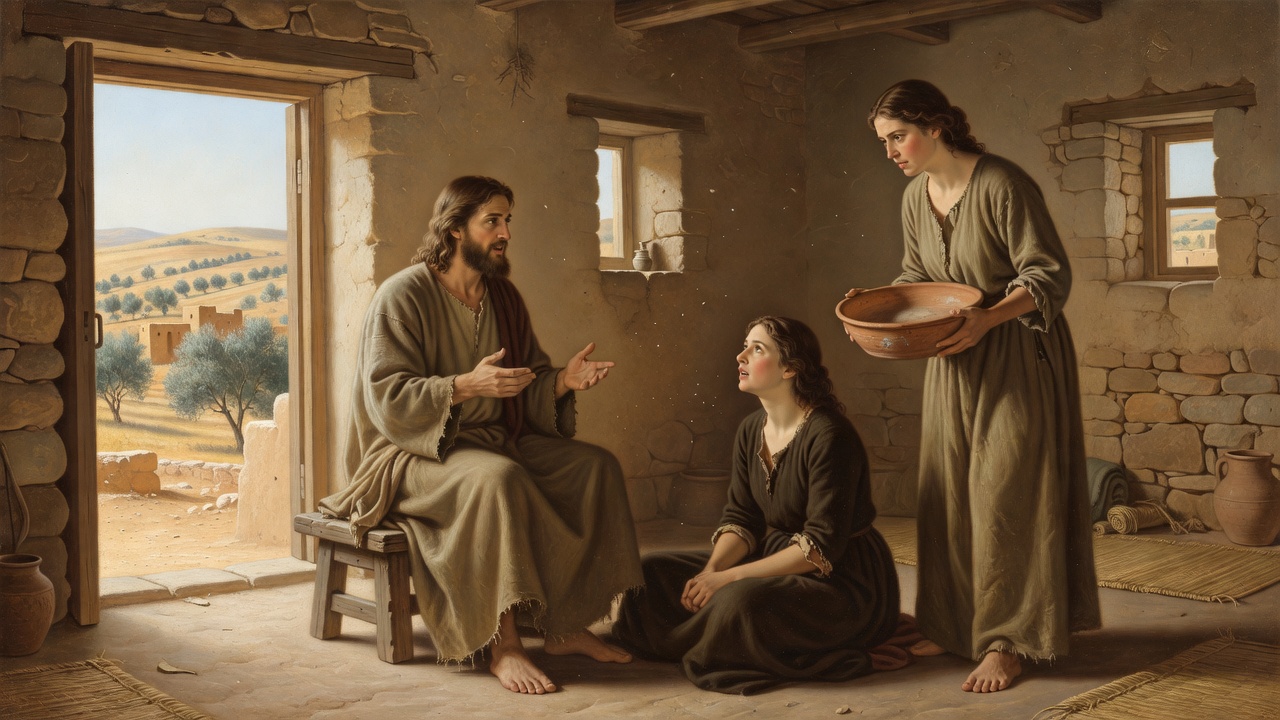
38Jesus and his followers kept going along the road to Jerusalem, and they went into a town. A woman called Martha lived in that town, and she asked him to come to her house, so they went with her. 39Then her sister, Mary, sat down near Jesus. He was teaching the people about God, and Mary just sat there listening to everything he said. 40Martha was busy getting a big dinner ready, and she got upset because Mary wasn’t helping her. So she said to Jesus, “Sir, my sister isn’t helping me with the work. She has left me to do it by myself. Do you think that is all right? Tell her to get up and help me.” Martha got upset because her sister wasn’t helping get dinner ready|src="wa03864b.tif" size="col" ref="10:40"
41Jesus said, “Martha, Martha, you worry about a lot of things. 42But only one thing is really important, and Mary is doing that. She is listening to me, and nobody can stop her.”
Você sabia?
A missão, as cidades e Marta e Maria
- O Dicionário Bíblico de Easton (1897) identifica Corazim, nomeada nos ais deste capítulo junto com Betsaida e Cafarnaum, com Kerazeh, cerca de duas milhas e meia subindo o Wady Kerazeh a partir de Cafarnaum. Diz que, depois que Jesus foi expulso de Nazaré, Cafarnaum passou a ser a sua própria cidade. O capítulo compara essas cidades com Tiro e Sidom; o dicionário chama Sidom de primeiro lar dos fenícios na costa da Palestina e de cidade-mãe de Tiro, cerca de vinte e cinco milhas ao norte de Tiro.Fontes: o próprio texto bíblico · Chorazin · Capernaum · Sidon
- O Dicionário Bíblico de Easton (1897) dá ao nome Marta o sentido de amargura e afirma que ela, a irmã Maria e o irmão Lázaro moravam em Betânia, sendo Marta provavelmente a mais velha. Como este trecho chama a casa de casa dela, o dicionário observa que alguns supuseram que ela era viúva e que o irmão e a irmã se hospedavam com ela. Descreve Marta como ansiosa e atarefada no cuidado com o hóspede, ao contrário de Maria, que se sentou aos pés de Jesus e escutou.Fontes: o próprio texto bíblico · Martha · Mary (sister of Lazarus)
- O Senhor designa outros setenta e dois e os envia dois a dois adiante dele, e uma cronologia de acontecimentos situa esse envio no ano 29 d.C. Quando voltam, alegres porque até os demônios se submetem em nome dele, ele diz que viu Satanás cair do céu como um relâmpago. O Dicionário Bíblico de Easton (1897) explica o nome Satanás como adversário ou acusador e observa que o Novo Testamento o usa de modo intercambiável com o diabo mais de trinta vezes.Fontes: o próprio texto bíblico · 70 Sent Out · Satan
Notas escritas com auxílio de IA a partir de fontes abertas (Theographic Bible Metadata, CC BY-SA 4.0; Easton’s Bible Dictionary, domínio público) e revisadas antes de publicar.
Lugares deste capítulo
- Sidon · Hoje: Sandikli archaeological site in Sidon · 33.561, 35.372 · versículos 13, 14
- Tyre · 33.271, 35.196 · versículos 13, 14
- Jericho · Hoje: Tell el Alayiq · 31.852, 35.436 · versículo 30
- Jerusalem · 31.777, 35.234 · versículos 30, 38
Só aparecem lugares com identificação de alta confiança (90% ou mais segundo as fontes acadêmicas reunidas pelo OpenBible). Mapa da época: DARE (Digital Atlas of the Roman Empire), CC BY 4.0; mapa atual: © colaboradores do OpenStreetMap; lugares: OpenBible.info (CC BY 4.0).
Créditos e licença desta tradução
Plain English Version
Portions of the Holy Bible in the Plain English Version translation for Australian Aboriginal people who speak English as a second language
Copyright © 2026 Wycliffe Bible Translators Australia
Language: Aboriginal English (English)
Dialect: Australian Aboriginal
Plain English Version © 2026 by Wycliffe Bible Translators Australia, licensed under Creative Commons Attribution-Share Alike 4.0 International (CC BY SA 4.0)
This licence allows you to copy and redistribute the material in any medium or format, even commercially. You may adapt, remix, transform, and build upon the material for any purpose, but if you do so, you must distribute your contributions under the same license as the original. You must always give appropriate credit, provide a link to the license, and indicate if changes were made. You may not suggest that Wycliffe Bible Translators endorses you or your use.
For full details of the licence, visit: creativecommons.org/licenses/by-sa/4.0/legalcode
This translation is made available to you under the terms of the
Creative Commons Attribution Share-Alike license 4.0.
You have permission to share and redistribute this Bible translation in any format and to make reasonable revisions and adaptations of this translation, provided that:
You include the above copyright and source information.
If you make any changes to the text, you must indicate that you did so in a way that makes it clear that the original licensor is not necessarily endorsing your changes.
If you redistribute this text, you must distribute your contributions under the same license as the original.
Pictures included with Scriptures and other documents on this site are licensed just for use with those Scriptures and documents.
For other uses, please contact the respective copyright owners.
Note that in addition to the rules above, revising and adapting God's Word involves a great responsibility to be true to God's Word. See Revelation 22:18-19.
2026-10-02
Fonte: http://ebible.org/engPEV/ · eBible.org