Gênesis 34
Plain English Version · Toque num versículo para ver as referências cruzadas.
Shekem’s mob tried to make an agreement with Jacob’s mob
1This story is about what happened to Jacob’s family in the town called Shekem, in Canaan country. The big boss of that town was called Hamor, and he was from the Hiv tribe. And Hamor had a son called Shekem.
Jacob and Leah’s daughter was called Dinah, and she was a young woman. One day, she went out to visit some other women that lived in that place. But that man Shekem, he saw Dinah, and he wanted to have her for himself. So he grabbed Dinah and he made her sleep with him, like a woman sleeps with her husband. Shekem really shamed Dinah.
3Shekem fell in love with Dinah, and he thought that she was wonderful. So he talked to her and tried to get her to love him too. 4Then Shekem talked to his father Hamor and said, “I want to marry that woman. Ask her father to give her to me, so that she can be my wife.”
5At that time, Jacob was in his camp, and Jacob’s sons were out in the grass lands looking after Jacob’s animals. Then somebody went and told Jacob that Shekem did that bad thing to his daughter Dinah. But Jacob didn’t say anything, because he wanted to wait for his sons to come home.
6Then somebody went and told Jacob’s sons that Shekem did that bad thing to Dinah. So Jacob’s sons got really upset and angry. They said, “Shekem slept with our sister. That was a properly wrong thing that he did. He made our family shamed.” And Jacob’s sons left the grass lands, and they quickly went back to Jacob’s camp.
Hamor, Shekem’s father, he went to Jacob’s camp to talk to Jacob, and Shekem went with him. 8And Hamor talked to Jacob and his sons. Hamor said, “My son Shekem, he loves your daughter Dinah, and he really wants to marry her. Please give her to him, so that she can be his wife. 9And let’s make an agreement between our families. Let’s agree that the men in my family can marry the women in your family, and the men in your family can marry the women in my family. 10You mob can live in our land, and you can do whatever you want here. You can buy things and sell things here, and you can even buy some of the land for yourself.”
11Then Shekem talked to Dinah’s father Jacob and her brothers. He said, “Please be good to me and do what I ask, and I will give you whatever you want.”
12In that culture, when a man married a woman, he used to pay money to that woman’s family and give them presents. So Shekem talked to Dinah’s father and brothers about that. He said, “Tell me how much money you want, and I will give it to you. Even if you want lots and lots of money and presents, I will give them to you. Please just let me marry that young woman Dinah.”
13But Jacob’s sons were still thinking about that bad thing that Shekem did to their sister Dinah. So they pretended to make an agreement with Shekem and Hamor, but really, they were tricking them. 14Jacob’s sons said, “You know, all of us men and boys in our mob, we had a young man operation. But you mob don’t do that operation on your boys. We can’t let our sister marry a man that didn’t have that operation. That will make our family shamed. 15So listen, we will make an agreement with you mob. You and all the men and boys in your mob, you have to have that young man operation. Then you will be like us. 16If you agree to do that, then we will let our sister marry Shekem. We will let our women marry your men, and our men will marry your women. We will live with you, and our mob will join together with your mob, and we will become one tribe. 17But if you will not agree to do what we say, if you will not do that young man operation on your boys and your men, then we will take our sister and we will leave this place.”
18Hamor and his son Shekem, they liked that idea, and they agreed to do what Jacob’s sons said. 19Shekem really loved Dinah, and he really wanted to marry her soon, so he went quickly to do those things. Shekem was the most important person in his father’s family. 20Hamor and his son Shekem, they went to the town gate, and they had a meeting with the other men that lived in that town. Hamor and Shekem said to those men, 21“You know, that man Jacob and his sons, they are friendly to us. So let them live here in our land, and let them buy things and sell things here. Our land is big, and there is plenty of room for them. Our men can marry their women, and their men can marry our women. 22But first, there is one thing that we have to do. All of us men and boys in our mob, we have to have a young man operation, just like Jacob and his family. If we do that, then Jacob and his sons will agree to live with us, and their mob will join together with our mob, and we will become one tribe. 23Then all their animals will belong to us, and everything else that they own, it will belong to us too. We just have to agree to do what they say. We have to have that young man operation. Then they will live here with us.”
24The men that lived in that town, they listened to Hamor and his son Shekem, and they agreed to do what Hamor and Shekem said. So all the boys and all the men that lived in that town, they had a young man operation.
Jacob’s sons finished up Shekem’s mob
25That young man operation hurt a lot. And 3 days later, all the men in Shekem’s mob still felt really weak. Then 2 of Jacob’s sons, they got some long knives, and they went to attack Shekem’s mob. Those 2 sons were Simeon and Levi, and they were Dinah’s brothers. Nobody in Shekem’s mob knew that Dinah’s brothers wanted to attack them, so they were not ready to fight. Simeon and Levi went into the town, and they killed all the boys and men there. 26They also killed Hamor and his son Shekem with those long knives.
At that time, Dinah was in Shekem’s house. So Simeon and Levi got Dinah from Shekem’s house, and they left the town.
27Then Jacob’s other sons went into the town, and they saw all the dead bodies of Shekem’s mob. So Jacob’s sons took everything that they wanted in that town. They thought, “Shekem did that bad thing to our sister, so we will take everything that belonged to his mob.” 28They took all the sheep, and cows, and donkeys. They took everything that was in the town, and everything that was in the grass lands. 29They took everything that was in the houses. And they got all the women and all the young kids, and they took them away, like they were prisoners.
30Then Jacob talked strongly to his sons Simeon and Levi. He said, “You made big trouble for me. You know about the other tribes that live in this land, the Canaan tribe and the Periz tribe. Well, now those tribes will hate us, because you finished up Shekem’s mob. And maybe those tribes will join together and attack us. My mob is small, so we will not be able to fight those big tribes, and then they will finish us up, me and my family.”
31But Simeon and Levi said, “That man did a bad thing to our sister. He made her sleep with him, like a woman sleeps with her husband, and then he tried to pay us money for her. Somebody had to do payback to his mob.”
Você sabia?
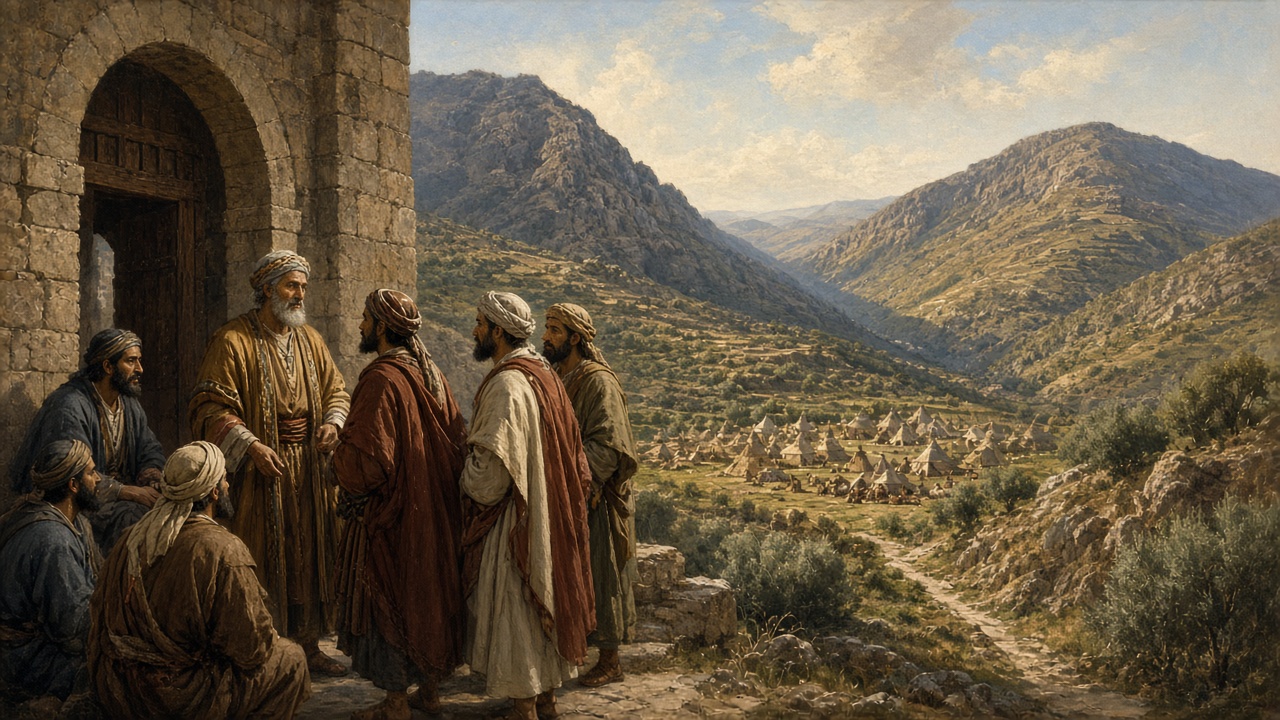
Diná e a cidade de Siquém
- Diná, filha de Jacó e Lia e irmã de Simeão e Levi, foi tomada à força por Siquém, filho de Hamor, o heveu. Simeão e Levi mataram então Hamor, Siquém e os homens da cidade; Jacó disse que eles o haviam tornado um fedor para os cananeus e os ferezeus e, ao morrer, pronunciou uma maldição contra Simeão.Fontes: Dinah · Simeon · o próprio texto bíblico
- A cidade de Siquém ficava num vale estreito e abrigado, entre o monte Ebal ao norte e o monte Gerizim ao sul, separados na base por apenas umas quinhentas jardas. Depois de voltar da Mesopotâmia, Jacó comprou ali uma porção de campo dos filhos de Hamor. O nome de Hamor é explicado como 'jumento', e Atos 7:16 o chama Emmor.Fontes: Shechem · Hamor
- Os heveus eram um dos povos espalhados desde o Hermom até Gibeão, ao sul; o nome é interpretado como 'gente das terras do meio' ou 'aldeões', e eles provavelmente eram um ramo dos hititas. Hamor, o heveu, é descrito como príncipe da terra na época do retorno de Jacó, e a narrativa chama seu filho Siquém o mais respeitado de toda a casa de seu pai.Fontes: Hivite · o próprio texto bíblico
Notas escritas com auxílio de IA a partir de fontes abertas (Theographic Bible Metadata, CC BY-SA 4.0; Easton’s Bible Dictionary, domínio público) e revisadas antes de publicar.
Créditos e licença desta tradução
Plain English Version
Portions of the Holy Bible in the Plain English Version translation for Australian Aboriginal people who speak English as a second language
Copyright © 2026 Wycliffe Bible Translators Australia
Language: Aboriginal English (English)
Dialect: Australian Aboriginal
Plain English Version © 2026 by Wycliffe Bible Translators Australia, licensed under Creative Commons Attribution-Share Alike 4.0 International (CC BY SA 4.0)
This licence allows you to copy and redistribute the material in any medium or format, even commercially. You may adapt, remix, transform, and build upon the material for any purpose, but if you do so, you must distribute your contributions under the same license as the original. You must always give appropriate credit, provide a link to the license, and indicate if changes were made. You may not suggest that Wycliffe Bible Translators endorses you or your use.
For full details of the licence, visit: creativecommons.org/licenses/by-sa/4.0/legalcode
This translation is made available to you under the terms of the
Creative Commons Attribution Share-Alike license 4.0.
You have permission to share and redistribute this Bible translation in any format and to make reasonable revisions and adaptations of this translation, provided that:
You include the above copyright and source information.
If you make any changes to the text, you must indicate that you did so in a way that makes it clear that the original licensor is not necessarily endorsing your changes.
If you redistribute this text, you must distribute your contributions under the same license as the original.
Pictures included with Scriptures and other documents on this site are licensed just for use with those Scriptures and documents.
For other uses, please contact the respective copyright owners.
Note that in addition to the rules above, revising and adapting God's Word involves a great responsibility to be true to God's Word. See Revelation 22:18-19.
2026-10-02
Fonte: http://ebible.org/engPEV/ · eBible.org