Gênesis 26
Plain English Version · Toque num versículo para ver as referências cruzadas.
God made the same promise to Isaac that he made to Abraham
1At another time, there was no rain and no food plants growing in the country where Isaac and Rebekah lived. It was like the time when there was no rain a long time before, while Abraham was still alive.
So Isaac and his family left that country, and they went to the town called Gerar, in Philistia country. The big boss of the Philistia people was called Abimelek, and he lived in that town.
2God showed himself to Isaac in that place, and God said, “Don’t go to Egypt country to try to get food. I’m going to tell you where you have to live. 3I’m telling you to camp here, in this country. You don’t need to worry. I will be with you, to take care of you. I will keep on being good to you. Remember that strong promise that I made to your father Abraham. Now I’m making the same promise to you. I will give you a really big family. You see, lots of kids and grand-kids will be born into your family later on, and they will become a really big mob of people. There will be lots and lots of them, just like there are lots of stars in the sky. And I will give them all of this country, and I will use them to do good things for all the nations in the world. 5You know, your father Abraham listened to me and did what I told him to do. That’s why I’m making that same promise to you that I made to him.”
6So Isaac set up his camp in Gerar, just like God told him to.
Isaac tried to trick the men in Gerar
7The men in Gerar saw Isaac’s wife Rebekah, and they asked Isaac, “Who is that woman?”
You know, Rebekah was very beautiful. So Isaac got worried about those men. He thought, “Maybe those men want to marry Rebekah. If I tell them that she is my wife, maybe they will kill me to get her.”
So Isaac lied and said, “She is my sister.”
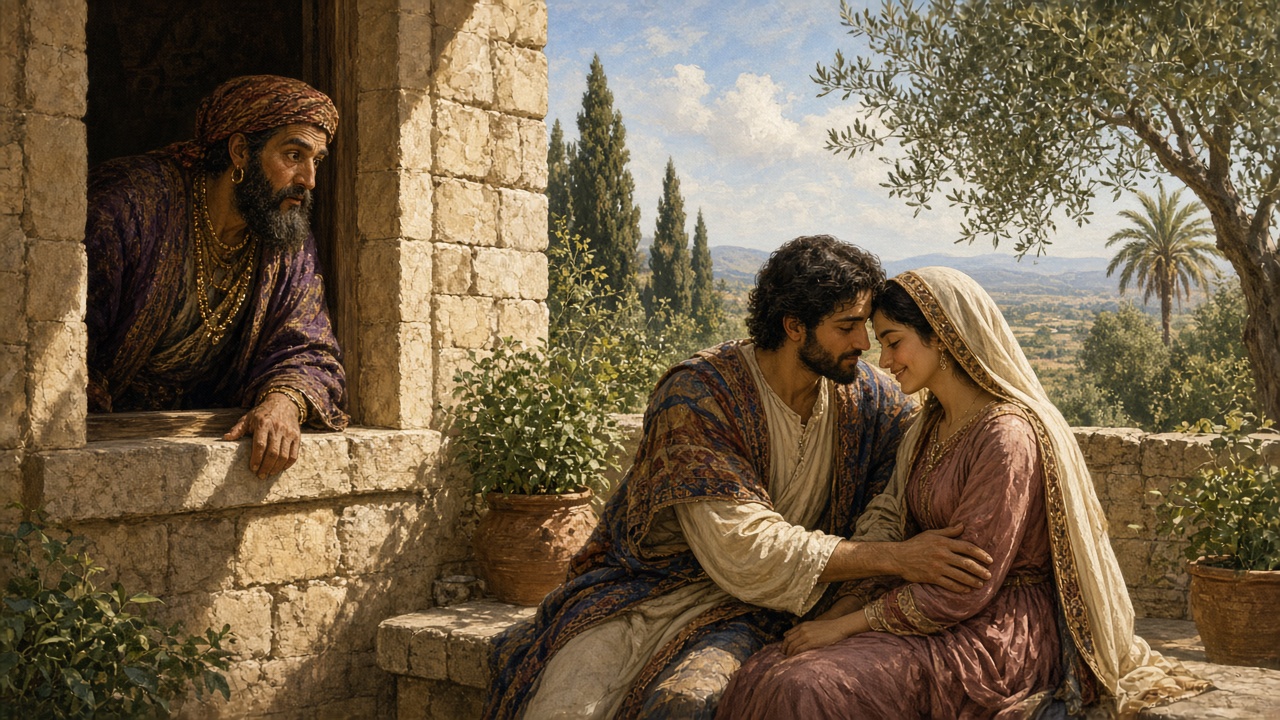
8After that, Isaac and Rebekah lived in Gerar for a long time. But one day Abimelek, the big boss of the Philistia people, he looked out of his window, and he saw Isaac hugging Rebekah. Then Abimelek knew that Rebekah was Isaac’s wife. 9So Abimelek sent somebody to get Isaac. Then Abimelek said to Isaac, “Now I know that Rebekah is your wife. Why did you say, ‘She is my sister’?”
Isaac said, “I was too frightened to say, ‘She is my wife.’ I thought that the men in Gerar will kill me and take Rebekah for themselves. So I said, ‘She is my sister.’”
10Then Abimelek was angry. He said to Isaac, “That was a bad thing that you did to us. You didn’t tell us that Rebekah is your wife. We thought that she is not married. What if one of my men slept with her, like men sleep with their wives? Think about that. Then me and all my people, we would be guilty of that bad thing.”
11After that, Abimelek talked strongly to all the people in Gerar. He said, “If any one of you hurts Isaac or Rebekah, I will kill you.”
God was good to Isaac
12While Isaac lived in Gerar, he planted seeds in the ground. And God was really good to Isaac. That same year, those seeds grew into really good food plants, so Isaac had lots and lots of food. 13And Isaac got more and more money and good things, and he became very rich. 14He had lots of sheep and cows, and lots of people that worked for him.
The Philistia people that lived in Gerar, they saw that Isaac was very rich, and they got jealous of him. 15So they got dirt and filled up the water-holes that Isaac was using. A long time before that, Isaac’s father Abraham got his workers to dig those water-holes.
Isaac dug some water-holes
16Then Abimelek, the big boss of the Philistia people, he said to Isaac, “Listen, you and your mob are a lot stronger than us now, so I don’t want you to keep on living here. You have to leave this place.”
17So Isaac and his family left Gerar, and they moved their camp to a place called the Valley of Gerar, and they lived in that place for a long time.
18A long time before this, when Isaac’s father Abraham was alive, Abraham and his workers dug lots of water-holes in that place, and Abraham gave all those water-holes names. But then, after Abraham died, the Philistia people filled up all those water-holes with dirt, so nobody could get water from them. Now, when Isaac moved there, he got his workers to take the dirt out of those water-holes, so that everybody could get water again. And Isaac gave those water-holes the same names that Abraham gave them a long time before.
19One day, Isaac’s workers dug a new water-hole in the valley, and they found fresh running water in that hole. 20But there were some men there from Gerar, looking after their animals, and those men came and argued with the men that looked after Isaac’s animals. The men from Gerar said, “That water belongs to us.” So Isaac called that water-hole Esek. That name means they argue. The Gerar men argued with Isaac’s workers about the water-hole|alt="New picture" src="GT Fighting at Well Genesis 26.tif" size="col" copy="Gordon Thompson" ref="26:20"
21After that, Isaac’s workers dug another water-hole, but the men from Gerar came and argued with them about that water-hole too. So Isaac called that water-hole Sitnah. That name means they are enemies.
22Then Isaac moved his camp to a new place, and his workers dug a water-hole in that place. This time, nobody argued with them about the water-hole. So Isaac called that water-hole Rehoboth. That name means big place. And Isaac said, “God has given us a big place to live. Our family will grow here, and our life will be good.”
God talked to Isaac at Beersheba
23Later on, Isaac moved his camp to the place called Beersheba.
24When Isaac got to Beersheba, that same night, God showed himself to Isaac. God said, “I am God. I am the one that looked after your father Abraham. Don’t be frightened. I am here with you, to take care of you. I will be good to you, and I will give you a really big family, just like I promised to your father Abraham.”
25Then Isaac wanted to show respect to God, so he piled up stones to make a table with a flat top. It was a special place for him to burn animals to show right respect to God. Then Isaac prayed to God, and he called God by his special name Yahweh.
After that, Isaac set up his camp, and he sent his workers to go and dig a water-hole.
Isaac and Abimelek made an agreement
26Abimelek, the big boss of the Philistia mob, he wanted to talk to Isaac again. So he left his home in Gerar, and he went to Isaac’s camp in Beersheba. He took 2 other men with him. One of those men was called Ahuzath, and he was Abimelek’s helper. The other man was called Ficol, and he was the leader of Abimelek’s army.
27When Isaac saw Abimelek and the 2 other men, he was shocked, and he said, “You told me to leave your country, so I know you hate me. So why did you come here to talk to me?”
28Then they said to Isaac, “We know that Yahweh your God is with you, and he helps you with everything you do. So we want you to make an agreement with us. 29We want you to promise that you will never hurt us or our people. Remember that time when you lived in our country. We never hurt you, and we always did good things for you. Even when we told you to leave our country, we didn’t make trouble for you. After that, your God kept on being good to you. That’s why we are asking you to promise that you will never hurt us.”
30Then Isaac agreed to make that promise, and he got lots of good food ready for Abimelek and the other 2 men. They all ate that food together, and then they stayed the night in that place. 31Early the next morning, they got up, and Isaac and Abimelek made strong promises to each other. They said, “I promise that I will never hurt you or your people.” So Isaac and Abimelek both felt happy and quiet inside themselves. Then Isaac said goodbye to Abimelek and the other 2 men, and they left to go back to their home country.
32Later that day, Isaac’s workers came to him, and they said, “We dug a water-hole, just like you said, and we found water.” 33Then Isaac called that water-hole Sheba. That name means promise. So people kept on calling the town near there Beersheba. That name means water-hole where they made a promise. They still use that town’s name today.
Esau married 2 women
34Isaac and Rebekah’s oldest son was called Esau. When Esau was 40 years old, he married 2 women. One of those women was called Judith. Her father was called Beeri, and he was from the Heth tribe. The other woman was called Basemath. Her father was called Elon, and he was from the Heth tribe too. 35Those 2 women gave Isaac and Rebekah a lot of trouble, and that made them very sad.
Você sabia?
Isaque em Gerar
- Durante uma fome, Isaque buscou refúgio junto a Abimeleque, rei de Gerar, antiga cidade e distrito na fronteira sul da Palestina. O Easton's Bible Dictionary (1897) observa que Isaque agiu com sua esposa Rebeca de modo muito parecido com o de seu pai Abraão em relação a Sara naquele lugar: disse que ela era sua irmã. Abimeleque depois o repreendeu, quando o engano foi descoberto.Fontes: Abimelech (King of Gerar) · Gerar · o próprio texto bíblico
- Os nomes dos poços no vale de Gerar recordam as disputas por eles. Eseque significa “contenda”, porque os pastores de Gerar reivindicaram a água, e Sitna significa “conflito”. Isaque também reabriu poços que os servos de seu pai Abraão haviam cavado e que os filisteus tinham tampado, e deu-lhes os mesmos nomes que seu pai lhes dera.Fontes: Esek · Sitnah · o próprio texto bíblico
- Berseba significa “poço do juramento” ou “poço dos sete”. Segundo o Easton's Bible Dictionary (1897), Abraão cavou ali um poço e lhe deu esse nome após um acordo com Abimeleque, e Isaque lhe deu o mesmo nome ao reabri-lo. O dicionário também identifica Ficol — “grande” — como capitão-chefe do exército de Abimeleque e diz que ele participou da aliança de Abraão acerca desse poço.Fontes: Beersheba · Phichol · o próprio texto bíblico
Notas escritas com auxílio de IA a partir de fontes abertas (Theographic Bible Metadata, CC BY-SA 4.0; Easton’s Bible Dictionary, domínio público) e revisadas antes de publicar.
Lugares deste capítulo
- Egypt · 30.129, 31.308 · versículo 2
- Valley of Gerar · Hoje: about 3 km around Tel Haror · 31.382, 34.606 · versículos 17, 19
Só aparecem lugares com identificação de alta confiança (90% ou mais segundo as fontes acadêmicas reunidas pelo OpenBible). Mapa da época: DARE (Digital Atlas of the Roman Empire), CC BY 4.0; mapa atual: © colaboradores do OpenStreetMap; lugares: OpenBible.info (CC BY 4.0).
Créditos e licença desta tradução
Plain English Version
Portions of the Holy Bible in the Plain English Version translation for Australian Aboriginal people who speak English as a second language
Copyright © 2026 Wycliffe Bible Translators Australia
Language: Aboriginal English (English)
Dialect: Australian Aboriginal
Plain English Version © 2026 by Wycliffe Bible Translators Australia, licensed under Creative Commons Attribution-Share Alike 4.0 International (CC BY SA 4.0)
This licence allows you to copy and redistribute the material in any medium or format, even commercially. You may adapt, remix, transform, and build upon the material for any purpose, but if you do so, you must distribute your contributions under the same license as the original. You must always give appropriate credit, provide a link to the license, and indicate if changes were made. You may not suggest that Wycliffe Bible Translators endorses you or your use.
For full details of the licence, visit: creativecommons.org/licenses/by-sa/4.0/legalcode
This translation is made available to you under the terms of the
Creative Commons Attribution Share-Alike license 4.0.
You have permission to share and redistribute this Bible translation in any format and to make reasonable revisions and adaptations of this translation, provided that:
You include the above copyright and source information.
If you make any changes to the text, you must indicate that you did so in a way that makes it clear that the original licensor is not necessarily endorsing your changes.
If you redistribute this text, you must distribute your contributions under the same license as the original.
Pictures included with Scriptures and other documents on this site are licensed just for use with those Scriptures and documents.
For other uses, please contact the respective copyright owners.
Note that in addition to the rules above, revising and adapting God's Word involves a great responsibility to be true to God's Word. See Revelation 22:18-19.
2026-10-02
Fonte: http://ebible.org/engPEV/ · eBible.org