Gênesis 11
Plain English Version · Toque num versículo para ver as referências cruzadas.
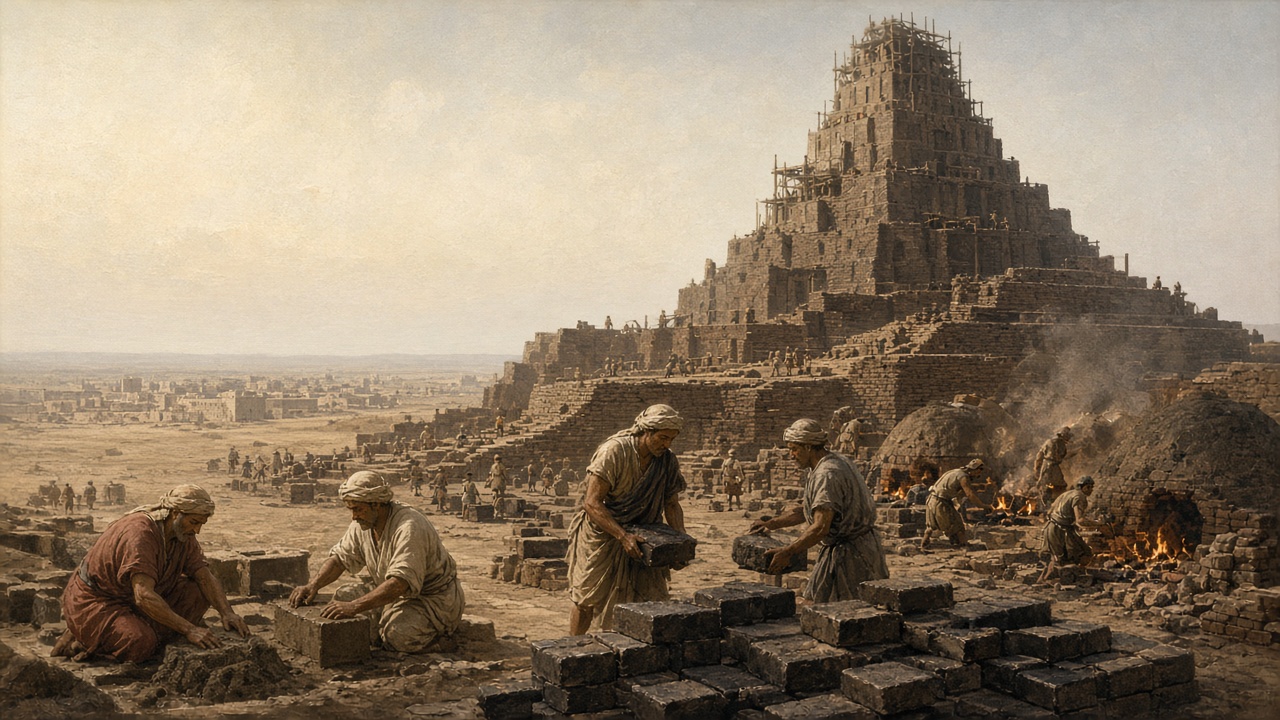
People tried to build a tall building
1You know, at first everyone talked the same language. 2And as people moved from place to place in the east, they got to some flat country in Babylonia, and they stayed there. 3Then they said to each other, “Look, we can make bricks here. So come on, let’s do that. We will bake them properly so that they are good strong bricks, and we will use them to build a city here. So come on, let’s build a big tall building in that city. It will be so tall that it will go right up into the sky.” You see, they had bricks and tar instead of stones and cement. And they said, “If we do that, everyone will think we are smart. Then we will not go and live all over the earth, but we will stay together right here.” The people started to build a really tall building|src="AP-01-40.tif" size="col" ref="11:3-4"
God made people talk in different languages
5So the people started to build a city and a really tall building, and God came down to look at those things. 6He said, “These people can all talk to each other in the same language, so they can do anything they want. If they keep on going this way, nothing will stop them from doing anything. 7Come on, let’s go down to these people, and we will make them talk in different languages. Then they will not understand each other, and they will be all mixed up. They will not work things out with each other, so they will not keep on building this city.”
8So God made all the people talk in different languages. None of them could understand anything the other people were saying. So they stopped building their big city. 9They all left that city and went to live in lots of different places, all over the world. That’s how God got people to be in different tribes all over the world. And they called that city Babel. That means mixed up. They gave it that name because God mixed up their languages at that time. God made people talk different languages so they didn’t understand each other|src="lll1-08.tif" size="col" ref="11:9"
The story of Shem’s family
10This is the story about Shem’s family.
Shem was 100 years old when he had a son called Arfaxad. That was 2 years after the big flood. 11Shem lived for 500 years after he had Arfaxad, and he had more sons and daughters.
12Arfaxad was 35 years old when he had a son called Shelah. 13Arfaxad lived for 403 years after he had Shelah, and he had more sons and daughters.
14Shelah was 30 years old when he had a son called Eber. 15Shelah lived for 403 years after he had Eber, and he had more sons and daughters.
16Eber was 34 years old when he had a son called Peleg. 17Eber lived for 430 years after he had Peleg, and he had more sons and daughters.
18Peleg was 30 years old when he had a son called Reyu. 19Peleg lived for 209 years after he had Reyu, and he had more sons and daughters.
20Reyu was 32 years old when he had a son called Serug. 21Reyu lived for 207 years after he had Serug, and he had more sons and daughters.
22Serug was 30 years old when he had a son called Nahor. 23Serug lived for 200 years after he had Nahor, and he had more sons and daughters.
24Nahor was 29 years old when he had a son called Terah. 25Nahor lived for 119 years after he had Terah, and he had more sons and daughters.
26Terah had 3 sons after he was 70 years old. Their names were Abram, Nahor and Haran.
The story of Terah’s family
27This is the story about Terah’s family. Terah had 3 sons, called Abram, and Nahor, and Haran.
Haran had a son called Lot. 28And he also had 2 daughters called Milcah and Iscah. After that, Haran died, while his father Terah was still alive. He died in the town called Ur, in Chaldia country, the place where he was born.
Nahor, Haran’s brother, married Milcah. And Abram married a woman called Sarai, 30but Abram and Sarai didn’t have any kids. Sarai just couldn’t have a baby.
31Then Terah went away from Ur, in Chaldia country, and he took some of his family with him. They were his son Abram, and Abram’s wife Sarai, and his grand-son Lot. They all left Ur, and they started to go to the country called Canaan. But they stopped half-way, at a town called Haran, and they stayed there. |src="PEV map Gen 12 Abraham.jpg" size="span" ref="11:31"
32Terah lived until he was 205 years old. Then he died there in Haran.
Você sabia?
Babel e o caminho desde Ur
- Viajantes, neste capítulo, se estabelecem numa planície em Sinar e constroem com tijolo cozido e betume, em vez de pedra e argamassa. Um dicionário trata Sinar como, provavelmente, a Babilônia ou o sul da Mesopotâmia, estendendo-se quase até o golfo Pérsico, diz que a torre de Babel foi construída ali e descreve os primeiros habitantes da terra como gente que fabricava tijolos e edificava cidades.Fontes: o próprio texto bíblico · Shinar
- A cidade inacabada recebe o nome de Babel porque, segundo a narrativa, ali o Senhor confundiu a língua do mundo inteiro e dispersou o povo. Um dicionário explica o nome como 'confusão' e sugere que a torre foi, provavelmente, pensada como um ponto de reunião na vasta planície de Sinar, depois de uma migração desde as terras altas da Armênia, para que os construtores não se dispersassem.Fontes: o próprio texto bíblico · Babel
- O capítulo termina com Terá saindo de Ur dos caldeus rumo a Canaã, com Abrão, Sarai e seu neto Ló, e estabelecendo-se depois em Harã, onde morre aos 205 anos; seu filho Harã já havia morrido em Ur. Um dicionário chama Ur de terra natal desse filho, a maior cidade de Sinar ou da Caldeia do norte, e um centro de comércio e poder político, e situa Harã, hoje Harran e chamada Charrã no Antigo Testamento grego e em Atos, junto ao Belik, afluente do Eufrates na Alta Mesopotâmia, onde Abrão permaneceu até a morte de Terá.Fontes: o próprio texto bíblico · Terah · Ur of the Chaldees · Haran
Notas escritas com auxílio de IA a partir de fontes abertas (Theographic Bible Metadata, CC BY-SA 4.0; Easton’s Bible Dictionary, domínio público) e revisadas antes de publicar.
Lugares deste capítulo
- Shinar · Hoje: Babylonia · 32.543, 44.422 · versículo 2
- Chaldea · 30.962, 46.104 · versículos 28, 31
- Canaan · 32.767, 35.333 · versículo 31
- Haran · Hoje: Harran · 36.864, 39.033 · versículos 31, 32
Só aparecem lugares com identificação de alta confiança (90% ou mais segundo as fontes acadêmicas reunidas pelo OpenBible). Mapa da época: DARE (Digital Atlas of the Roman Empire), CC BY 4.0; mapa atual: © colaboradores do OpenStreetMap; lugares: OpenBible.info (CC BY 4.0).
Créditos e licença desta tradução
Plain English Version
Portions of the Holy Bible in the Plain English Version translation for Australian Aboriginal people who speak English as a second language
Copyright © 2026 Wycliffe Bible Translators Australia
Language: Aboriginal English (English)
Dialect: Australian Aboriginal
Plain English Version © 2026 by Wycliffe Bible Translators Australia, licensed under Creative Commons Attribution-Share Alike 4.0 International (CC BY SA 4.0)
This licence allows you to copy and redistribute the material in any medium or format, even commercially. You may adapt, remix, transform, and build upon the material for any purpose, but if you do so, you must distribute your contributions under the same license as the original. You must always give appropriate credit, provide a link to the license, and indicate if changes were made. You may not suggest that Wycliffe Bible Translators endorses you or your use.
For full details of the licence, visit: creativecommons.org/licenses/by-sa/4.0/legalcode
This translation is made available to you under the terms of the
Creative Commons Attribution Share-Alike license 4.0.
You have permission to share and redistribute this Bible translation in any format and to make reasonable revisions and adaptations of this translation, provided that:
You include the above copyright and source information.
If you make any changes to the text, you must indicate that you did so in a way that makes it clear that the original licensor is not necessarily endorsing your changes.
If you redistribute this text, you must distribute your contributions under the same license as the original.
Pictures included with Scriptures and other documents on this site are licensed just for use with those Scriptures and documents.
For other uses, please contact the respective copyright owners.
Note that in addition to the rules above, revising and adapting God's Word involves a great responsibility to be true to God's Word. See Revelation 22:18-19.
2026-10-02
Fonte: http://ebible.org/engPEV/ · eBible.org