Cântico dos Cânticos 4
Douay-Rheims 1899 · Toque num versículo para ver as referências cruzadas.
Solomon Admires His Bride
The Bridegroom
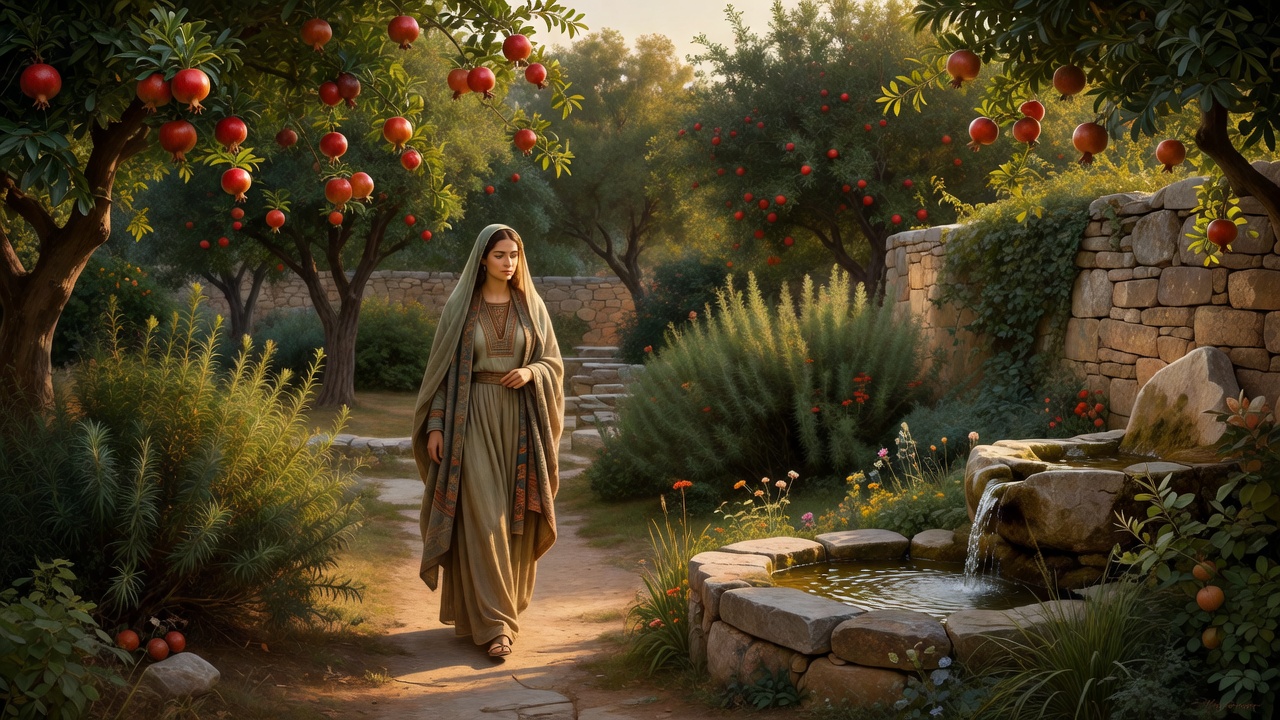
1How beautiful art thou, my love, how beautiful art thou! thy eyes are doves’ eyes, besides what is hid within. Thy hair is as flocks of goats, which Come up from mount Galaad. 2Thy teeth as flocks of sheep, that are shorn which come up from the washing, all with twins, and there is none barren among them. 3Thy lips are as a scarlet lace: and thy speech sweet. Thy cheeks are as a piece of a pomegranate, besides that which lieth hid within. 4Thy neck, is as the tower of David, which is built with bulwarks: a thousand bucklers hang upon it, all the armour of valiant men. 5Thy two breasts like two young roes that are twins, which feed among the lilies. 6Till the day break, and the shadows retire, I will go to the mountain of myrrh, and to the hill of frankincense. 7Thou art all fair, O my love, and there is not a spot in thee. 8Come from Libanus, my spouse, come from Libanus, come: thou shalt be crowned from the top of Amana, from the top of Sanir and Hermon, from the dens of the lions, from the mountains of the leopards. 9Thou hast wounded my heart, my sister, my spouse, thou hast wounded my heart with one of thy eyes, and with one hair of thy neck. 10How beautiful are thy breasts, my sister, my spouse! thy breasts are more beautiful than wine, and the sweet smell of thy ointments above all aromatical spices. 11Thy lips, my spouse, are as a dropping honeycomb, honey and milk are under thy tongue; and the smell of thy garments, as the smell of frankincense. 12My sister, my spouse, is a garden enclosed, a garden enclosed, a fountain sealed up. 13Thy plants are a paradise of pomegranates with the fruits of the orchard. Cypress with spikenard. 14Spikenard and saffron, sweet cane and cinnamon, with all the trees of Libanus, myrrh and aloes with all the chief perfumes. 15The fountain of gardens: the well of living waters, which run with a strong stream from Libanus.
The Bride
16Arise, O north wind, and come, O south wind, blow through my garden, and let the aromatical spices thereof flow.
Você sabia?
A beleza da noiva e o jardim de especiarias
- O poema chama a noiva a descer das imponentes cordilheiras ao norte no Líbano, incluindo Amana, Senir e o monte Hermom. O monte Hermom é o pico mais alto da cordilheira do Antilíbano, e fontes bíblicas registram que Senir era o nome amorreu para o Hermom.Fontes: o próprio texto bíblico · Hermon · Senir · Lebanon
- O cabelo da amada é comparado a um rebanho de cabras descendo o monte Gileade, uma região fértil e montanhosa situada a leste do rio Jordão.Fontes: o próprio texto bíblico · Gilead
- A noiva é retratada como um jardim fechado, uma fonte selada e um pomar repleto de especiarias preciosas como nardo, açafrão, canela e incenso, evocando exclusividade, frescor e aroma.Fontes: o próprio texto bíblico
Notas escritas com auxílio de IA a partir de fontes abertas (Theographic Bible Metadata, CC BY-SA 4.0; Easton’s Bible Dictionary, domínio público) e revisadas antes de publicar.
Lugares deste capítulo
- Gilead · Hoje: Gilead 1 · 32.187, 35.692 · versículo 1
- Lebanon · 33.540, 35.584 · versículos 8, 11, 15
- Mount Hermon · 33.400, 35.850 · versículo 8
- Senir · Hoje: Mount Hermon · 33.400, 35.850 · versículo 8
Só aparecem lugares com identificação de alta confiança (90% ou mais segundo as fontes acadêmicas reunidas pelo OpenBible). Mapa da época: DARE (Digital Atlas of the Roman Empire), CC BY 4.0; mapa atual: © colaboradores do OpenStreetMap; lugares: OpenBible.info (CC BY 4.0).
Créditos e licença desta tradução
Douay-Rheims 1899
The Holy Bible in English, Douay-Rheims American Edition of 1899, translated from the Latin Vulgate
Public Domain
Language: English
Dialect: archaic American
Translation by: English College, Douai
This Public Domain Bible text is brought to you courtesy of eBible.org.
Help support free Bible access at https://eBible.org/give.php .
2022-11-03
Títulos de seção adaptados da Berean Standard Bible (domínio público); não fazem parte do texto bíblico desta tradução.
Fonte: http://ebible.org/engDRA/ · eBible.org