Deuteronômio 19
Douay-Rheims 1899 · Toque num versículo para ver as referências cruzadas.
Cities of Refuge
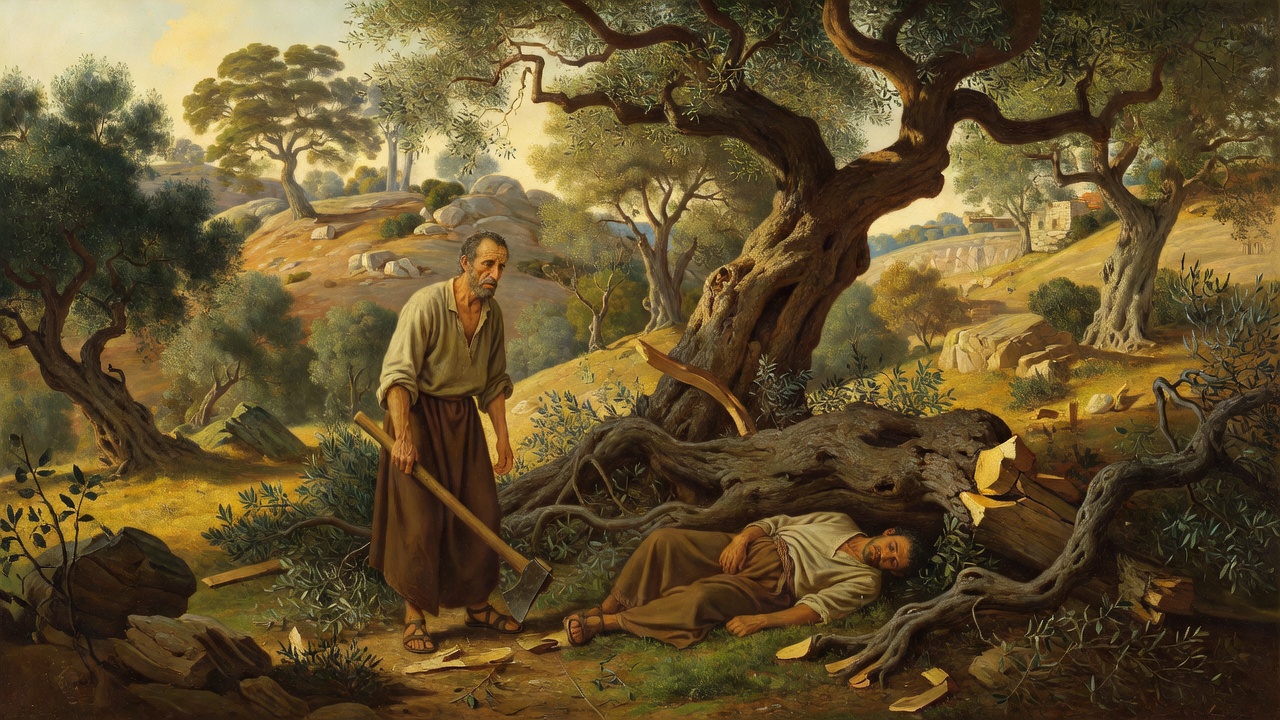
1When the Lord thy God hath destroyed the nations, whose land he will deliver to thee, and thou shalt possess it, and shalt dwell in the cities and houses thereof: 2Thou shalt separate to thee three cities in the midst of the land, which the Lord will give thee in possession, 3Paving diligently the way: and thou shalt divide the whole province of thy land equally into three parts: that he who is forced to flee for manslaughter, may have near at hand whither to escape. 4This shall be the law of the slayer that fleeth, whose life is to be saved: He that killeth his neighbour ignorantly, and who is proved to have had no hatred against him yesterday and the day before: 5But to have gone with him to the wood to hew wood, and in cutting down the tree the axe slipped out of his hand, and the iron slipping from the handle struck his friend, and killed him: he shall flee to one of the cities aforesaid, and live: 6Lest perhaps the next kinsman of him whose blood was shed, pushed on by his grief should pursue, and apprehend him. if the way be too long, and take away the life of him who is not guilty of death, because he is proved to have had no hatred before against him that was slain. 7Therefore I command thee, that thou separate three cities at equal distance one from another. 8And when the Lord thy God shall have enlarged thy borders, as he swore to thy fathers, and shall give thee all the land that he promised them, 9(Yet so, if thou keep his commandments, and do the things which I command thee this day, that thou love the Lord thy God, and walk in his ways at all times) thou shalt add to thee other three cities, and shalt double the number of the three cities aforesaid: 10That innocent blood may not be shed in the midst of the land which the Lord thy God will give thee to possess, lest thou be guilty of blood. 11But if any man hating his neighbour, lie in wait for his life, and rise and strike him, and he die, and he flee to one of the cities aforesaid, 12The ancients of his city shall send, and take him out of the place of refuge, and shall deliver him into the hand of the kinsman of him whose blood was shed, and he shall die. 13Thou shalt not pity him, and thou shalt take away the guilt of innocent blood out of Israel, that it may be well with thee. 14Thou shalt not take nor remove thy neighbour’s landmark, which thy predecessors have set in thy possession. which the Lord thy God will give thee in the land that thou shalt receive to possess.
The Testimony of Two or Three Witnesses
15One witness shall not rise up against any man, whatsoever the sin or wickedness be: but in the mouth of two or three witnesses every word shall stand. 16If a lying witness stand against a man, accusing him of transgression, 17Both of them, between whom the controversy is, shall stand before the Lord in the sight of the priests and the judges that shall be in those days. 18And when after most diligent inquisition, they shall find that the false witness hath told a lie against his brother: 19They shall render to him as he meant to do to his brother, and thou shalt take away the evil out of the midst of thee: 20That others hearing may fear, and may not dare to do such things. 21Thou shalt not pity him, but shalt require life for life, eye for eye, tooth for tooth, hand for hand, foot for foot.
Você sabia?
Cidades de refúgio, limites e justiça imparcial
- A lei ordenava que Israel separasse três cidades de refúgio e construísse estradas de acesso através de três regiões da terra. Essas cidades designadas permitiam que alguém que matasse o próximo por acidente, como no caso do ferro de um machado que se soltasse do cabo, fugisse em segurança do vingador do sangue.Fontes: o próprio texto bíblico
- Mudar o marco que demarcava a propriedade herdada de um vizinho era estritamente proibido. Esses marcos delimitavam as heranças de terra concedidas às famílias, e deslocá-los constituía uma apropriação indevida de terras.Fontes: o próprio texto bíblico
- Para evitar condenações injustas, uma única testemunha nunca era suficiente para estabelecer uma acusação, sendo necessários dois ou três testemunhos. Caso uma investigação de sacerdotes e juízes comprovasse que a testemunha havia mentido com malícia, ela recebia a pena exata que planejava impor ao acusado.Fontes: o próprio texto bíblico
Notas escritas com auxílio de IA a partir de fontes abertas (Theographic Bible Metadata, CC BY-SA 4.0; Easton’s Bible Dictionary, domínio público) e revisadas antes de publicar.
Créditos e licença desta tradução
Douay-Rheims 1899
The Holy Bible in English, Douay-Rheims American Edition of 1899, translated from the Latin Vulgate
Public Domain
Language: English
Dialect: archaic American
Translation by: English College, Douai
This Public Domain Bible text is brought to you courtesy of eBible.org.
Help support free Bible access at https://eBible.org/give.php .
2022-11-03
Títulos de seção adaptados da Berean Standard Bible (domínio público); não fazem parte do texto bíblico desta tradução.
Fonte: http://ebible.org/engDRA/ · eBible.org