1 Crônicas 25
Bible in Basic English · Toque num versículo para ver as referências cruzadas.
Twenty-Four Divisions of Musicians
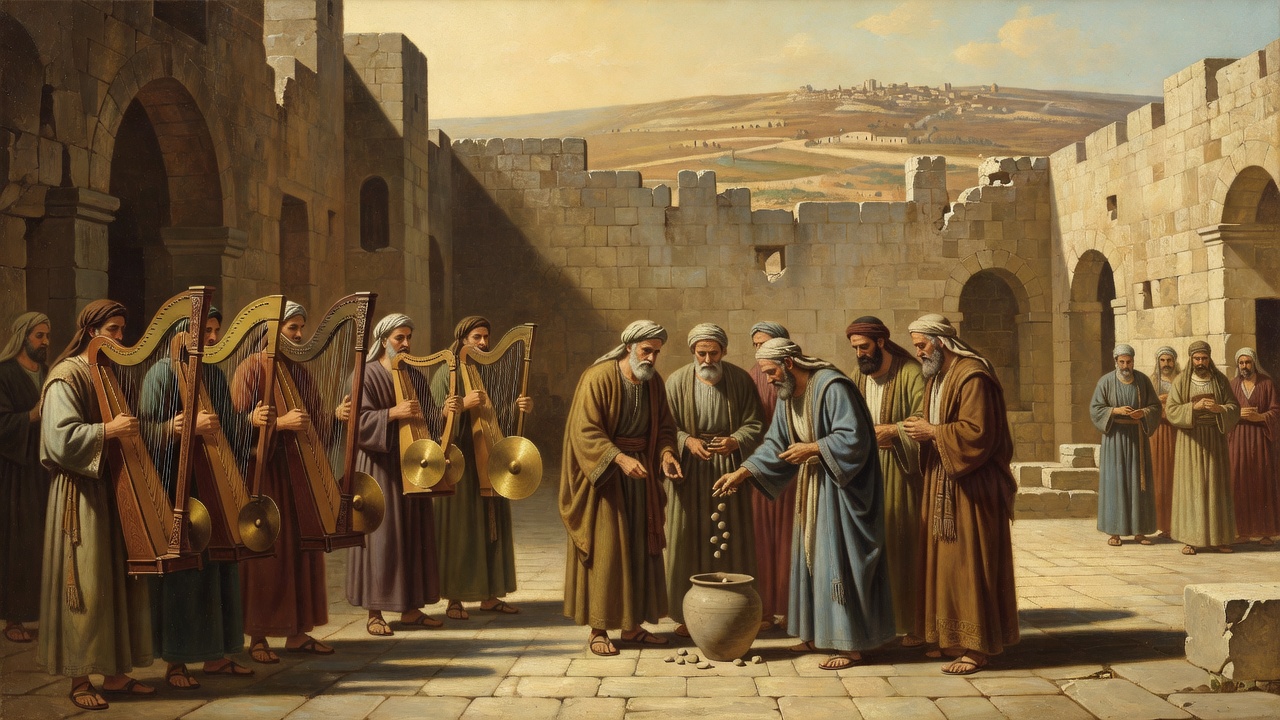
1Further, David and the chiefs of the servants of the holy place made selection of certain of the sons of Asaph and of Heman and of Jeduthun for the work of prophets, to make melody with corded instruments and brass; and the number of the men for the work they had to do was: 2Of the sons of Asaph: Zaccur and Joseph and Nethaniah and Asharelah, sons of Asaph; under the direction of Asaph, acting as a prophet under the orders of the king; 3Of Jeduthun: the six sons of Jeduthun, Gedaliah and Zeri and Jeshaiah, Hashabiah and Mattithiah; under the direction of their father Jeduthun who, acting as a prophet, with corded instruments gave praise and glory to the Lord. 4Of Heman, the sons of Heman: Bukkiah, Mattaniah, Uzziel, Shebuel and Jerimoth, Hananiah, Hanani, Eliathah, Giddalti and Romamti-ezer, Joshbekashah, Mallothi, Hothir, Mahazioth; 5All these were sons of Heman, the king's seer in the words of God. And to make great his power God gave Heman fourteen sons and three daughters. 6All these, under the direction of their father, made music in the house of the Lord, with brass and corded instruments, for the worship of the house of God; Asaph, Jeduthun, and Heman being under the orders of the king. 7And the number of them, with their brothers who were trained and expert in making melody to the Lord, was two hundred and eighty-eight. 8And selection was made of them for their special work, all having equal chances, small as well as great, the teacher as the learner. 9Now of the group of Asaph, the first name to come out was Joseph; the second Gedaliah; he and his brothers and sons were twelve? 10The third Zaccur, with his sons and his brothers, twelve; 11The fourth Izri, with his sons and his brothers, twelve; 12The fifth Nethaniah, with his sons and his brothers, twelve; 13The sixth Bukkiah, with his sons and his brothers, twelve; 14The seventh Jesharelah, with his sons and his brothers, twelve; 15The eighth Jeshaiah, with his sons and his brothers, twelve; 16The ninth Mattaniah, with his sons and his brothers, twelve; 17The tenth Shimei, with his sons and his brothers, twelve; 18The eleventh Azarel, with his sons and his brothers, twelve; 19The twelfth Hashabiah, with his sons and his brothers, twelve; 20The thirteenth Shubael, with his sons and his brothers, twelve; 21The fourteenth Mattithiah, with his sons and his brothers, twelve; 22The fifteenth Jeremoth, with his sons and his brothers, twelve; 23The sixteenth Hananiah, with his sons and his brothers, twelve; 24The seventeenth Joshbekashah, with his sons and his brothers, twelve; 25The eighteenth Hanani, with his sons and his brothers, twelve; 26The nineteenth Mallothi, with his sons and his brothers, twelve; 27The twentieth Eliathah, with his sons and his brothers, twelve; 28The twenty-first Hothir, with his sons and his brothers, twelve; 29The twenty-second Giddalti, with his sons and his brothers, twelve; 30The twenty-third Mahazioth, with his sons and his brothers, twelve; 31The twenty-fourth Romamti-ezer, with his sons and his brothers, twelve.
Você sabia?
Organização dos Músicos do Templo
- O ministério dos músicos levitas sob a liderança de Asafe, Hemã e Jedutum é descrito como profetizar com harpas, liras e címbalos. Isso reflete uma estreita associação bíblica entre a prática musical, as ações de graças e a inspiração profética no culto de Israel.Fontes: o próprio texto bíblico · Asaph (Levite) · Heman
- Os músicos foram organizados em 24 divisões de 12 membros habilitados cada, totalizando 288 cantores e instrumentistas treinados. Suas funções e a ordem de serviço eram determinadas por sorteio, tratando jovens e idosos, mestre e discípulo, em termos de igualdade.Fontes: o próprio texto bíblico
- Os líderes dessas famílias musicais desempenhavam importantes funções espirituais; Asafe e Hemã são identificados como videntes, e a tradição atribui diversos salmos bíblicos diretamente a eles ou a seus grupos.Fontes: o próprio texto bíblico · Asaph (Levite) · Heman · Jeduthun (Ethan)
Notas escritas com auxílio de IA a partir de fontes abertas (Theographic Bible Metadata, CC BY-SA 4.0; Easton’s Bible Dictionary, domínio público) e revisadas antes de publicar.
Créditos e licença desta tradução
Bible in Basic English
The Bible in Basic English
Public Domain
Language: English
Dialect: simple British
Translation by: Samuel Henry Hooke
The Bible In Basic English was printed in 1965 by Cambridge Press in England. Published without any copyright notice and distributed in America, this work fell immediately and irretrievably into the Public Domain in the United States according to the UCC convention of that time. A call to Cambridge prior to placing this work in etext resulted in an admission of this fact.
2020-04-17
Títulos de seção adaptados da Berean Standard Bible (domínio público); não fazem parte do texto bíblico desta tradução.
Fonte: http://ebible.org/engBBE/ · eBible.org